if you’re developing solar projects in Japan, you know the drill. Land is expensive, the topography is a nightmare, and the regulatory hurdles are enough to give any EPC a headache. But here’s the thing: while ground-mount space is drying up, there are millions of square meters of asphalt currently doing nothing but baking in the sun. We’re talking about parking lots.
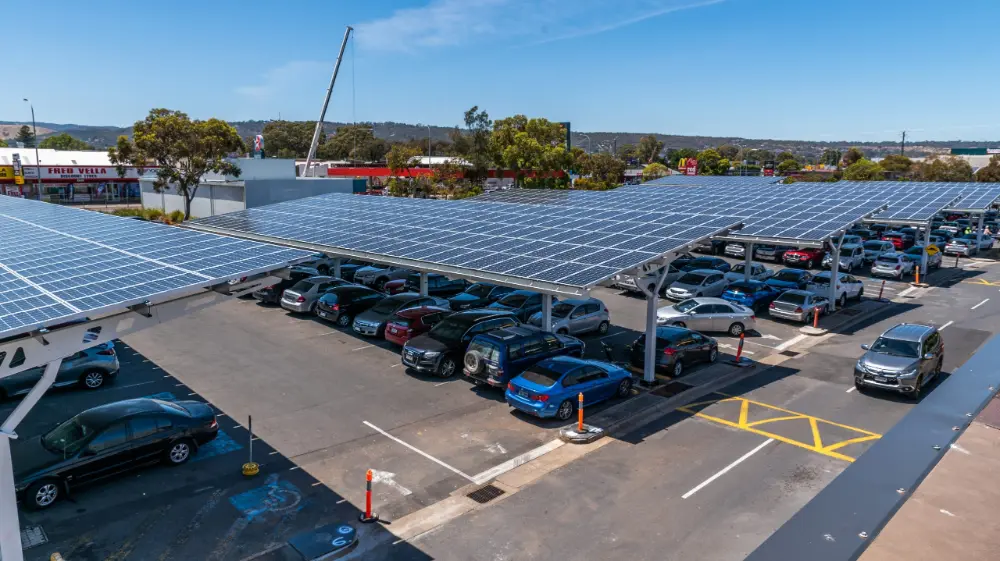
At SR Solar, we’ve seen a massive surge in demand for the solar powered waterproof carport in Japan. It’s not just a trend; it’s a logical evolution. Why settle for a standard racking system that lets rain soak your customers and their expensive EVs when you can provide a high-end, waterproof shelter that pays for itself? It’s the ultimate “two birds, one stone” scenario for commercial properties and industrial hubs across the archipelago.
Why the Japanese Market is Shifting to Waterproof Solar Carports
The conversation in Japan has shifted from “can we fit solar here?” to “how can this solar installation add more value?” For an Independent Power Producer (IPP) or a commercial developer, a solar powered waterproof carport in Japan represents a premium asset. It turns a liability—a hot, wet parking lot—into a comfortable, revenue-generating facility.
Land Scarcity and the Rise of Dual-Use Infrastructure
We all know the struggle of finding flat, “easy” land in Japan. Between the mountains and the strict zoning laws, developers have to get creative. This is where carports shine. By using existing parking footprints, you’re bypassing the need for new land acquisition and often simplifying some of the environmental impact assessments. It’s the smartest way to scale your portfolio without fighting for every acre of rural land.
EV Integration: Beyond Power Generation to User Experience
With Japan’s goal to ban new gasoline car sales by 2035, the “EV-ready” parking lot isn’t a luxury anymore; it’s the baseline. But have you ever tried to plug in a fast charger during a Tokyo downpour? It’s not fun. A waterproof solar powered carport ensures that the charging hardware stays dry and the user stays comfortable. This “soft value” is exactly what corporate clients are looking for when they sign long-term PPA agreements.
Engineering for the Extremes: Meeting JIS Standards
In Japan, a carport isn’t just a “mount”—it’s a building. That means it falls under the Japanese Building Standards Act. At SR Solar, we take this seriously. We don’t just “estimate” loads; we engineer every solar powered waterproof carport in Japan to meet the rigorous JIS standards. If your structure can’t handle a “once-in-a-century” typhoon, it shouldn’t be on the market.
Wind Resistance: Surviving Japan’s Typhoon Season (60m/s+)
We’ve all seen the footage of typhoon winds tossing structures like toys. For our projects in coastal regions like Okinawa or Chiba, we design for wind speeds exceeding 60m/s. This involves advanced Finite Element Method (FEM) analysis to ensure every bolt and joint can handle the uplift. Our waterproof solar powered carports use reinforced columns and specialized base plates to stay anchored when the weather turns ugly.
Snow Load Management: Solutions for the “Snow Country” (Yukiguni)
If you’re building in Hokkaido or Niigata, wind is only half the battle. You’re dealing with heavy, wet snow that can weigh tons. A standard carport would buckle under that weight. We offer high-clearance, heavy-duty designs capable of supporting snow loads up to 1.5kN/m². We also adjust the tilt angle to ensure that snow slides off naturally while keeping the solar powered waterproof carport functional.
The SR Solar Advantage: Our “Internal Drainage” Waterproofing Tech
Now, let’s talk about the “waterproof” part. Most people think “waterproof” means putting a tin roof under the solar panels. That’s the old way—it’s heavy, it’s ugly, and it’s hard to maintain. SR Solar does things differently. We’ve developed an integrated system where the structural components are the drainage system.
EPDM Sealing and Interlocking Rail Systems Explained
Instead of a secondary roof, our solar powered waterproof carport in Japan uses a clever interlocking rail system. We use high-grade EPDM gaskets between the modules that create a watertight seal. Think of it like a high-tech tongue-and-groove floor, but for your roof. This keeps the weight down and the aesthetics high. No leaks, no mess, just a clean look from both above and below.
Zero-Maintenance Water Management: From Purlin to Pillar
Where does the water go? It doesn’t just drip off the sides. We’ve engineered “hidden” gutters into our purlins. Rainwater is collected at the panel seams, routed into these internal channels, and then discharged through the vertical columns. This keeps the ground underneath 100% dry. It’s a “set it and forget it” system that requires almost zero maintenance over its 25-year lifespan.
Material Science in Humid and Coastal Environments
Japan is an island nation, which means salt air is your biggest enemy for metal structures. If you use cheap steel, you’ll see rust in three years. That’s why SR Solar offers two primary paths for our solar powered waterproof carport in Japan: high-strength AL6005-T5 Aluminum with a thick anodized coating (≥10μm), or MAC (Magnesium-Aluminum-Coating) Steel. Both are designed to resist the humid, salty conditions of places like Osaka Bay or Yokohama.
Optimizing “Soft Costs” for Japanese EPCs and Developers
If you’re an EPC, you know that labor is your biggest “variable” cost. In Japan, skilled labor is expensive and hard to find. We’ve designed our carports to be “installer-friendly.” We don’t want your crew spending weeks on-site with a welder and a prayer.
Reducing On-site Labor with Pre-assembled Components
We pre-assemble as much as possible in our factory. The support legs and rail connectors arrive at the site ready to be bolted together. It’s almost like a giant LEGO set for adults. This approach can reduce your on-site man-hours. When you’re running a tight schedule on a commercial project, that time saving goes straight to your bottom line.
Conclusion: Building a Bankable Future with SR Solar
At the end of the day, a solar powered waterproof carport in Japan is more than just a piece of hardware; it’s a long-term investment. By choosing SR Solar, you’re not just getting a rack—you’re getting a partner who understands the nuances of the Japanese market, from JIS compliance to the specific needs of a Niigata winter. We build things to last 25+ years because that’s the only way to ensure your project remains bankable and your clients remain happy.
Whether you’re a PV project developer looking to maximize a corporate lot or an EPC trying to stay under budget, let’s talk. We have the engineering expertise to turn that empty asphalt into a high-performance energy hub.
Frequently Asked Questions
1. Does the waterproof carport require a special type of solar module?
Not necessarily! Our system is compatible with most standard framed modules. However, we often recommend bifacial glass-glass modules for carports because they can capture reflected light from the ground, boosting your yield by up to 10–15% while looking great from below.
2. How do you handle the permitting process for carports in Japan?
Since carports are considered buildings under the Japanese Building Standards Act, you’ll need a “Building Confirmation” (Kenchiku Kakunitsu). SR Solar provides the detailed structural calculations and drawings required by local authorities to ensure your permit is approved quickly.
3. What is the typical tilt angle for a Japanese solar carport?
We usually design for a 5° to 10° tilt. This provides the best balance between water runoff efficiency and maximizing energy generation in Japan’s latitude. If you’re in a high-snow area, we might bump that up slightly to help with snow shedding.
4. How long does the waterproof seal last?
Our EPDM gaskets are automotive-grade and designed to last the life of the system. We provide a 10-year warranty on the waterproofing components and a 25-year service life guarantee on the structural integrity of the aluminum or steel frames.
5. Can SR Solar carports be customized for different vehicle sizes?
Absolutely. While we have standard 1-car, 2-car, and multi-row configurations, we frequently provide “Long-Span” custom designs. If you need to clear a specific height for delivery trucks or want fewer pillars to make parking easier, our engineers can make it happen.