If you’re managing a large-scale PV installation or a complex EPC contract, you know that “ideal soil” only exists in the brochures. In the real world, we deal with “bony” ground—terrain that’s packed with cobbles, boulders, or shallow bedrock. When we talk about screw piles in rocky ground, we aren’t just talking about whether the pile will go in; we’re talking about project velocity, machine wear, and the structural integrity of the entire array.
At SR Solar, we’ve seen projects where screw piles saved the day on rocky hillsides, and others where a lack of geological foresight led to twisted steel and blown hydraulic lines. For technical professionals, the goal isn’t to force a solution—it’s to understand the mechanics of the ground and apply the right installation methodology.
Defining the Threshold: When Does “Rocky” Become “Impenetrable”?
The phrase “rocky ground” is frustratingly vague for an engineer. We need to categorize the resistance. Are we looking at a dense glacial till with 20% cobble content, or a solid shelf of sedimentary rock? The feasibility of using screw piles in rocky ground depends entirely on the soil matrix. If the stones are “floaters” within a compressible soil like clay or sand, the pile will displace them. But once the stones become interlocking, the pile essentially hits a wall.
Soil Mechanics: Displacement vs. Obstruction
When a helical pile rotates, it works by shearing the soil and moving it along the face of the helix. In stony ground, a high-torque drive head provides enough force to push smaller rocks into the surrounding soil voids. This is why screw piles in rocky ground often show higher load-bearing capacities than in clean soil—the rocks essentially “armor” the pile shaft once they’re packed back in.
The D/d Ratio: Why Particle Size Dictates Helix Geometry
Here is a quick technical benchmark: the ratio of the stone diameter (D) to the pitch of the helix (d). As a rule, if the stone diameter exceeds 50–60% of the helix pitch, the pile will likely struggle to “bite.” For example, if you’re using an SR Solar pile with a 100mm pitch, rocks over 60mm become significant obstacles. At this point, the helix can’t get under the rock to lift/displace it, and you’ll start seeing the pile “walk” off-center.
Refusal and Torsional Limits: The Engineering Reality of Bedrock
We often get asked: “Can we just drill into the bedrock?” For a standard helical pile, the answer is a firm no. These aren’t rock drills; they are displacement anchors. Attempting to drive screw piles in rocky ground that consists of competent bedrock (unweathered, solid rock) will result in “refusal.”
Identifying “False Torque” in High-Gravel Strata
This is a critical point for site supervisors. In high-gravel environments, you might see your torque gauge spike to the target level at only half the required depth. This is “false torque” caused by extreme skin friction against the shaft, not by the helix reaching a load-bearing stratum. If you’re installing screw piles in rocky ground, you must verify that the torque is consistent with the depth targets defined in your engineering plan. Don’t let a layer of packed gravel trick you into a shallow, unstable foundation.
Weathered Rock vs. Competent Bedrock: Penetration Capabilities
There is a gray area: weathered or “rotten” rock. If the rock has an SPT (Standard Penetration Test) N-value between 30 and 50, a heavy-duty screw pile in rocky ground might be able to penetrate the upper layers. This provides an incredibly stiff foundation with almost zero settlement. However, this requires a drive head with high “crowd” (downward pressure) to keep the lead point from spinning in place and overheating.
Installation Logistics: High-Torque Drives and Down-Pressure Mastery
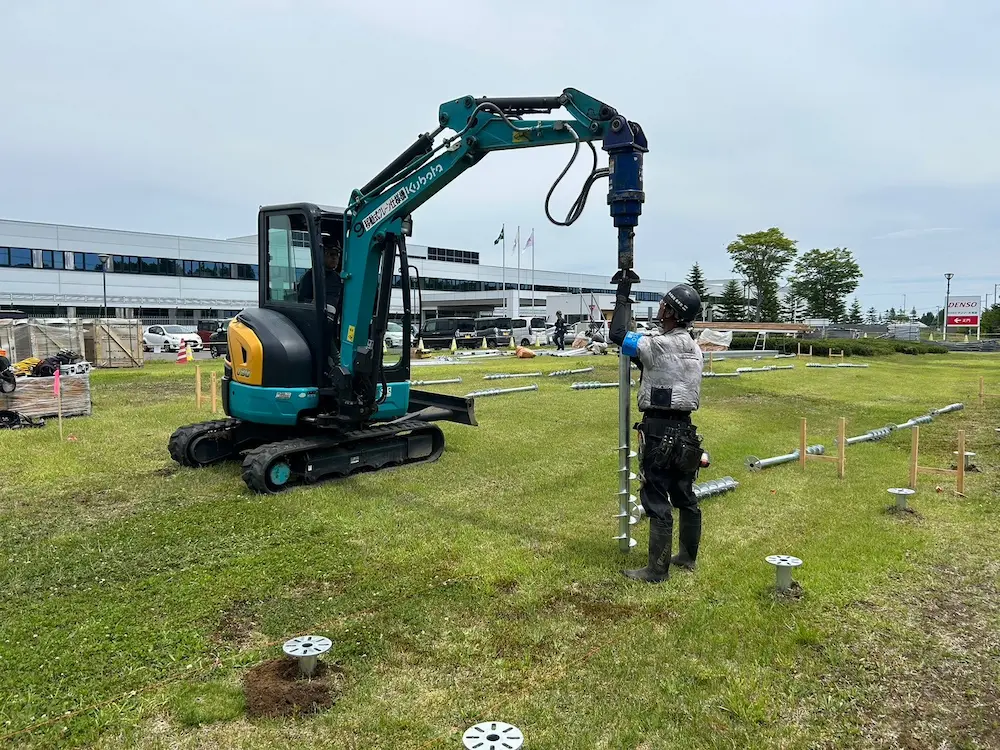
To successfully install screw piles in rocky ground, your equipment specs are just as important as the pile design. You can’t do this with a mini-excavator and a low-flow attachment. You need a machine with enough mass to provide significant down-pressure, ensuring the helix stays engaged with the ground rather than just riding on top of the rocks.
Managing Lateral Drift and Pile “Walking”
One of the biggest headaches in the field is “walking.” This happens when the lead point of the screw pile in rocky ground hits a sloped rock surface and slides to the side. To prevent this, our teams at SR Solar recommend starting with a “starter hole” or using a guide jig. If the pile starts to drift more than a few degrees off-vertical, it’s better to reverse out, reposition, or pre-drill than to try and “muscle” it back to center.
The Pilot Hole Protocol: When to Deploy Rock Augers
If the geology is too aggressive for direct installation, we move to the pilot hole protocol. This involves using a specialized rock auger to drill a hole that is roughly 70% of the pile’s shaft diameter. This breaks the interlocking rock structure and allows the screw pile in rocky ground to be driven to depth while maintaining its displacement-based load capacity. It’s an extra step that saves hours of frustration and protects your equipment from terminal wear.
Structural Integrity: Protecting the Zinc Coating in Abrasive Soils
Engineers are often concerned about the longevity of screw piles in rocky ground. Yes, driving steel through rocks will scratch the galvanization. However, the hot-dip galvanizing process used by SR Solar creates a metallurgical bond with the steel. Even with surface abrasions, the sacrificial nature of the zinc provides cathodic protection to the exposed areas. In highly aggressive rocky soils, we can also specify a thicker wall for the pile shaft to allow for a “corrosion allowance” over the 25-to-30-year life of the project.
Risk Mitigation: Why Geotechnical SPT Data is Non-Negotiable
If you’re the lead engineer on a B2B project, you shouldn’t be guessing about what’s under the surface. A professional geotechnical report with bore logs and SPT N-values is your best tool for managing the risks of screw piles in rocky ground. This data allows us to optimize the pile length and helix configuration before the first truck arrives on site. At SR Solar, we use this data to calculate the “torque-to-capacity” ratio, ensuring that every pile we provide meets the structural requirements of your specific site.
SR Solar Solutions for High-Resistance Environments
We don’t believe in one-size-fits-all. SR Solar specializes in heavy-duty helical foundations designed for the “tough” jobs. Our screw piles for rocky ground feature reinforced lead points and high-yield strength steel that can withstand the extreme torsional stresses of a rock-heavy installation. When you’re dealing with challenging EPC specs, you need a partner who understands the difference between a residential deck and a multi-megawatt solar array.
Summary: Optimizing Foundation Choice for Rocky Geologies
Using screw piles in rocky ground is a high-efficiency solution, provided you respect the engineering limits of the technology. By understanding the D/d ratio, accounting for false torque in gravel, and utilizing pre-drilling when bedrock is encountered, technical teams can maintain project momentum without compromising structural integrity. At SR Solar, we’re committed to providing the technical support and high-performance hardware needed to make even the most “rocky” project a success.
FAQ
1. What is the maximum stone size a 76mm screw pile can handle?
Generally, a 76mm pile with a standard pitch can navigate stones up to 40-50mm in diameter. Anything larger risks displacing the pile from its vertical axis or causing refusal.
2. Can we use screw piles in areas with a high water table and rocks?
Yes. One of the primary advantages of screw piles over bored piers is that they don’t require open excavations, which is a major benefit in high-water-table areas where “slumping” or “caving” of holes is a risk.
3. What happens if the pile hits a boulder mid-way down?
If the boulder is too large to move, you have two options: use a rock auger to pre-drill through it, or relocate the pile. Any relocation must be approved by the project structural engineer to ensure the load distribution remains within spec.
4. How do you prevent the pile from shearing under high torque?
Every pile has a rated “allowable torque.” We monitor the hydraulic pressure of the drive head during installation to ensure we never exceed 80% of the pile’s mechanical torsional strength, providing a safe buffer for the steel.