The Middle Eastern solar market has moved far beyond utility-scale desert plants. Today, commercial and industrial (C&I) rooftop solar is scaling at an unprecedented rate across Saudi Arabia, the UAE, Oman, and Qatar. But here is the reality that field engineers face: designing solar roofs in the Middle East is a completely different ballgame compared to European or North American counterparts.
When you are dealing with ambient temperatures exceeding 50°C, high relative humidity along the coasts, intense UV radiation, and abrasive sandstorms, standard mounting practices will fail.
How do you select the right mounting topology for the specific roof types dominating the Middle Eastern landscape? Let’s break down the mechanics, material sciences, and field-proven engineering strategies required to safeguard your C&I portfolio.
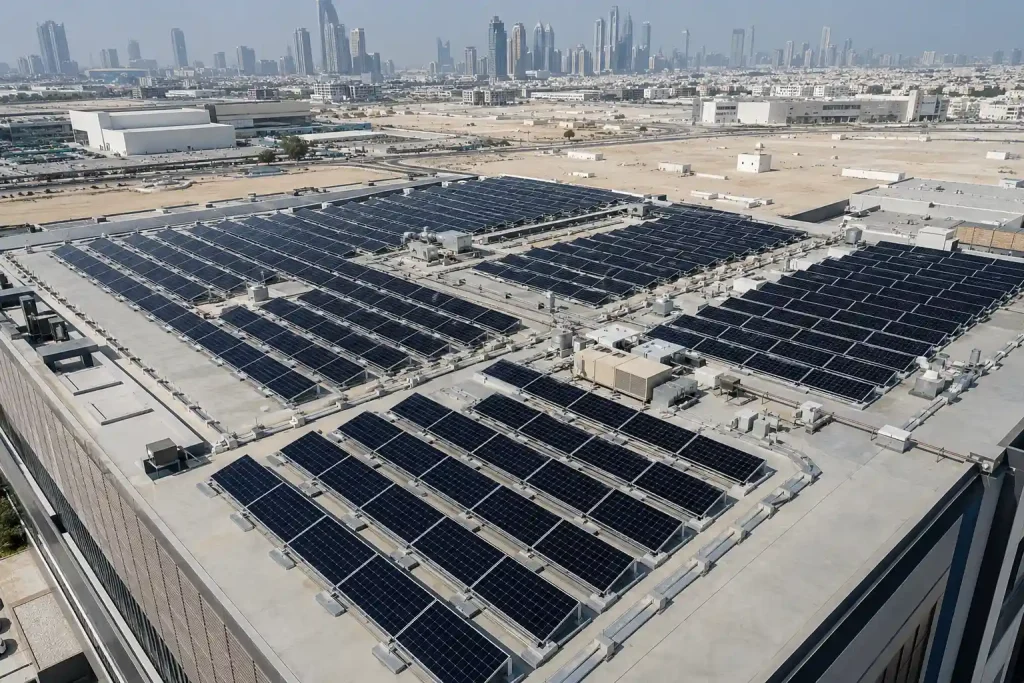
1. Concrete Flat Roofs: The Ballasted vs. Anchored Dilemma
A vast majority of commercial and institutional buildings in the Middle East region feature flat concrete roofs. For these structures, the primary engineering challenge is balancing wind uplift resistance with structural dead load and waterproofing integrity.
The Non-Penetrative Ballasted Approach
Why drill into a concrete roof and risk destroying the multi-layer waterproofing membrane? In the Middle East, where rare but torrential winter downpours can cause catastrophic leaks, a non-penetrative ballasted solar mounting system is often the preferred choice.
However, a common EPC error is underestimating the aerodynamic forces. The wind profile in regions like Riyadh or coastal Abu Dhabi requires meticulous calculation.
- Aerodynamic Optimization: To reduce the required concrete ballast weight—which can exceed the roof’s structural load capacity—the system must incorporate aerodynamic wind deflectors (back plates). By shielding the underside of the panels, you turn wind force into downward pressure rather than uplift.
- Tilt Angle Trade-off: While a 10° to 15° tilt angle minimizes wind profile and ballast requirements, it introduces another Middle East specific issue: soiling. A lower tilt angle accelerates sand and dust accumulation. In our project experience, a 10° tilt requires up to 30% more frequent cleaning cycles compared to a 15° tilt. Engineers must run an optimization matrix balancing structural ballast cost against 25-year cleaning O&M expenses.
Material Integrity: Aluminum vs. ZAM Steel
For ballasted systems directly exposed to the harsh desert sun and coastal humidity, material selection determines the system’s lifespan:
- Anodized Aluminum (AL6005-T5): Ideal for minimizing dead weight on older concrete roofs. Ensure the anodized film thickness is at least 20μm to withstand the abrasive action of blowing silica sand.
- ZAM (Zinc-Aluminum-Magnesium) Coated Steel: For heavy-duty configurations or projects requiring cost-efficiency at scale, ZAM steel offers superior scratch resistance and a self-healing mechanism on cut edges—critical when sand abrasion strips standard galvanized coatings.
2. Metal Trapezoidal Sheet Roofs: Optimizing for Speed and Thermal Movement
Industrial zones in cities like Jubail or Jebel Ali are dominated by pre-engineered steel buildings with trapezoidal metal roofs. Here, the priority shifts to maximizing installation speed and managing structural thermal movement.
Mini-Rail vs. Continuous Rail Systems
Should you specify a traditional continuous rail system or a direct-mount mini-rail system? For most Middle Eastern C&I projects, the mini-rail system wins on both logistics and economics.
- Structural Mechanics: Mini-rails (typically 120mm to 400mm in length) are fixed directly onto the crowns of the trapezoidal sheet using self-tapping screws. This transfers the load directly into the roof structure, minimizing material usage.
- The Thermal Expansion Trap: Metal roofs in the Middle East experience extreme thermal cycles. In summer, roof sheet temperatures can skyrocket to 80°C during the day and drop to 25°C at night. If you use long, continuous aluminum rails without structural thermal breaks, the cumulative expansion will shear the roof fasteners or buckle the solar modules. Mini-rails inherently solve this by isolating each module row, allowing the roof sheet to expand and contract independently.
Ensuring Water-Tightness in Arid Regions
Just because it rarely rains doesn’t mean waterproofing can be ignored. When a flash flood occurs, poorly sealed penetrations fail instantly.
- EPDM Material Quality: Always verify that the mini-rails come pre-assembled with high-density, UV-stabilized EPDM gaskets. Standard rubber will degrade within 36 months under the intense UV index of the Middle East, leading to micro-leaks.
- Fastener Specification: Screws must be SUS304 stainless steel with a premium coating, equipped with an EPDM-backed washer to form a permanent mechanical seal upon torque application.
3. Standing Seam Roofs: Zero Penetration, Zero Risk
For high-end logistics hubs, cold storage facilities, and modern airport terminals, building owners almost always install premium standing seam roofs (such as Kalzip profiles). These roofs come with long-term material warranties that are completely voided if a single hole is drilled.
The Mechanical Clamping Mechanism
The engineering solution here is absolute: non-penetrative standing seam clamps.
The clamp wraps around the folded seam of the roof sheet and locks into place via calibrated torque set-screws.
- Preserving the Warranty: Because the system achieves structural attachment purely through friction and mechanical locking, the integrity of the roof sheet remains 100% intact.
- Deformation Risk: A critical mistake in field execution is over-torquing the clamp screws, which crushes the standing seam and restricts the roof’s natural floating movement designed to handle thermal expansion. Clamps must be precision-engineered to match the specific seam profile (e.g., round seam vs. angled seam) and installed using calibrated torque wrenches according to strict engineering manuals.
4. The Real-World Engineering Layer: Middle East Environmental Reality Check
What does not show up in laboratory simulations are the compounded environmental factors of the Middle East. Let’s look at two critical real-world engineering failures we frequently observe in the field.
Galvanic Corrosion in Coastal Desert Zones
Many EPCs assume that because the desert is dry, corrosion is a low risk. This is a dangerous misconception. In coastal cities like Dammam, Jeddah, or Doha, high humidity combines with airborne sea salt and fine desert dust to form a highly conductive, corrosive film on solar structures.
If you place an uninsulated aluminum clamp directly onto a galvanized steel roof sheet, galvanic corrosion will degrade the contact point within a few seasons. At SR Solar, our engineering standard mandates absolute material isolation: using specialized rubber buffers, EPDM isolation strips, or specific anti-corrosion coatings to ensure dissimilar metals never make direct contact.
The “Sand Accumulation Dam” Effect
When designing low-profile mounting systems for metal roofs, engineers often place the landscape or portrait modules too close to the roof surface. During sandstorms, the space beneath the modules acts as a wind trap, collecting sand. Over time, this forms a sand dam that:
- Blocks the natural drainage channels of the trapezoidal or corrugated sheet.
- Creates hot spots on the backside of the modules due to restricted airflow and trapped heat.
- Significantly increases the dead load on the roof structure.
The Solution: Maintain a minimum clearance height (typically at least 100mm to 150mm) between the roof crown and the module frame to allow wind to flush out dust and ensure sufficient ventilation to lower the module’s operating temperature, thereby protecting the system’s performance ratio (PR).
5. Economic Impact: Connecting Engineering to Project LCOE
Every engineering decision must be justified on the balance sheet. For an EPC managing a multi-megawatt C&I portfolio in the Middle East, mounting system selection influences two major financial metrics: Upfront Labor Costs and Long-Term System O&M.
Minimizing On-Site Labor Hours
With strict localization quotas (such as Saudization targets) and shifting labor regulations across the Middle East, the cost of skilled on-site engineering labor is rising.
- Using pre-assembled components—such as clamps with integrated grounding washers and click-in nut modules—cuts installation time per kilowatt significantly.
- A direct-mount mini-rail system reduces the total tonnage of structural steel or aluminum to be transported, craned, and handled on the roof, directly shrinking logistics and labor overheads.
Optimizing SKU Efficiency
When executing multiple projects across different roof types, working with a flexible mounting manufacturer allows you to standardize your hardware. Utilizing components that share mid-clamps, end-clamps, and grounding lugs reduces warehouse SKU complexity, minimizes sorting errors on site, and increases purchasing leverage.
6. The SR Solar Standard: Engineering Integrity First
At SR Solar, we approach solar roofs in the Middle East not as a product supply chain, but as a specialized structural engineering challenge.
Our mounting systems are engineered based on extensive wind tunnel testing and certified to global structural standards, including AS/NZS 1170.2 and JIS C 8955. We specialize in high-grade anodized aluminum (AL6005-T5) and advanced ZAM steel solutions designed explicitly to withstand the combination of high wind loads, extreme thermal expansion, and corrosive environments unique to the Middle East region.
Our engineering team works peer-to-peer with your technical department to provide static calculations, wind load simulations, and customized layout designs that optimize both structural safety and project economics.
Summary & Key Takeaways
- Concrete Roofs: Prioritize non-penetrative ballasted systems; optimize tilt angles (10°–15°) to balance wind uplift forces against sand soiling mitigation.
- Metal Roofs: Utilize mini-rail designs to inherently manage extreme thermal expansion and contraction cycles without shearing fasteners.
- Standing Seam: Stick to zero-penetration mechanical seam clamps with precision torque settings to safeguard building warranties.
- Corrosion Prevention: Never overlook coastal desert galvanic corrosion; always isolate dissimilar metals using EPDM or specialized coatings.
Frequently Asked Questions (FAQs)
Q1: Can standard galvanized steel mounting systems be used for C&I roofs in the Middle East?
Standard hot-dip galvanized steel (HDG) can be used if the coating thickness is sufficient (typically >85μm) and the site is inland. However, in coastal desert zones (within 5km of the sea), sand abrasion combined with high salinity will rapidly degrade standard HDG. ZAM steel or anodized aluminum (20μm) offers significantly better long-term durability and scratch resistance under these specific conditions.
Q2: How do you prevent wind tunnel effects from lifting ballasted systems on high-rise commercial roofs?
On high-rise buildings, wind speeds increase dramatically near the roof corners and edges (the perimeter zones). To mitigate this, our engineering designs utilize a denser ballast layout or localized mechanical anchoring in high-risk perimeter zones, combined with aerodynamic wind deflectors across the array to equalize pressure.
Q3: Do aluminum mini-rails expand enough to damage solar panels under 50°C+ ambient temperatures?
Because mini-rails are short (usually less than 400mm), their individual thermal expansion is negligible. The risk comes from the underlying metal roof sheets expanding over long distances. The short mini-rail configuration acts as a natural expansion joint, preventing the transmission of cumulative structural stress to the solar module frames.
Q4: Are EPDM gaskets durable enough to survive 25 years under the Middle Eastern UV index?
Standard commercial rubber will fail within a few years. However, high-density, automotive-grade UV-stabilized EPDM is specifically molecularly bonded to resist UV radiation and extreme ozone exposure. SR Solar strictly utilizes certified UV-stabilized EPDM components across all roof clamp and rail systems to match the 25-year design life of the PV modules.
Q5: How does the choice of mounting system affect the cleaning frequency of solar roofs in the Middle East?
Mounting systems that allow for higher tilt angles or include integrated tilting legs facilitate better natural cleaning (via wind or rare rain) and make manual water washing more efficient. Low-profile, low-tilt systems tend to trap dust at the bottom frame edge, requiring the integration of anti-soiling drainage clips to prevent edge shading hot-spots.
Technical Consultation & Project Evaluation
Ready to optimize your next Middle Eastern C&I rooftop project for maximum structural safety and optimized LCOE? Contact the SR Solar structural engineering team today for a comprehensive layout simulation, wind load calculation, and customized Bill of Materials (BOM) matching your specific site requirements.