Nobody gets into the solar business because they love pouring concrete. If you’re an EPC or a PV project developer, you’ve likely spent more nights than you’d care to admit staring at weather forecasts, praying that a week of rain won’t turn your site into a mud pit and stall your concrete trucks. It’s the “ground-breaking” phase that often breaks the budget. At SR Solar, we’ve seen how traditional foundation methods can become a logistical nightmare that eats into your project’s IRR. That’s why we’ve focused our engineering on efficient and sustainable solar installation foundations that keep your crew moving, regardless of what the soil or the sky throws at you.
The Foundation Crisis in Utility-Scale Solar Projects
When we talk to IPPs and system integrators, the conversation eventually shifts to “Soft Costs.” It’s not just the price of the panels; it’s the labor, the machinery, and the time spent on-site. Traditional concrete foundations are a legacy solution in a fast-paced industry. They require massive excavation, soil removal, and a mandatory “waiting game” while the concrete cures. In the world of utility-scale solar, time isn’t just money—it’s the difference between hitting your PPA milestones or facing penalties.
Moving Beyond the Concrete “Time Sink”
Why are we still waiting 7 to 28 days for foundations to reach full strength? It feels a bit outdated, doesn’t it? Concrete is heavy, messy, and environmentally taxing. If you’re working on a remote site, the logistics of getting mixing trucks to the location can be a project in itself. By shifting to efficient and sustainable solar installation foundations like ground screws, you’re essentially deleting the most unpredictable variable from your construction schedule. We at SR believe that the foundation should be the fastest part of the build, not the bottleneck.
Why Ground Screws are the “Soft Cost” Killers
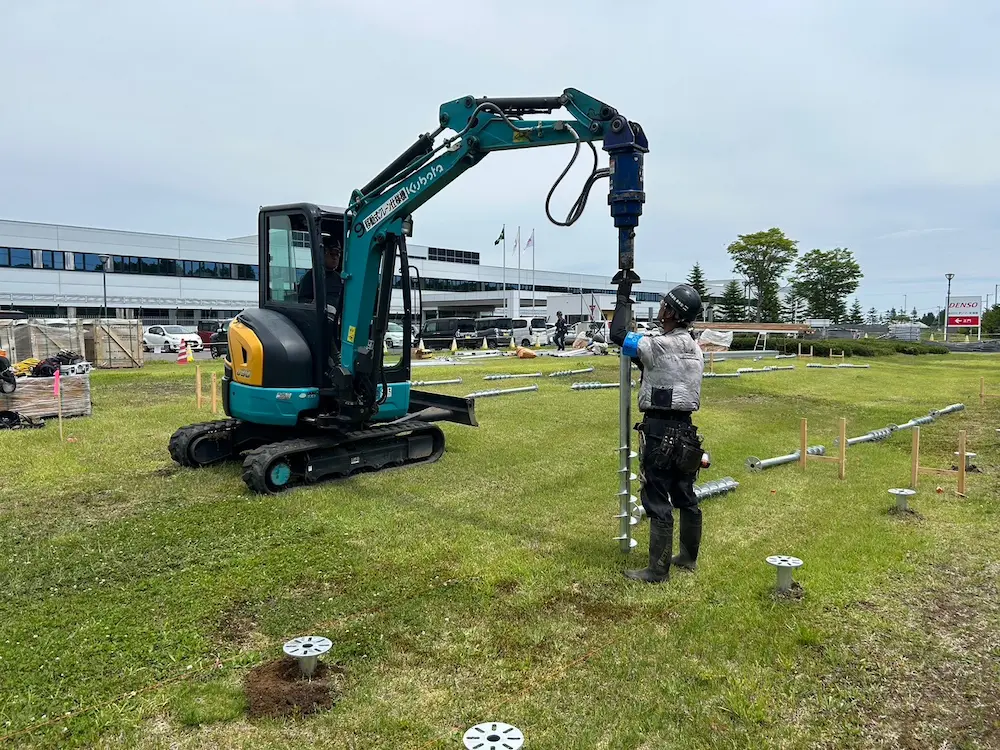
If you want to compress your timeline, you have to look at labor efficiency. SR Solar’s ground screws are designed for rapid deployment. Think about it: a small team with a hydraulic driver can install hundreds of screws in a single shift. There’s no digging, no mess, and—most importantly—no waiting. These aren’t just anchors; they are precision-engineered components that allow for efficient and sustainable solar installation foundations in almost any environment.
Instant Load-Bearing: From Installation to Racking in Minutes
Here is where the magic happens. Once an SR ground screw is in the dirt, it is ready to work. You can literally follow the pile driver with your mounting racks. Our screws feature universal flanges that are a perfect match for our pre-assembled mounting structures. We’ve had partners tell us they’ve reduced their on-site man-hours by nearly 50% just by making this switch. It’s like Lego for grown-ups, but with much higher stakes and better ROI. Have you ever considered how much you’d save if your mechanical team didn’t have to wait for the civil team to finish?
Weather-Proofing Your Project Timeline
Winter is usually the enemy of solar construction. If the ground is frozen or the rain is pouring, concrete is a no-go. But ground screws? They don’t care about the temperature. Whether you’re building in the frost of Northern Europe or the humidity of Southeast Asia, these efficient and sustainable solar installation foundations keep the project moving. This all-weather capability prevents those seasonal delays that can absolutely wreck a project’s financial projections.
The Engineering Behind SR Solar’s Structural Integrity
Now, I know what some of the old-school engineers are thinking: “Is a screw really as strong as a block of concrete?” The answer lies in the physics of soil tension. Our continuous helix design isn’t just for ease of entry; it creates a massive amount of pull-out resistance. We don’t just guess; we provide the geotechnical data to back it up.

Material Excellence: Hot-Dip Galvanization and Carbon Steel
A foundation is only as good as its lifespan. Since solar assets are expected to perform for 25 to 30 years, the steel in the ground has to be bulletproof—or at least corrosion-proof. SR Solar uses high-grade carbon steel that undergoes a Hot-Dip Galvanized (HDG) process. We ensure a minimum thickness of 80μm. This isn’t just a “nice to have”; it’s a requirement if you’re dealing with acidic soils or coastal sites with high salinity.
Corrosion Resistance in High-Salinity Environments
If you’re an EPC working near the coast, you know that salt air eats metal for breakfast. Our HDG finish acts as a sacrificial layer, ensuring that the structural integrity of the screw remains intact for decades. We adhere strictly to ISO 1461 standards because we know your investors are looking for long-term reliability, not a foundation that turns to rust in ten years.
Superior Pull-Out Resistance and Terrain Adaptability
Every site is different. Some are flat and easy; others are sloping hillsides or rocky terrain where a traditional pile would just bounce off the surface. The versatility of our efficient and sustainable solar installation foundations is unmatched. We offer variable specifications—lengths from 1.2m to 3m—to ensure that whether you’re hitting bedrock or sandy loam, you get the anchoring you need. Have you ever had to level a site just to fit a mounting system? With ground screws, you can follow the natural contour of the land, saving you a fortune in grading costs.
Navigating the Regulatory Maze: Global Standards for Foundations
One of the biggest headaches for PV project developers is compliance. You can have the best hardware in the world, but if the local building inspector doesn’t like the paperwork, you’re stuck. At SR Solar, we speak the language of international standards. We don’t just ship products; we ship peace of mind in the form of detailed calculation reports and certification.
JIS, AS/NZS, and ISO: Meeting Local Building Codes
Whether you’re working under the strict seismic requirements of Japan (JIS C 8955) or the intense wind load standards of Australia and New Zealand (AS/NZS 1170), our engineering team has you covered. We design our efficient and sustainable solar installation foundations to meet or exceed these local codes. It makes the permitting process a whole lot smoother when you can hand the authorities a comprehensive structural report that already checks every box.
The Green Advantage: Sustainable “Zero-Impact” Engineering
Sustainability isn’t just a buzzword anymore; it’s a B2B requirement. Many land leases now come with “reversion” clauses, meaning the developer must return the land to its original state once the project is decommissioned. If you’ve poured thousands of tons of concrete into the earth, that’s an expensive problem for the future. Ground screws are the ultimate “leave no trace” solution.
Preserving Soil Health and Drainage in Agri-PV Projects
In Agricultural-PV (Agri-PV), the goal is to produce energy and crops simultaneously. You can’t do that if you’ve destroyed the topsoil and messed up the natural drainage patterns with concrete pads. Our efficient and sustainable solar installation foundations require zero excavation. The soil stays where it belongs. And if the lease ends? You just unscrew them. The land is ready for farming again within days. It’s a compelling story to tell landowners and local communities who might be hesitant about solar “industrializing” their fields.
Maximizing B2B Value: The SR Solar Partnership
At the end of the day, SR Solar doesn’t want to be just another name on your vendor list. We want to be your engineering partner. We know that switching foundation types is a big decision for an EPC or an IPP. That’s why we provide full-scale support, from initial geotechnical analysis to on-site installation guidance. By choosing our efficient and sustainable solar installation foundations, you’re choosing a path that lowers your Total Cost of Ownership (TCO).
We empower our partners to move from “ground-breaking” to “grid-connected” faster than the competition. When you reduce the complexity of the foundation, you reduce the risk of the entire project. And in this industry, risk mitigation is the name of the game.
Conclusion: Speed, Strength, and Sustainability
The transition to renewable energy is moving faster than ever, and your construction methods need to keep up. SR Solar ground screws offer a rare “triple win”: they are faster to install, structurally superior in diverse terrains, and significantly better for the planet than traditional methods. By focusing on efficient and sustainable solar installation foundations, you aren’t just building a solar farm; you’re building a more profitable, future-proof asset. Let’s stop waiting for concrete to dry and start getting more power to the grid.
Frequently Asked Questions
1. Can SR Solar ground screws be used in very rocky soil?
As a general rule, you cannot use screw piles in solid rock. While the occasional exception can be made, where a lead helical plate may be advanced into the first few inches of weathered rock, in most instances this is not recommended. So, if you have plans to build upon rocky surfaces, we would advise finding alternative solutions.
2. How long do these ground screws actually last?
Our screws are designed for a 25-year service life, matching the typical lifespan of solar modules. The Hot-Dip Galvanization (minimum 80μm) provides the necessary protection against corrosion to ensure the foundation remains structurally sound for the duration of the project.
3. Do I need special machinery to install them?
You will need a hydraulic pile driver or a ground screw motor, which can often be attached to a standard excavator or skid steer.
4. How do ground screws perform in high-wind regions?
Very well. Because the helix creates a “cone” of soil above it, the pull-out resistance is incredibly high. We provide site-specific calculation reports based on your local wind load requirements (like AS/NZS 1170) to ensure the system is over-engineered for safety.
5. Are ground screws more expensive than concrete?
When you look at the “sticker price” of a screw versus a bag of cement, the screw might seem higher. However, when you factor in the labor savings, the lack of heavy machinery for excavation, and the zero-waiting time, the “Total Cost of Ownership” is almost always lower with ground screws.
-16-scaled.jpg)