If you’ve been in the EPC game long enough, you’ve probably seen those “budget-friendly” structures that look great on a sunny Tuesday but turn into a twisted pile of scrap metal after a high-wind event or a heavy blizzard. At SR Solar, we’ve seen it all. We know that when you’re talking to a PV project developer or an institutional investor, “cheap” is a four-letter word that usually ends in a lawsuit or an insurance nightmare. What they really want—and what you need to provide—is structural integrity that lets them sleep at night.
Why Standard Designs Fail in Extreme Weather
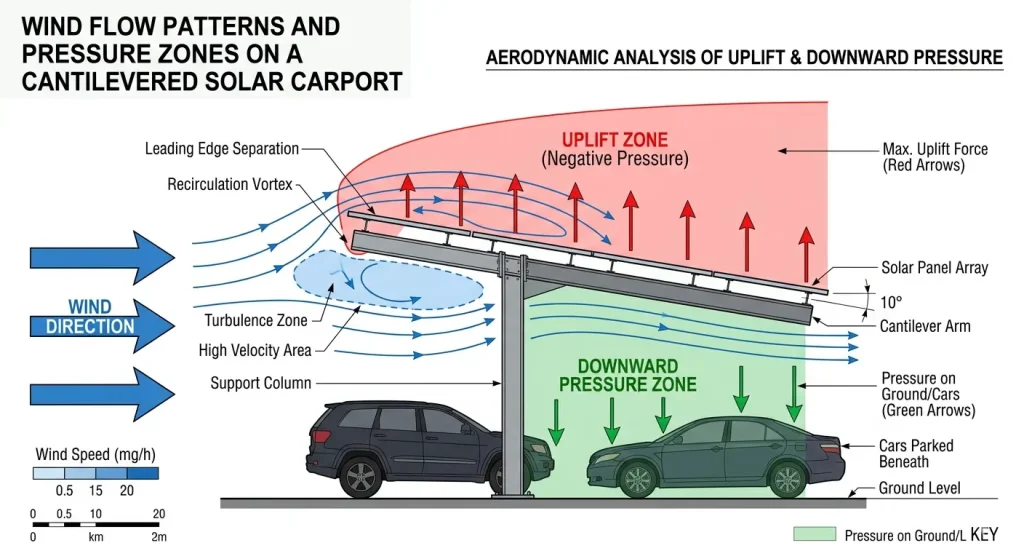
Why do so many carports struggle when the weather gets nasty? It’s usually because they were designed like a ground-mount system that just happens to be taller. That’s a massive mistake. A solar carport is essentially a giant wing. It’s an open or semi-open cantilevered structure that interacts with the wind in ways a rooftop or a low-profile ground mount never will. When the wind hits a carport, it doesn’t just push against it; it gets trapped underneath, creating a massive amount of uplift.
Understanding the “Sail Effect” in Open Canopy Structures
Think of your carport as a sail on a ship. In a 120 mph wind gust—which is becoming the new normal in many jurisdictions—the upward force on those panels can be double or triple the actual weight of the structure. If your design hasn’t accounted for the “Sail Effect,” the wind will literally try to pluck the columns out of the ground. This isn’t just theory; we’ve seen 55 m/s winds turn poorly anchored carports into projectiles. It’s about more than just the steel; it’s about the connection points and the aerodynamics of the canopy itself.
The Hidden Dangers of Unbalanced Snow Accumulation
Snow is a different beast entirely. Most people think about snow as a uniform weight, but nature is rarely that organized. Wind moves snow around, creating “drifts” on one side of the canopy while the other side stays bare. This creates an unbalanced load, which puts a nasty amount of torsion (twisting force) on the main beams and columns. If your structural engineer didn’t model for this eccentricity, the cantilevered arms can fail even if the total weight of the snow is within “limits.” We always tell our clients: it’s not the weight that kills the structure; it’s the way the weight is distributed.
Navigating the 2026 Regulatory Landscape: ASCE 7-22 and Beyond
If you’re working in the US or looking at international projects that follow US standards, you’ve likely noticed that the 2024 International Building Code (IBC) has fully embraced ASCE 7-22. This is a game-changer. We’ve moved away from the old 50-year mean recurrence intervals and toward a “strength-based” ground snow load. What does that mean for you? It means the safety margins are tighter, and the site-specific data is more precise. You can’t just say “this area is a 30 psf snow zone” anymore. You have to look at the geodatabase and account for the specific reliability targets of the project’s risk category.
Site-Specific Parameters: Beyond the Basic Wind Speed Map
One of the biggest mistakes we see PV distributors make is selling “standard kits” without checking the local topography. Is the project on a hillside? Is it in an open field (Exposure Category C) or a sheltered urban area (Category B)? A carport in a “Wind Borne Debris Region” needs a completely different level of reinforcement than one in a shielded valley. At SR Solar, we use the ASCE Hazard Tool for every single project to ensure the velocity pressure ($q_z$) is calculated correctly based on the exact coordinates of the site.
The Physics of Wind Load: Uplift, Torsion, and Lateral Force
Let’s talk about the actual physics here, but without the headache of a classroom lecture. When wind hits a solar carport, it’s not just a simple “push.” Because the structure is open underneath, the wind speeds up as it’s squeezed between the ground and the canopy. This creates a massive pressure difference. It’s the exact same principle that allows a 300-ton Boeing 747 to lift off the runway. Your carport is essentially trying to take flight, and your columns and foundations are the only things keeping it grounded.
Instead of just worrying about the weight of the panels pushing down, we have to design for the wind pulling up. We call this “net uplift.” In a heavy storm, the upward suction on those panels can be far greater than the actual weight of the steel itself. If you haven’t accounted for this “reverse gravity,” you’re going to see base plates warping and bolts shearing off.
Why Corners and Edges Are Your Structure’s Weakest Links
If a carport is going to fail, it almost always starts at the corners. Think about what happens when you try to peel a stubborn sticker off a box—you don’t start in the middle; you grab a corner. Wind works the same way. It curls around the edges of the canopy, creating violent little mini-tornadoes (we call these vortices) that put localized stress on the outer panels.
This is why we don’t treat the whole roof the same. At SR Solar, we reinforce the “perimeter zones.” We might use more heavy-duty clamps or add extra support rails only at the edges and corners. It’s a strategic way to beef up the structure where it’s most vulnerable without blowing the budget by over-engineering the calm center of the canopy. Have you ever seen a carport where the middle is fine but the edge panels are missing? That’s a classic case of ignoring edge-zone physics.
Snow Load Dynamics: More Than Just Weight on a Roof
Snow isn’t just frozen water; it’s a dynamic load. In colder regions, you have to worry about “rain-on-snow” events, where a heavy rain falls on an existing snowpack, doubling the weight almost instantly. Our designs at SR Solar account for this by looking at the “Slope Factor” ($C_s$). A steeper tilt helps the snow slide off, but there’s a catch: a steeper tilt also increases your wind surface area. It’s a delicate balancing act.
Managing the Drift: How Tilt Angles Affect Snow Shedding
We generally recommend a tilt angle of around 10 to 15 degrees for most carports. It’s the “Goldilocks” zone—steep enough to encourage snow to shed and rain to wash away dust, but flat enough to keep the wind uplift manageable. If you go too flat (say, 5 degrees), you’re asking for ice damming and massive snow accumulation. If you go too steep (over 20 degrees), your steel costs are going to skyrocket because of the wind load.
Material Science in Carport Engineering
What should you build your carport out of? In the B2B world, the answer is almost always hot-dip galvanized steel or high-grade aluminum. At SR Solar, we lean toward Q355 steel for high-load environments. Why? Because it has a higher yield strength than standard Q235, allowing us to use thinner profiles that are actually stronger. We ensure all our steel has a coating thickness of at least 65μm to prevent corrosion over the 25-year lifespan of the project.
Hot-Dip Galvanized Steel vs. Aluminum Alloys: The SR Solar Verdict
Aluminum (like 6063-T5) is fantastic for smaller spans and coastal areas where salt spray is a killer. It’s lightweight and easy to install. However, when you’re dealing with 180 kg/m² of snow or 140 mph winds, steel is king. It’s stiffer, more predictable in a crisis, and generally more cost-effective for large-scale commercial carports. We often use a hybrid approach: steel for the main columns and beams, and aluminum for the purlins and module mounting rails.
Foundation Strategies for High-Load Environments
You can have the strongest steel in the world, but if your foundation isn’t up to the task, it’s all for naught. The foundation has to resist two main things: the downward weight of the snow and the upward “pull-out” force of the wind. In many Southwestern regions like Phoenix, the soil can be tricky. It might look solid, but the moment it gets wet, its bearing capacity changes.
Choosing Between Helical Piles and Concrete Piers
For speed and efficiency, we love helical piles (screw piles). They’re great for year-round construction because you don’t have to wait for concrete to cure in the winter. However, for maximum stability in high-uplift zones, a deep concrete pier foundation is hard to beat. It provides the “dead weight” needed to counteract the wind’s attempt to lift the carport. We always recommend a site-specific soil report before you even think about digging.
Final Checklist for EPCs: Ensuring Long-Term Asset Integrity
Before you sign off on a design, ask yourself:
- Is this calculated using the latest ASCE 7-22 codes?
- Has the “unbalanced snow load” been modeled?
- Are the fasteners high-strength and anti-corrosive?
- Is there a clear drainage path to prevent ponding on the panels?
At the end of the day, a solar carport is a long-term asset. It needs to generate power, but more importantly, it needs to be safe for the cars and people underneath it. At SR Solar, we pride ourselves on delivering designs that aren’t just “compliant,” but are truly resilient.
Conclusion
Designing a wind and snow load rated solar carport is an exercise in balancing aerodynamic forces with structural mass. By moving away from “standard” ground-mount logic and adopting site-specific engineering based on ASCE 7-22, EPCs can deliver projects that withstand the increasingly volatile climate of 2026. Prioritizing material quality, foundation depth, and edge-zone reinforcement ensures that your solar carport remains an asset rather than a liability.
Frequently Asked Questions
1. Does a solar carport need a higher wind rating than a ground-mount system?
Yes, generally. Because carports are elevated and have an open underside, they experience significant uplift forces that ground-mount systems, which are closer to the earth and often have wind-breaking features, do not.
2. How does the tilt angle affect the cost of the steel structure?
A higher tilt angle increases the vertical surface area exposed to the wind. This increases the “lateral load,” which requires thicker columns and more robust foundations, typically raising the total steel cost by 10-15% for every 5 degrees of additional tilt beyond 15 degrees.
3. What is the most common reason for carport structural failure?
Most failures occur at the connection points—either where the panels attach to the purlins or where the cantilevered beams meet the main columns. These are the points where wind-induced vibration and “flutter” concentrate stress.
4. Can I use a standard 50-year wind map for a 2026 project?
No. Current codes like ASCE 7-22 have moved toward “Risk-Targeted” maps that provide different wind speeds based on the structure’s risk category. Using an outdated map could lead to an under-designed structure that won’t pass local building permits.
5. How do I prevent snow from sliding off and damaging cars parked underneath?
We recommend a combination of a moderate tilt angle (10-15°) and integrated “snow guards” or gutter systems. Some of our B2B clients also opt for bifacial panels, which warm up faster and help shed snow more evenly in small amounts before it becomes a heavy “shelf.”