Have you ever looked at a sleek, glass-fronted skyscraper and wondered why those thousands of square feet aren’t generating power? Or maybe you’re an EPC developer tired of the “clunky” look of traditional solar racks on a beautiful new build. That’s where Building-Integrated Photovoltaics (BIPV) comes in.
In 2026, we’ve moved past the experimental phase. BIPV is no longer just a “cool idea” for tech giants; it’s a legitimate construction standard. But let’s be real: it’s not all sunshine and rainbows. There are serious advantages and disadvantages of BIPV that you need to weigh before you commit your budget. At SR Solar, we’ve helped hundreds of partners navigate these waters, and I’m going to share exactly what we’ve learned from the front lines.
What Exactly is BIPV and Why Does It Matter Now?
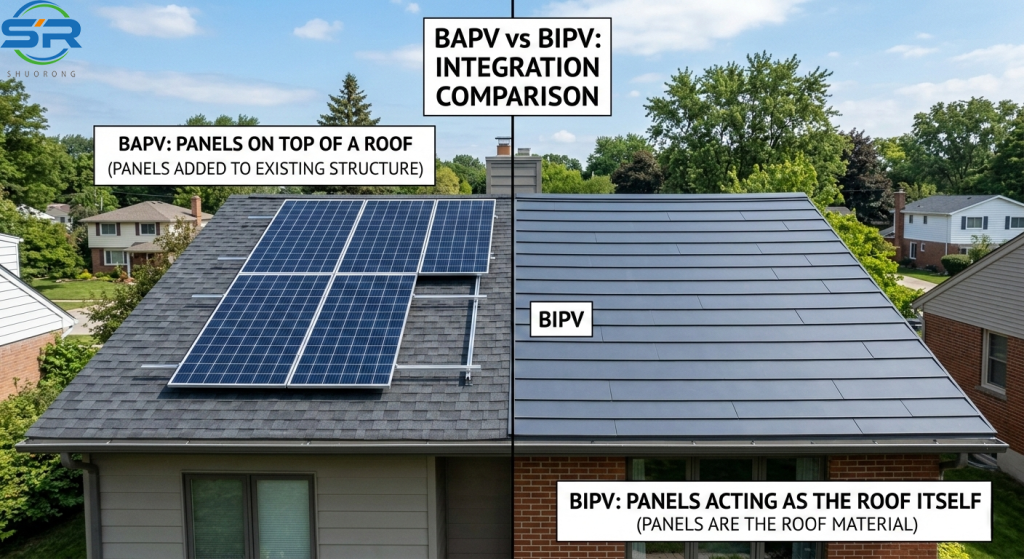
To understand the advantages and disadvantages of BIPV, we first need to agree on what it is. BIPV isn’t just “solar on a building.” It is the building. We’re talking about solar cells integrated into the roof, the windows, or the facade. When you use a BIPV system, you aren’t installing a roof and then adding solar; the solar modules are the roof.
The Fundamental Difference: BIPV vs. BAPV
If you’ve been in the industry for a minute, you know BAPV (Building-Applied Photovoltaics). That’s the traditional way: you finish the building, then you bolt on some rails and panels. BIPV flips the script. Because the solar serves as the outer “skin” of the structure, it has to meet the same building codes as traditional materials—fire resistance, wind load, and waterproofing. It’s a dual-purpose beast.
The Major Advantages: Why BIPV is Winning the Market
Why are we seeing such a massive spike in BIPV adoption this year? It’s not just about “looking green.” The advantages of BIPV are rooted in hard economics and structural efficiency.
1. Material Displacement: Saving Money by Doing Double Duty
This is the big one. When people look at the price tag of BIPV, they often get sticker shock. But here’s the trick: you have to look at the net cost. In a BIPV project, you are replacing expensive traditional materials like standing seam metal roofs, glass curtain walls, or high-end cladding.
At SR Solar, we’ve seen projects where the “material displacement” effect actually made the solar portion of the budget feel almost free. By consolidating the roofing and solar installation into one phase, you reduce “soft costs” and on-site labor time. You aren’t paying a roofing crew and then a solar crew—you’re paying one team to install a multifunctional system.
2. Aesthetic Superiority and Architectural Freedom
Let’s be honest: traditional solar can be ugly. For high-end commercial projects or LEED-certified landmarks, aesthetics are non-negotiable. BIPV offers a “seamless” look. Whether it’s semi-transparent solar glass for a skylight or sleek black roof tiles that look like slate, BIPV allows architects to be creative without sacrificing energy goals. It’s the difference between a “gadget” stuck on a house and a masterpiece of modern engineering.
3. Boosting Property Value and ESG Credentials
In 2026, ESG (Environmental, Social, and Governance) scores are everything for B2B clients. A building that generates its own power isn’t just a building; it’s a high-performing asset. Studies show that commercial properties with integrated green tech see an 8–15% increase in property value. Plus, you’re hitting those carbon neutrality targets much faster than with rooftop solar alone because you’re utilizing every available square inch of the building’s envelope.
The Honest Disadvantages: The Hurdles You’ll Face
Now, I wouldn’t be a very good peer if I didn’t tell you the risks. The disadvantages of BIPV are mostly technical, and if you ignore them, they will come back to haunt you in the form of maintenance calls and angry clients.
1. The Thermal Challenge: Heat vs. Efficiency
Here’s a bit of physics for you: solar cells hate heat. In a standard racking system, there’s plenty of airflow behind the panels to keep them cool. But with BIPV, the panels are often flush with the building or integrated into the insulation.
Without proper ventilation, these modules can get scorching hot, leading to a $0.4\%$ to $0.5\%$ drop in efficiency for every degree Celsius the temperature rises above $25$°C. If your design doesn’t account for this “heat island” effect, your energy yield will be much lower than promised in your brochures.
2. Waterproofing: When the Solar is the Barrier
In traditional solar, if a panel mounting point leaks, the roof underneath is your backup. In BIPV, the solar system IS the roof. If your integration points aren’t perfect, you have water entering the building. This is the #1 fear for EPCs. Waterproofing a BIPV system requires a level of precision that standard solar installers often aren’t used to. You need specialized gaskets, sealants, and a structural design that can handle extreme precipitation.
3. Complexity in Maintenance and Installation
Standard panels are easy to swap out. If one breaks, you unclip it and put a new one in. With BIPV, the module is part of the building’s skin. Replacing a damaged unit might involve breaking the waterproof seal or using specialized scaffolding for a facade. This makes the Operations & Maintenance (O&M) costs higher over the 25-year lifespan of the building. It’s not “plug and play” in the way we’re used to.
SR Solar’s Engineering Solutions: Turning Cons into Pros
At SR Solar, we didn’t want to just talk about the advantages and disadvantages of BIPV; we wanted to solve the problems. Our R&D team spent years obsessing over those technical hurdles so you don’t have to.
Our Secret Sauce: U-Shape & M-Shape Troughs
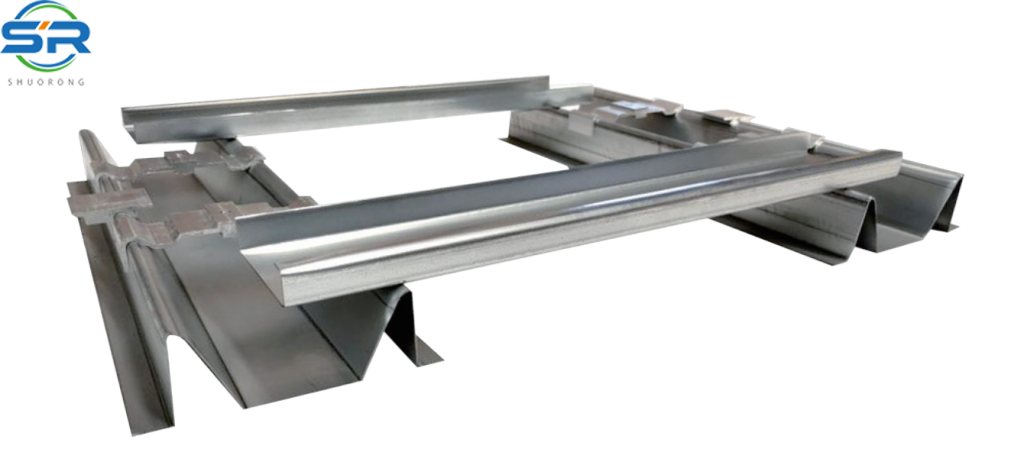
To solve the waterproofing nightmare, we developed a double-drainage structure. Our systems use U-Shape & M-shape troughs made of ZAM steel. This isn’t your average galvanized steel; it’s a high-corrosion-resistance material that can outlast in harsh environments.
If water manages to get past the primary seal, it’s caught by the internal water guide grooves and channeled safely off the building. No leaks, no stress.
Is BIPV Right for Your Next B2B Project?
So, should you pull the trigger? Here’s my rule of thumb:
- Go with BIPV if: You are working on a new construction project, a major facade renovation, or a building where aesthetics and “zero-energy” certification are the primary goals. The material displacement savings will likely make it a financial win.
- Stick to BAPV if: You are doing a simple retrofit on an existing roof that is still in good condition. BIPV is a “built-in” solution, not a “bolt-on” one.
Conclusion: The Future of Integrated Energy
The advantages and disadvantages of BIPV essentially boil down to a trade-off between architectural value and engineering rigor. Yes, it’s more complex. Yes, the initial engineering needs to be more precise. But the result is a building that is an active participant in the energy grid—a beautiful, high-value asset that pays for itself.
At SR Solar, we provide the pre-assembled components and customized design schemes to take the “complexity” out of your hands. We help you bridge the gap between a “pretty picture” in a design software and a rock-solid, waterproof reality on the job site.
Frequently Asked Questions (FAQ)
1. Is BIPV much more expensive than traditional solar?
Initially, the equipment cost is higher. However, since BIPV replaces traditional building materials (like roofing or glass), the total project cost often balances out. In 2026, many developers find that BIPV is more cost-effective over a 10-year period due to material savings and higher energy yields from utilizing larger surface areas.
2. How do you handle leaks in a BIPV roof?
Preventing leaks starts with the design. SR Solar uses a double-drainage system with U-shape & M-shape water guide grooves and high-grade EPDM sealing. This ensures that even in extreme rain, water is channeled away from the electrical components and the building interior.
3. Does BIPV work on vertical walls (facades)?
Absolutely! Facade BIPV is one of the fastest-growing segments. While vertical panels produce less energy than tilted ones, they are excellent for capturing winter sun and providing shade to the building, which significantly reduces cooling costs (HVAC loads).
4. Can I replace a single BIPV panel if it breaks?
Yes, but it requires a specialized mounting system. Our SR Solar BIPV racks are designed with “accessible integration,” meaning individual modules can be removed and replaced without compromising the structural integrity of the surrounding panels.
5. What is the lifespan of a BIPV system?
A well-engineered BIPV system is designed to last as long as the building itself—typically 25 to 30 years for the electrical components.