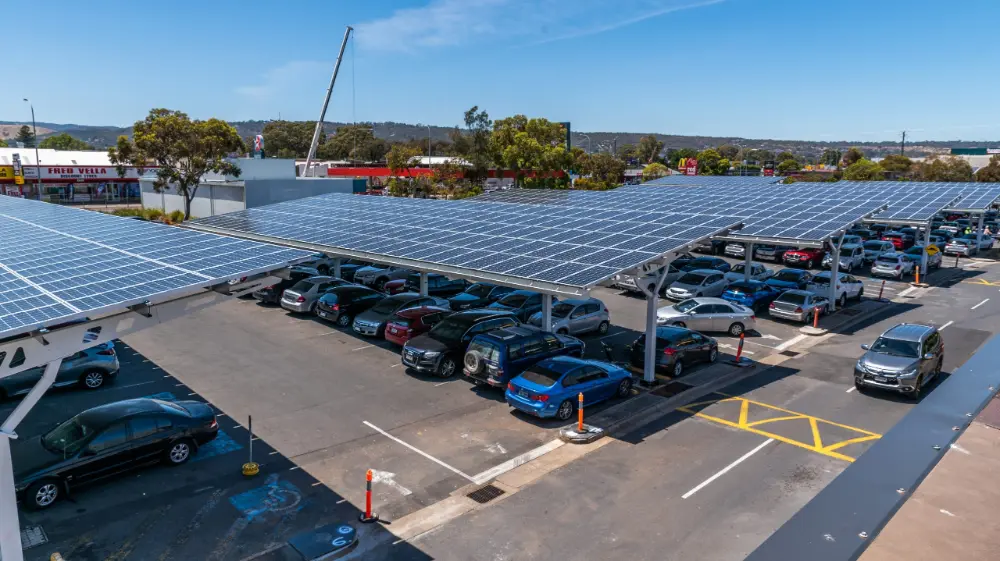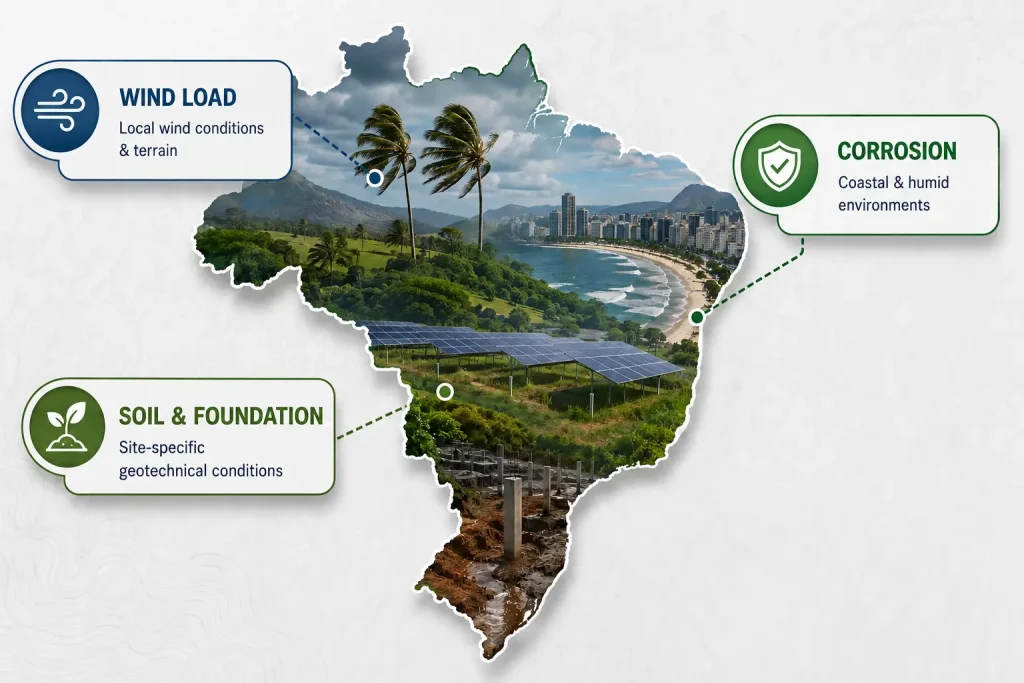
Brazil is one of the largest solar markets in the world, but designing a reliable Brazil solar mounting system requires more than choosing a standard structure from a catalog. Ground mounted solar projects can face very different conditions depending on location, terrain, soil, climate, and proximity to the coast. For EPC contractors and solar developers, wind load, corrosion, soil and foundation conditions, and rainfall and drainage should all be considered before the mounting structure is finalized.
A mounting system may look simple once it is installed. The engineering behind it is not.
The same structure that performs well on a relatively flat inland site may require a different design approach in a coastal area, on weak soil, or on a site exposed to strong wind and heavy rainfall. This is why a Brazil solar mounting system should be designed around the project site rather than selected only by module type or price.
Why Brazil Solar Projects Need Site Specific Mounting Design
Brazil covers a very large geographic area, and solar projects can be developed in environments with very different natural conditions.
A ground mounted PV system in an inland region may have relatively stable soil and limited exposure to saline air. A project closer to the coast may face higher corrosion risk. Another project may be located on sloped terrain where rainfall creates drainage and erosion concerns.
These differences directly affect the solar mounting structure.
Before selecting a ground mounting system Brazil EPCs should consider several basic questions.
What is the local wind environment?
What type of soil is present at the project site?
Is the project exposed to salt, humidity, or industrial pollutants?
How does rainwater move across the site?
What foundation method is appropriate for the actual ground conditions?
How much installation work will be required in the field?
These questions are not only structural engineering questions. They also affect construction time, labor requirements, maintenance, and the overall project cost.
In our project experience, problems with mounting structures often start before the structure reaches the construction site. A design may be technically sound on paper but unsuitable for the actual soil, terrain, or environmental conditions.
That is why site information should be part of the design process from the beginning.
Wind Load and Solar Mounting System Design in Brazil
Wind load is one of the first structural factors to consider when designing a solar mounting system in Brazil.
Solar modules create a large exposed surface, and the mounting structure needs to transfer wind forces safely through the rails, brackets, posts, foundations, and finally into the ground.
The challenge is that wind conditions are not determined only by the general climate of a region.
Terrain, structure height, module tilt, array configuration, surrounding buildings, vegetation, and site exposure can all influence the actual loading conditions experienced by the structure.
How Terrain and Structure Height Affect Wind Loads
A project located in an open area can experience different wind exposure from a project surrounded by buildings, trees, or other structures.
Terrain also matters.
A relatively exposed site may require a different structural approach from a site with more natural wind protection. The height of the mounting structure can also influence the loads transferred to the posts and foundations.
For EPCs, this means that using the same structural configuration across different Brazilian projects can create unnecessary risk.
A reliable solar mounting system design should start with the project location and relevant design conditions. Structural members, connections, posts, and foundations should then be checked as a complete load transfer system.
Why Array Layout Matters for Ground Mounted Solar
Array layout is another factor that is sometimes underestimated.
Module orientation, row spacing, tilt angle, and the arrangement of tables can affect wind exposure. Changing the layout may change the way wind interacts with the array.
This is particularly important for large ground mounted solar projects where thousands of modules are installed across an open site.
A common EPC error is to focus on the module and rail connection while treating the foundation as a separate issue. In reality, the entire structure works as one system. If the wind load increases, the effect can eventually reach the foundation and soil.
Good engineering therefore considers the complete load path rather than checking individual components in isolation.
Corrosion Protection for Solar Mounting Systems in Brazil
Corrosion is another important consideration for a Brazil solar mounting system, particularly in coastal and high humidity environments.
Solar mounting structures are expected to remain outdoors for many years. Unlike equipment that can easily be replaced, the mounting structure is installed across the entire project and can be difficult and expensive to access after construction.
Material selection should therefore be based on the environment rather than simply the initial purchase price.
Coastal and High Humidity Environments
Coastal projects can expose metal components to salt laden air and higher humidity. These conditions can accelerate corrosion if the material and protective treatment are not appropriate.
The risk is not limited to the main structural members.
Rails, clamps, fasteners, brackets, posts, and other smaller components also need suitable corrosion resistance.
This is one reason why quality control should cover the complete mounting system rather than focusing only on the main structure.
For a solar mounting system in Brazil, the expected environmental conditions should be considered before choosing between materials and surface treatments.
Choosing Materials for Different Brazilian Environments
Aluminum, galvanized steel, ZAM steel, and stainless steel can all play different roles in solar mounting applications.
Aluminum is commonly used where low weight, corrosion resistance, and easy handling are important.
Steel provides high structural strength and is widely used for posts and other load bearing components.
ZAM coated steel can provide a useful combination of structural strength and corrosion protection for outdoor solar applications.
Stainless steel is often used for smaller components and fasteners where higher corrosion resistance is required.
The correct choice depends on the project environment, structural requirements, expected service conditions, and cost targets.
The cheapest material is not necessarily the lowest cost solution over the entire project life.
A small saving during procurement may have little value if it creates additional maintenance work later.
Soil Conditions and Foundation Design for Brazil Solar Projects
The ground is where the solar mounting structure ultimately transfers its loads.
That makes soil conditions one of the most important factors in ground mounting system Brazil projects.
Two sites that appear similar from the surface can have very different subsurface conditions. Soil density, strength, rock layers, groundwater, moisture, and other geotechnical characteristics can all influence foundation selection.
Why Soil Investigation Matters
Foundation design should be based on reliable information about the actual site.
For larger projects, geotechnical investigation can provide important information for determining whether a proposed foundation method is appropriate.
This can help engineers evaluate different foundation options and identify potential construction problems before large scale installation begins.
If the soil is suitable, driven posts or ground screws may provide an efficient installation method. In other conditions, a different foundation approach may be required.
There is no universal foundation that works equally well on every Brazilian solar project.
Ground Screws, Concrete Foundations and Site Conditions
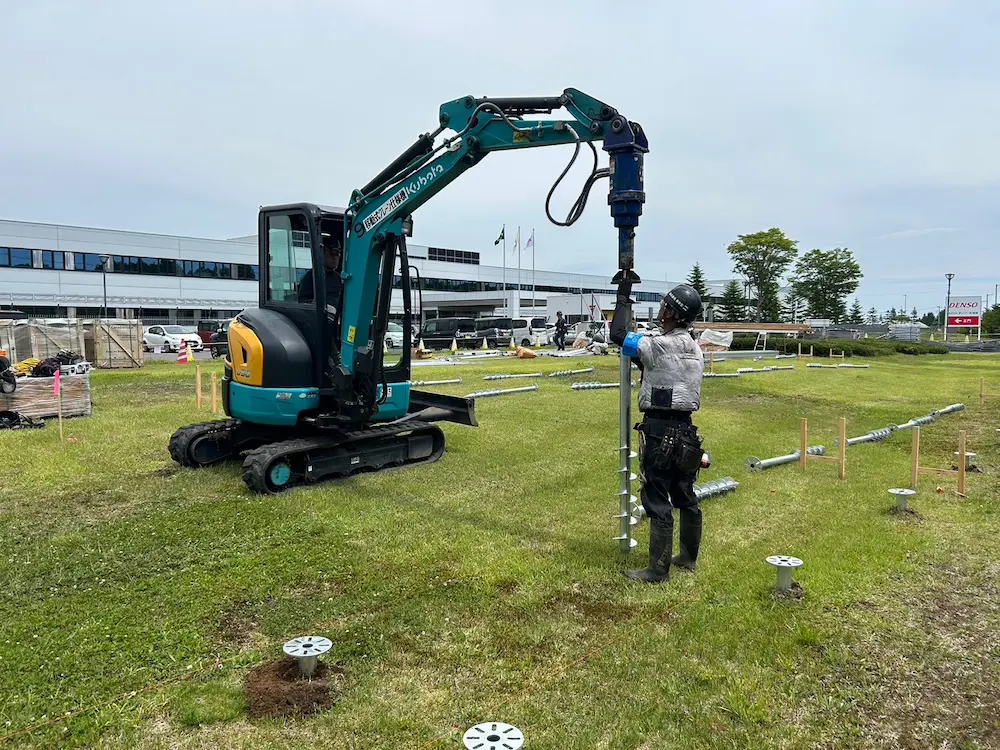
Ground screws can be attractive for projects where installation speed and reduced concrete work are important. They can also reduce some of the wet construction activities associated with traditional concrete foundations.
Concrete foundations may be more appropriate where ground conditions, structural requirements, or project specifications make them necessary.
The decision should not be based only on the foundation price per unit.
EPCs should also consider installation equipment, labor, transportation, curing time where applicable, site access, soil conditions, and construction schedule.
A foundation that costs slightly more per unit but significantly reduces installation time may provide a better overall project result.
This is where solar mounting system design connects directly with project economics.
Rainfall, Drainage and Erosion in Ground Mounted Solar Projects
Brazil has regions that experience substantial rainfall, and water management should not be treated as an afterthought during solar project development.
Heavy rainfall can affect soil bearing conditions, drainage paths, slopes, access roads, and foundation stability.
Poor drainage can also create erosion around foundations.
How Heavy Rainfall Can Affect Solar Foundations
When water accumulates around a foundation, the condition of the surrounding soil can change.
On some sites, repeated rainfall can wash away soil around posts or foundations. On sloped terrain, concentrated water flow can create erosion channels that become larger over time.
The mounting system itself may remain structurally sound while the ground around it gradually deteriorates.
That is why foundation design should be considered together with the site’s drainage conditions.
Drainage Considerations on Sloped Sites
Sloped sites require particular attention because water naturally moves toward lower areas.
Solar arrays can also change local water flow patterns. Roads, foundations, grading, and other site infrastructure may further influence how rainwater moves through the project.
Good site planning should identify natural drainage routes and avoid concentrating runoff around critical foundations.
For EPCs, this is not simply an environmental consideration. Poor drainage can create additional maintenance work, access problems, and foundation repairs.
The mounting structure should therefore be considered as part of the wider site engineering strategy.
How to Choose a Brazil Solar Mounting System
So how should an EPC select a solar mounting system for a Brazilian project?
The starting point should be the project conditions rather than a standard product list.
Start With the Project Location
The location provides the first layer of engineering information.
Wind conditions, environmental exposure, terrain, rainfall, and soil conditions should be reviewed before the structural configuration is finalized.
The same product may be suitable for one site but require modification for another.
Match Materials With the Environment
Material selection should consider the expected exposure throughout the project life.
For coastal projects, corrosion protection deserves particular attention. For inland projects, structural requirements and installation efficiency may have greater influence.
There is no reason to overengineer every component, but there is also little value in saving on materials that are critical to long term reliability.
Consider Installation Efficiency
For large solar projects, installation labor can become a significant part of the construction budget.
A mounting structure that is easy to handle, align, and install can reduce field labor and help maintain the construction schedule.
This is especially relevant when the project has thousands of repeated mounting points.
Good design should therefore consider not only whether the structure can be installed, but how efficiently it can be installed.
Work With Engineering Data From the Beginning
A professional solar mounting system manufacturer should be able to work with project information rather than simply provide a standard quotation.
Useful information may include site location, module specifications, array configuration, terrain information, soil data, wind conditions, and project requirements.
The more accurate the input information, the more useful the engineering output can be.
At SR Solar, our approach is to treat the mounting system as an engineered part of the project rather than an isolated hardware package. Material selection, structural configuration, foundation options, manufacturing requirements, and installation considerations should work together.
What EPCs Should Check Before Ordering a Solar Mounting System
Before placing an order for a ground mounting system Brazil EPCs can benefit from checking several basic points.
First, confirm that the structural design reflects the actual project location and environmental conditions.
Second, review the proposed material and corrosion protection according to the site environment.
Third, confirm that the foundation method has been considered against the available soil information.
Fourth, check whether the structure is practical for field installation.
Finally, make sure the manufacturer can provide engineering support when site conditions change.
These checks may seem simple, but they can prevent costly changes later.
A mounting system is installed across the entire solar project. If an unsuitable detail is discovered after production or installation has already started, correcting it can affect materials, labor, transportation, and schedule.
The earlier engineering decisions are made, the easier they are to manage.
Summary
Brazil offers enormous potential for solar development, but the country’s geographic and environmental diversity means that one standard mounting solution cannot automatically fit every project.
A reliable Brazil solar mounting system should be designed around the actual site.
Wind load affects the structural configuration and foundation requirements.
Corrosion conditions influence material and coating selection.
Soil conditions determine whether a proposed foundation method is suitable.
Rainfall and drainage can affect soil stability, erosion, and long term foundation performance.
For EPCs and developers, these factors are closely connected to project cost and construction efficiency. A technically appropriate mounting system can reduce installation problems, improve site efficiency, and lower the risk of expensive modifications during construction.
The right question is not simply which solar mounting system costs less.
The better question is which system is engineered correctly for the site and can be installed efficiently over the project lifecycle.
At SR Solar, we use project conditions as the starting point for mounting system engineering. If you are planning a ground mounted solar project in Brazil, sharing the basic project information with the engineering team early can help identify the right structural and foundation approach before procurement begins.
FAQs
What should be considered when choosing a Brazil solar mounting system?
The main considerations include wind conditions, soil characteristics, corrosion environment, rainfall, drainage, module specifications, terrain, foundation requirements, and installation conditions.
Are ground screws suitable for solar projects in Brazil?
Ground screws can be suitable for many projects, but their application depends on actual soil conditions and structural requirements. A site investigation should be considered before confirming the foundation method.
Which material is best for solar mounting systems in Brazil?
There is no single material that is best for every project. Aluminum, steel, ZAM steel, and stainless steel can serve different purposes depending on structural requirements and environmental exposure.
Does coastal location affect solar mounting system design?
Yes. Coastal environments can increase corrosion risk because of salt and humidity. Material selection, protective treatment, and component selection should reflect the environmental conditions.
Why is drainage important for ground mounted solar projects?
Poor drainage can contribute to soil erosion, water accumulation, and changes in foundation conditions. Drainage should therefore be considered together with site grading, foundation design, and overall project planning.