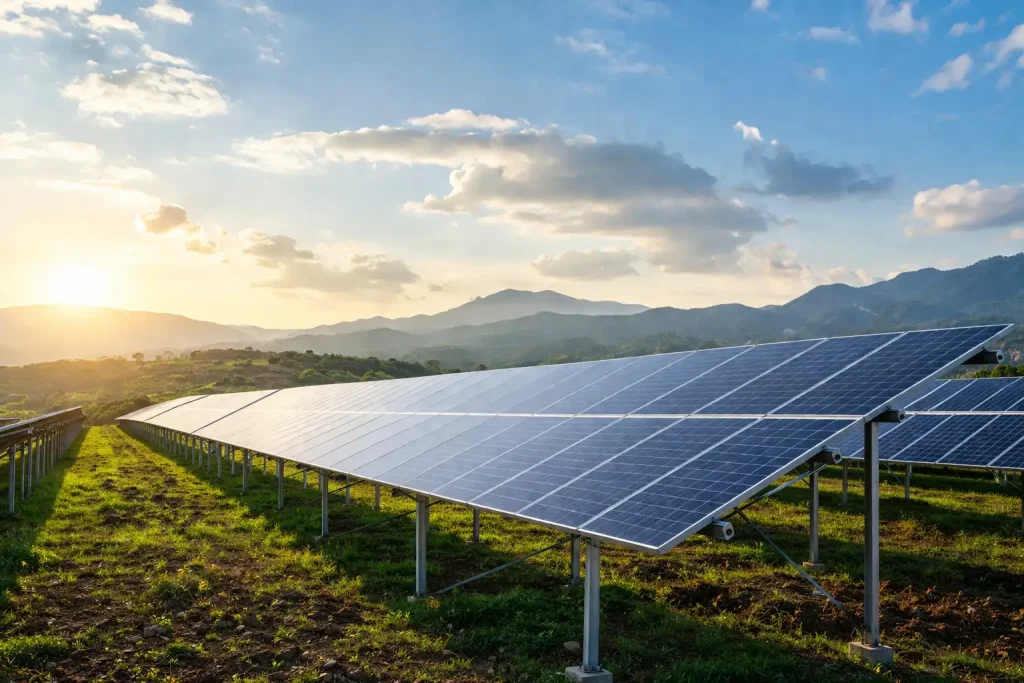
In the world of utility-scale and commercial solar, selecting a site is often treated as a checkbox exercise: “Does it have sun? Is it flat?” However, as any seasoned EPC (Engineering, Procurement, and Construction) professional knows, the difference between a high-performing asset and a maintenance nightmare often lies in the centimeters below the surface and the micro-climates above it.
Choosing the right location for ground mount solar panels isn’t just about maximizing irradiance; it’s about minimizing the Levelized Cost of Energy (LCOE) through strategic structural engineering.
1. Geotechnical Reality: Why the Soil is Your Most Important Stakeholder
From a structural perspective, the ground is not just dirt—it is the foundation of your entire investment. At SR Solar, we’ve seen projects delayed by months because the site selection didn’t account for subsurface conditions.
Soil Composition vs. Foundation Type
The soil determines which solar panel ground mounting kit or piling method you must use.
- Class 1-3 Soils (Dense/Hard): Ideal for pre-drilling or heavy-duty ground screws.
- Class 4-5 Soils (Loose/Sandy): Often require driven piles or even concrete ballast if the pull-out resistance is too low.
- Corrosive Soils: High salinity or acidity can eat through standard galvanized steel in years. In these locations, we recommend specialized coatings or the SR Solar High-strength Concrete Pile system, which offers superior longevity in aggressive environments.
Engineering Insight: A common mistake in EPC projects is relying on a single soil bore across a 10-hectare site. Variations in soil density can lead to uneven settling, which puts torsional stress on the solar frames and can even crack modules.
2. Topography and Slope: The Hidden Costs of Earthmoving
While a perfectly flat site is the “holy grail,” the reality is usually undulating terrain. When choosing the right location, you must weigh the cost of Civil Works (Grading) vs. Adaptive Mounting Solutions.
North-South vs. East-West Slopes
- North-South Slopes: These are generally easier to manage with fixed-tilt systems by adjusting pile heights.
- East-West Slopes: These are the “silent killers” for trackers and certain fixed-row configurations. If the slope is too aggressive (typically over 10-15%), the shading between rows becomes unpredictable, and the structural load on the mounting rails increases significantly.
3. How to Choose the Right Solar Mounting System (The Decision Matrix)
Selecting the site and selecting the hardware are two sides of the same coin. Use the following matrix to align your location with the right technology:
| Site Condition | Recommended Mounting Strategy | Engineering Focus |
| High Wind Zones (Coastal) | Dual-post Fixed Tilt / Thicker Gauges | Vibration & Uplift Resistance |
| Flood-Prone Areas | High Clearance | Waterline protection for electronics |
| Rocky/Hard Ground | Ground Screws or Pre-drilling | Avoid pile refusal and equipment damage |
| Soft/Unstable Soil | Concrete Piles or Wide-Flange Beams | Pull-out strength & settlement |
| Limited Land Area | High-density Bi-facial layouts | Albedo effect & optimized row spacing |
4. The “Micro-Shading” Factor: Looking Beyond Trees
Everyone knows to avoid trees. But an expert engineer looks for the “invisible” shadows. When determining the right location for ground mount solar panels, analyze:
- Horizon Shading: Distant mountains or buildings that cut off “Golden Hour” production.
- Self-Shading: In high-latitude locations, the rows themselves are the biggest threat. If your site is cramped, you’ll be forced to reduce row spacing, leading to massive losses in winter months.
- Future-Proofing: Is there planned development nearby? A warehouse built next door two years from now could ruin your ROI.
5. Real-World Experience: Hard Lessons from the Field
In our years of supporting global installations, we’ve learned that the “perfect” site on Google Earth is rarely perfect on the ground.
The Drainage Trap: We once consulted on a project where the site was chosen for its flatness. However, it turned out to be the natural basin for the surrounding hills. During the first monsoon, the mounting structures were standing in two feet of water. This didn’t just risk the piles; it made maintenance access impossible.
- The SR Solar approach: We now emphasize “Hydro-logical Siting.” If the location is low-lying, we integrate our High-Clearance systems to keep the sensitive components dry and accessible.
The Grid Proximity Myth: A site with 5% more sun but located 2 miles further from the interconnection point is often a worse financial choice. The cost of trenching, cabling, and voltage drop over long distances usually outweighs the marginal gain in irradiance.
6. ROI Perspective: Why Location Dictates Labor Costs
Location isn’t just about physics; it’s about logistics. When we help clients evaluate a site, we look at:
- Access Roads: Can a 40ft container reach the site? If not, you’ll pay a premium for “last-mile” transloading.
- Staging Areas: A good location has enough flat, dry space for the “solar panel ground mounting kit” to be unboxed and pre-assembled.
- Labor Efficiency: A site with excessive rocks or steep slopes can increase installation man-hours by 30-50%.
7. Soft Brand Integration: The SR Solar Advantage
At SR Solar, we don’t just ship steel and aluminum. In the SR Solar engineering process, we begin with a site-specific structural analysis. Whether your location is a corrosive coastal strip or a rocky mountain slope, we adapt our mounting solutions—such as our galvanized carbon steel or aluminum alloy systems—to ensure the structural integrity matches the 25-year lifespan of your modules.
We typically handle the heavy lifting of calculating wind and snow loads based on your specific GPS coordinates, ensuring that the “right location” is backed by the “right engineering.”
Summary: The Final Checklist
To ensure your ground-mount project succeeds, remember that the “Right Location” must satisfy:
- Mechanical Stability: Can the soil hold the piles under 150mph wind loads?
- Hydraulic Safety: Will the site drain properly during a 100-year storm?
- Financial Viability: Does the proximity to the grid and ease of installation protect your CAPEX?
Selecting the location is the first and most critical “engineering decision” of the project. Don’t leave it to chance.
FAQs
1. Can I install ground mount panels on a steep slope? Yes, but it increases costs. Slopes over 20% usually require specialized terracing or custom-length piles to keep the array level, which impacts the total system ROI.
2. How do I know if I need a ground screw or a driven pile? It depends on your Geotech report. Driven piles are faster and cheaper for large-scale projects in cohesive soils, while ground screws are better for rocky or varied terrain where pile driving might fail.
3. What is the minimum clearance I should have from the ground? Standard clearance is 500mm-800mm to avoid vegetation shading and “splash-back” dirt. However, in snow-heavy or flood-prone areas, this should be increased.
4. Does the “right location” change if I use bifacial modules? Absolutely. For bifacial modules, you need a location with high Albedo (reflective ground) and higher mounting heights to allow light to reach the back of the panel.
5. How far should ground mount panels be from the property line? This varies by local zoning laws. Most jurisdictions require a “setback” of 5 to 20 feet. Always check local permits before finalizing your site layout.
Are you evaluating a potential site for your next solar project? Don’t wait until the piles are being driven to find out the soil is too soft or the drainage is poor. Contact the SR Solar Engineering Team today for a preliminary structural consultation. Let’s ensure your site is built on a solid foundation.