Selecting a site for a utility-scale ground mount system is often mistaken as a simple exercise in “finding a sunny field.” But for an EPC, the “right” location isn’t just about irradiance—it’s about the geotechnical and structural viability that keeps your LCOE from spiraling out of control.
Why does a site with 5% higher yield sometimes fail the ROI test? Usually, because the engineering team ignored what was happening beneath the topsoil. In this guide, we’ll move past the basics and look at site selection through the lens of structural integrity and site efficiency.
The Foundation Dictates the Rack: Why Soil is Your Biggest Variable
When we talk about ground mounts, the foundation is the largest line item in terms of labor and material risk. You can have the most efficient AL6005-T5 or ZAM (Zinc-Aluminum-Magnesium) racking system, but if the soil doesn’t cooperate, your installation costs will skyrocket.
1. Geotechnical Risk: The “Hidden” Cost of Ground Mounts
A common EPC error is relying on surface-level soil assessments. Are you dealing with expansive clay, bedrock, or loose sand?
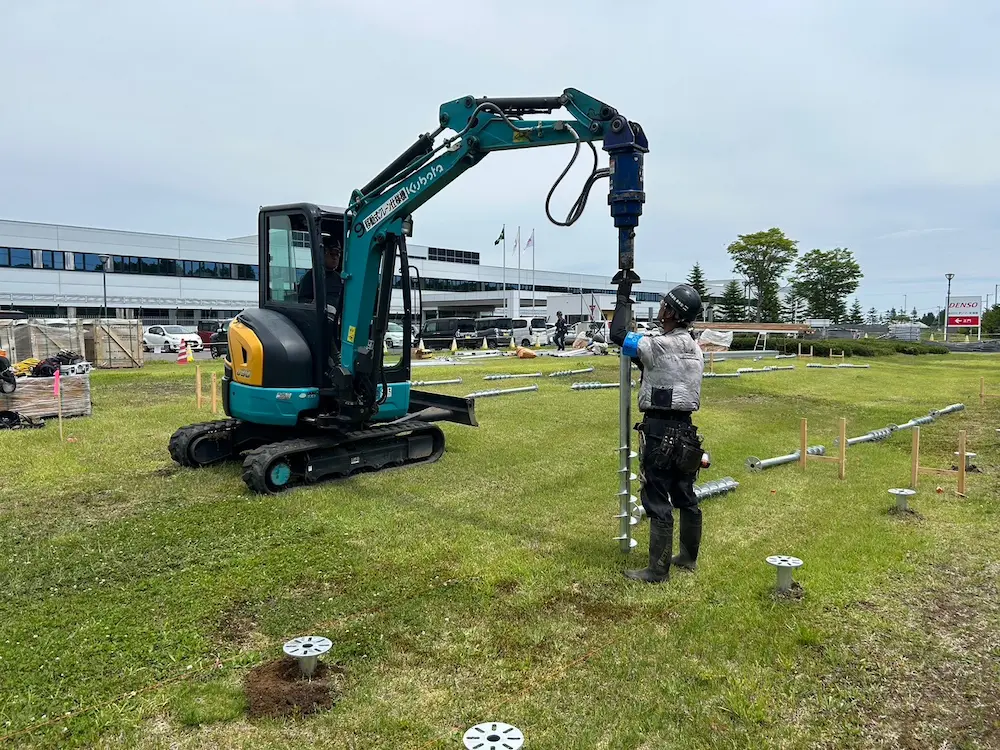
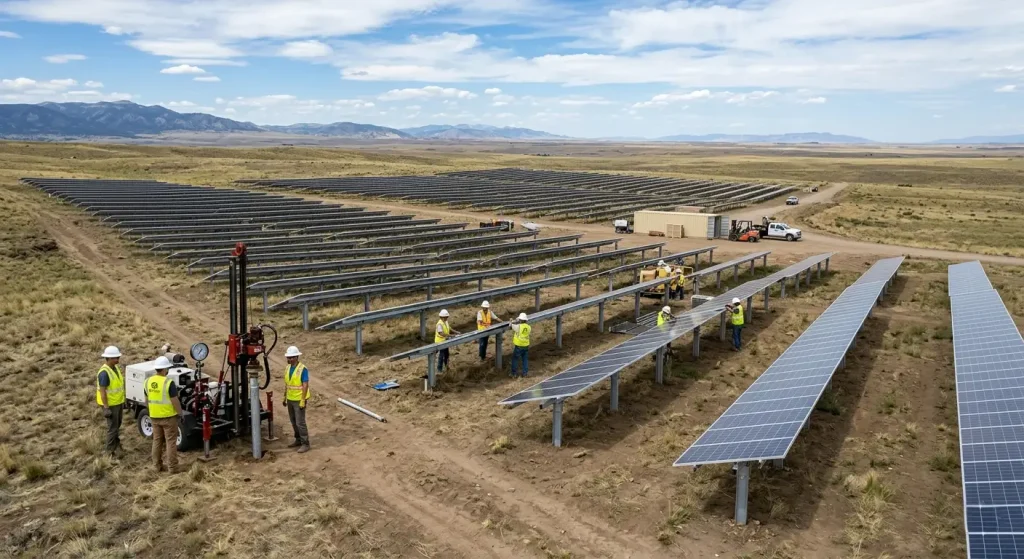
- Driven Pile Systems: If the site has consistent, non-rocky soil, a Driven Pile foundation is your best friend. It’s fast, requires no concrete, and significantly reduces on-site labor.
- The “Refusal” Nightmare: If your site selection team picks a location with shallow bedrock without a proper pull-out test, your “fast” driven pile project suddenly requires pre-drilling and concrete encasement. That’s a 3x jump in foundation costs overnight.
In our project experience, we’ve seen sites where a 500-meter shift in array location saved the client over $40,000 in specialized drilling equipment rental. Have you conducted a professional pull-out test before finalizing your site layout?
2. Topography: The Slope Efficiency Matrix
While modern trackers and fixed-tilt systems can handle some slope, every degree of North-South (N-S) or East-West (E-W) variance adds complexity to the structural engineering.
- N-S Slopes: Excessive N-S slopes can cause shading issues between rows, forcing you to increase the pitch (distance between rows), which reduces the total MW capacity of the land.
- Grading vs. Racking: Do you pay for earthmoving (grading) or do you pay for longer piles? At SR Solar, we generally advise EPCs to minimize grading—it disturbs the soil’s natural compaction and creates drainage headaches. Instead, we adapt the pile height (using SUS304 fasteners for adjustability) to meet the terrain.
Material Selection: Matching the Environment to the Alloy
Site selection isn’t just about where you put the panels, but what the environment will do to the steel and aluminum over 25 years.
The C5 Corrosive Challenge
If your site is near the coast or in an industrial zone, standard galvanized steel won’t cut it. We’ve seen EPCs regret using standard coatings in high-salinity environments, leading to structural “blooming” or rust within 5 years.
- ZAM (Zinc-Aluminum-Magnesium): For high-corrosion sites, ZAM is the gold standard. The self-healing properties of the magnesium-based oxide film are critical for the cut edges of the mounting rails.
- AL6005-T5: For sites with high humidity but lower wind loads, high-strength aluminum offers an incredible strength-to-weight ratio, making logistics to remote sites much cheaper.
Are you factoring in the “replacement cost” of a system that fails its corrosion audit in year 10?
Logistics and the “Last Mile” Efficiency
An overlooked part of site selection is the construction staging area.
Site Accessibility
If the location is beautiful but the access road can’t handle a 40ft container, your “Site Efficiency” is dead on arrival.
- Pro-Tip: Look for sites that allow for “Point-of-Use” delivery. If our SR Solar kits can be dropped directly at the end of each row, you eliminate the need for telehandlers and secondary transport on-site. This can save up to 15% in mechanical installation labor.
Drainage and the “Mud Factor”
A site that looks perfect in the dry season can become a swamp in the rainy season. Beyond the risk of equipment getting stuck, poor drainage leads to soil liquefaction and pile instability.
- Engineering Check: Does the site have a natural 1-2% grade for runoff? If not, are you prepared for the cost of integrated drainage channels?
The Economic Reality: How Site Selection Drives LCOE
Every technical decision made during site selection feeds back into the Levelized Cost of Energy (LCOE).
- Labor Cost (The EPC Killer): A site with rocky soil or steep slopes requires more man-hours. In high-labor-cost markets, this is often the difference between a profitable project and a loss.
- SKU Management: Choosing a site that allows for a unified foundation type (e.g., all Driven Piles instead of a mix of piles and concrete pads) simplifies your supply chain.
- Risk Mitigation: Using field-proven standards like AS/NZS 1170.2 or JIS C 8955 ensures that when you choose a high-wind-load location, the structural math actually holds up during a cyclone.
SR Solar Engineering Standards
At SR Solar, we don’t just provide “hardware.” We provide an engineering ecosystem designed to handle the realities of imperfect sites.
- Precision Engineering: Our grounding clips and pre-fabricated components are designed for 1mm-level accuracy, even when the ground isn’t perfect.
- Material Integrity: We utilize ZAM and AL6005-T5 exclusively to ensure that your site selection isn’t undermined by environmental degradation.
Summary & FAQ
Summary
The “perfect” ground mount location is a balance of high solar yield, stable geotechnical conditions, manageable topography, and logistical ease. For an EPC, the goal is to minimize unforeseen site variables. By conducting rigorous pull-out tests and choosing a flexible racking partner like SR Solar, you can de-risk the project before the first pile is driven.
FAQs
- How much slope can a standard ground mount handle? Most fixed-tilt systems can handle up to 10-15 degrees of slope before requiring custom engineering or significant grading. Trackers are usually limited to 5-7 degrees.
- Is ZAM steel better than Hot-Dip Galvanized (HDG) for ground mounts? Yes, especially in acidic soils or coastal areas. ZAM offers superior corrosion resistance and is more cost-effective over the 25-year lifecycle due to its self-healing properties.
- What is the most common error in site selection? Underestimating “Subsurface Risk.” Without a soil report, you are guessing at your foundation costs.
- Can we install ground mounts on “Brownfields” or landfills? Yes, but these require Ballasted Systems (non-penetrative) because you cannot pierce the landfill cap. This changes the site selection math significantly.
- How does site selection affect the ROI for distributors? For distributors, understanding site trends helps you stock the right SKUs. If your region has rocky soil, stocking “Driven Pile” kits exclusively will lead to dead inventory. Versatility is key.
Looking for a technical review of your site’s structural requirements? [Contact the SR Solar Engineering Team for a Site-Specific Consultation]