Ground mount solar panel racking systems are not something you should choose simply by looking at a product catalog. The right system depends on the site, the soil, the wind conditions, the foundation method, the module layout, and even how the system will be installed.
This is where things can become confusing. You may already have years of solar project experience, but that does not mean you need to be a structural engineer to understand every design decision behind a ground mounted solar system. What really matters is knowing which project conditions affect the racking system and what questions should be asked before placing an order.
For EPCs, installers, and solar developers, a good mounting system should do more than hold the panels. It should be structurally reliable, practical to install, suitable for the site, and reasonable in total project cost.
So how do you choose the right ground mount solar panel racking systems for your project?
Start With the Project Site, Not the Solar Mounting Product
One of the most common mistakes is choosing a mounting system first and checking the site conditions later.
It sounds simple, but this happens more often than you might expect.
A project may require a certain panel orientation, tilt angle, row spacing, or foundation method. At the same time, the site may have soft soil, rocky ground, high wind, uneven terrain, or difficult access for installation equipment.
All of these factors can affect the design.
Before selecting a solar panel racking system ground mount solution, it is useful to understand several basic project conditions.
Soil Conditions
Soil is one of the most important factors for a ground mounted solar project.
A ground screw or pile that works well on one site may not perform the same way on another site. Sandy soil, clay soil, gravel, weathered rock, and mixed soil can behave very differently.
This is why a soil investigation or geotechnical report can be extremely useful.
You do not need to understand every technical term in the report. The important information for the mounting system is whether the proposed foundation can achieve sufficient stability and whether installation equipment can work efficiently on the site.
In our project experience, foundation selection is often where the biggest difference between two apparently similar projects appears.
Two solar farms with the same capacity and the same modules can require completely different foundation solutions because the ground conditions are different.
Wind Conditions
Wind is another major factor.
The wind load on a solar mounting structure is not determined only by the local wind speed. The site terrain, structure height, module arrangement, tilt angle, and array layout can also affect the structural requirements.
A system installed in an open area with strong wind exposure may require a different structural design from a similar system installed in a more sheltered location.
This is particularly important for large ground mounted solar projects.
A common EPC error is to select a mounting system based mainly on module dimensions and project capacity. The structure still needs to be checked against the actual site conditions.
Terrain and Site Layout
Is the project on flat land?
Is there a slope?
Does the site have elevation changes?
Will the rows need different foundation heights?
These questions affect the structure as well as installation.
For relatively flat sites, a standard configuration may be sufficient. For more complicated terrain, the mounting system may need additional adjustment or a customized structural design.
The goal is not always to make every part of the system completely different. A good engineering approach is usually to keep the system as standardized as possible while making the necessary adjustments for the site.
How to Choose the Right Solar Panel Ground Mount Racking System
Once the site conditions are understood, the next question is the system configuration itself.
There is no single ground mount system that is ideal for every project.
The right choice depends on what the project is trying to achieve.
Fixed Tilt Systems
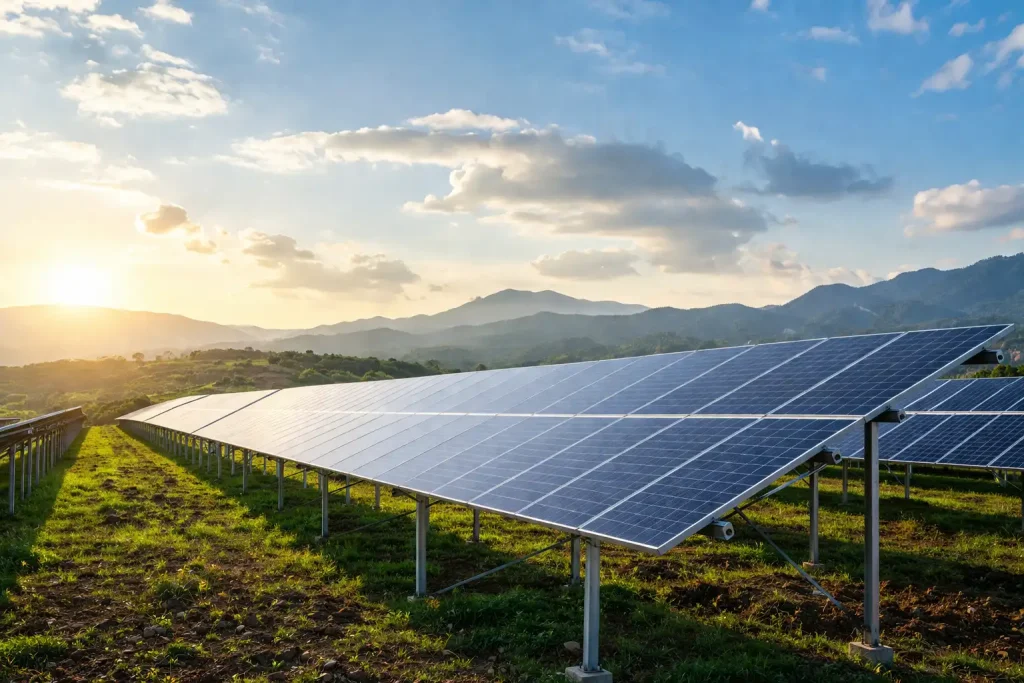
Fixed tilt is one of the most common solutions for ground mounted solar projects.
The structure is designed around a specific module orientation and tilt angle. This makes the system relatively straightforward and can simplify installation and maintenance.
For many commercial and utility scale projects, fixed tilt systems offer a practical balance between structural simplicity, energy production, installation efficiency, and overall cost.
The key is choosing a suitable configuration for the project location rather than simply using the same angle everywhere.
Different Module Layouts
The number of modules installed in each row can also affect the mounting structure.
For example, a project may use different module orientations or different numbers of modules per table depending on the available land and project design.
This can influence:
- Rail length
- Post spacing
- Structural member size
- Foundation position
- Wind loading
- Installation sequence
That is why the mounting system should be considered together with the module layout rather than as a separate component.
Ground Mount Systems for Different Project Sizes
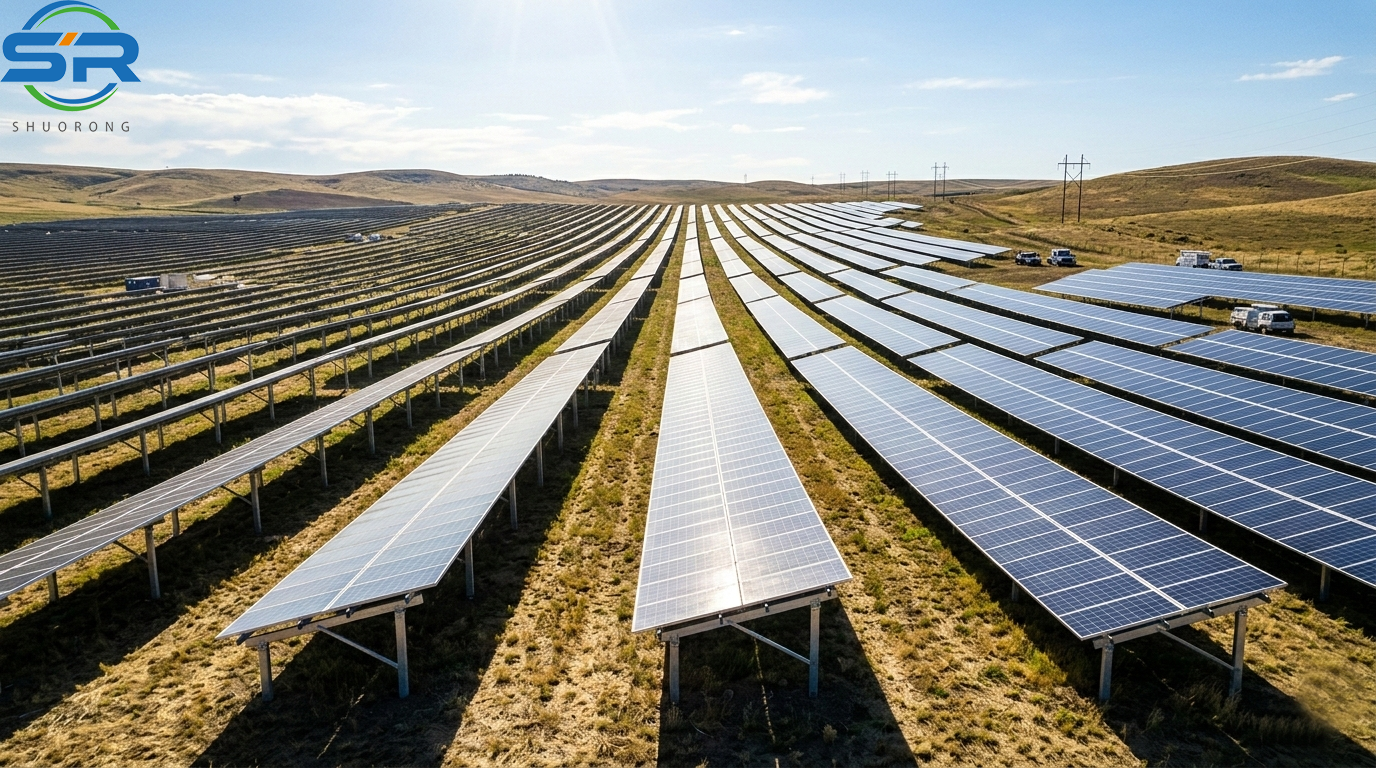
A small commercial ground mounted system and a large utility scale solar farm may use similar basic structural principles, but their priorities can be very different.
For smaller projects, installation flexibility and ease of adjustment may be more important.
For large projects, installation speed, material efficiency, logistics, and repeatability become much more important.
When thousands of modules are being installed, even a small improvement in installation time per module can have a meaningful effect on the total labor cost.
Choosing the Right Foundation for Ground Mount Solar Panel Racking Systems
The foundation is one of the parts of a ground mounted solar structure that deserves more attention than it usually gets.
Why?
Because the foundation connects the entire structure to the ground.
A strong steel or aluminum structure does not solve the problem if the foundation is not suitable for the actual soil conditions.
Ground Screw Foundations
Ground screws can be an efficient option when the soil conditions are suitable.
They can reduce the need for extensive excavation and concrete work, which can simplify installation and reduce site disturbance.
For projects where installation speed is important, ground screws can also offer advantages because the installation process can be relatively straightforward when the soil allows it.
However, ground screws are not automatically the best solution for every site.
The actual soil conditions need to be considered before making the decision.
Concrete Foundations
Concrete foundations remain an important option for many ground mounted solar projects.
They can be useful where ground conditions, structural requirements, or local construction practices make concrete a practical choice.
The tradeoff is that concrete foundations normally involve additional excavation, concrete work, curing time, and labor.
For some projects, that extra work is completely justified. For others, a different foundation approach may provide better installation efficiency.
The question is not whether ground screws or concrete is universally better.
The better question is which foundation method fits the actual project.
Driven Piles
Driven piles can also be used for suitable ground conditions and large scale projects.
They can provide an efficient installation process when the site and equipment are suitable.
However, equipment access, soil conditions, noise restrictions, and local construction requirements should all be considered.
This is another reason why foundation selection should happen during the engineering stage rather than after the mounting system has already been selected.
Aluminum, HDG Steel, or ZAM Steel Which Material Should You Choose
Material selection is another important part of choosing a ground mount solar panel racking system.
At SR Solar, common material options include Aluminum, HDG Steel, and ZAM Steel.
Each has its own characteristics, and the right choice depends on the project environment and structural requirements.
Aluminum
Aluminum is widely used in solar mounting systems because it is lightweight and naturally resistant to corrosion.
Its lower weight can make handling easier during installation, which can be useful for certain project types.
Aluminum can be particularly attractive when weight reduction and ease of handling are important.
However, lightweight does not automatically mean that aluminum is the best option for every ground mounted project.
The structural design, span, wind load, module arrangement, and connection design still need to be considered.
HDG Steel
HDG Steel means hot dip galvanized steel.
Steel provides high structural strength and is commonly used for posts and other load bearing components in ground mounted solar systems.
The hot dip galvanizing process provides corrosion protection, making HDG Steel suitable for many outdoor solar applications.
For larger structures or projects with significant structural loading, steel can be a practical choice because of its strength and structural characteristics.
However, the required galvanizing quality and material specification should be considered carefully, especially in areas with higher corrosion exposure.
ZAM Steel
ZAM Steel is different from a conventional galvanized steel coating approach.
ZAM is a metallic coated steel material based on zinc, aluminum, and magnesium. In other words, ZAM Steel refers to the material itself and should not simply be described as a coating applied to ordinary steel.
This distinction matters when discussing material selection.
ZAM Steel offers strong corrosion resistance and can be an attractive option for outdoor solar mounting structures, particularly where long term durability is an important consideration.
For solar projects exposed to humidity, coastal environments, or other challenging conditions, ZAM Steel can be considered as part of the material selection process.
The best material is still determined by the complete project environment and structural design.
Consider Corrosion Before Choosing the Material
Solar mounting structures can remain outdoors for decades.
That means corrosion should not be treated as a small detail.
A project near the coast may face salt exposure.
A project in a humid region may experience long periods of moisture.
An agricultural solar project may have different environmental conditions from a dry utility scale site.
These differences matter.
When comparing Aluminum, HDG Steel, and ZAM Steel, the question should not simply be which material is strongest or which one costs less.
Instead, consider:
- Local climate
- Humidity
- Salt exposure
- Expected service life
- Structural requirements
- Material availability
- Transportation
- Installation method
- Long term maintenance
A slightly higher material cost can sometimes make sense if it reduces long term maintenance requirements or improves project reliability.
Installation Efficiency Matters More Than You May Think
When engineers compare mounting systems, the conversation often focuses on material cost.
But EPCs know that material cost is only part of the project cost.
Installation labor can become a major expense, especially on large projects.
Imagine a mounting structure that saves a small amount of material but requires significantly more time to assemble. On a small project, the difference may not be very noticeable.
On a large solar farm, it can become a major issue.
This is why we recommend looking at the complete installation process.
How many components need to be assembled?
How easy is the connection?
Can the structure be installed with commonly available equipment?
Can installers quickly understand the assembly sequence?
Can the same installation method be repeated across thousands of modules?
These questions are just as important as the material specification.
A good solar panel racking system ground mount solution should work well on paper and on the actual construction site.
Do Not Forget Logistics and Packaging
For large projects, mounting components can involve significant transportation volume.
The structure should therefore be considered from both an engineering and logistics perspective.
Components that can be efficiently bundled and packed may help reduce transportation space and simplify unloading.
Standardized components can also make inventory management easier for distributors and installation teams.
For EPCs, this can reduce unnecessary handling on site.
For distributors, a system with a reasonable number of standardized components can make inventory planning much easier.
The best design is not necessarily the one with the fewest individual components.
It is the one that balances structural performance, installation efficiency, logistics, and project requirements.
A Common EPC Error Is Choosing the System Too Early
A common EPC error is treating the mounting structure as a standard product before the project conditions have been fully reviewed.
For example, an EPC may know the module dimensions and project capacity and immediately ask for a standard ground mount structure.
But what about the soil?
What about wind?
What about terrain?
What about the foundation?
What about the distance between rows?
What about the local corrosion environment?
Without this information, it is difficult to determine whether a standard configuration is actually appropriate.
This does not mean every project needs a complicated custom structure.
Quite the opposite.
Good engineering should aim to use standardized solutions whenever possible and customize only where the project actually requires it.
That approach can help control both engineering complexity and manufacturing cost.
What If You Are Not Sure Which Ground Mount System to Choose
This is where working with an experienced engineering team can save a lot of time.
If you are not sure whether your project should use Aluminum, HDG Steel, or ZAM Steel, or whether you should consider ground screws, concrete foundations, or another foundation method, you do not need to make the decision based only on a product catalog.
At SR Solar, our engineering team can review your project requirements and recommend a suitable ground mount solar panel racking system based on the actual application.
If a geotechnical or soil investigation report is available, it can also be used as an important reference during the engineering process.
The team can consider factors such as:
- Project location
- Solar module specifications
- Project capacity
- Wind conditions
- Soil conditions
- Foundation requirements
- Terrain
- Material selection
- Installation method
- Project specific requirements
This is especially useful for EPCs that are working on projects in different countries.
You know your project.
We focus on the mounting structure.
The goal is to bring the two together and develop a solution that makes sense both structurally and commercially.
Summary
Choosing ground mount solar panel racking systems should not start with the question of which product is cheapest.
It should start with the project.
Understand the soil conditions.
Check the wind environment.
Review the terrain and module layout.
Select a foundation method that fits the site.
Then consider whether Aluminum, HDG Steel, or ZAM Steel is the most appropriate material.
Finally, look at installation efficiency, logistics, and long term durability.
A well designed solar mounting system should not only support the modules. It should also help the project team install faster, manage risk, and control the total cost of the project.
If you already have your project specifications or a geotechnical report but are not sure which ground mount solution is appropriate, SR Solar can have its engineering team review the requirements and provide a recommendation based on the actual project conditions.
Frequently Asked Questions
What are ground mount solar panel racking systems?
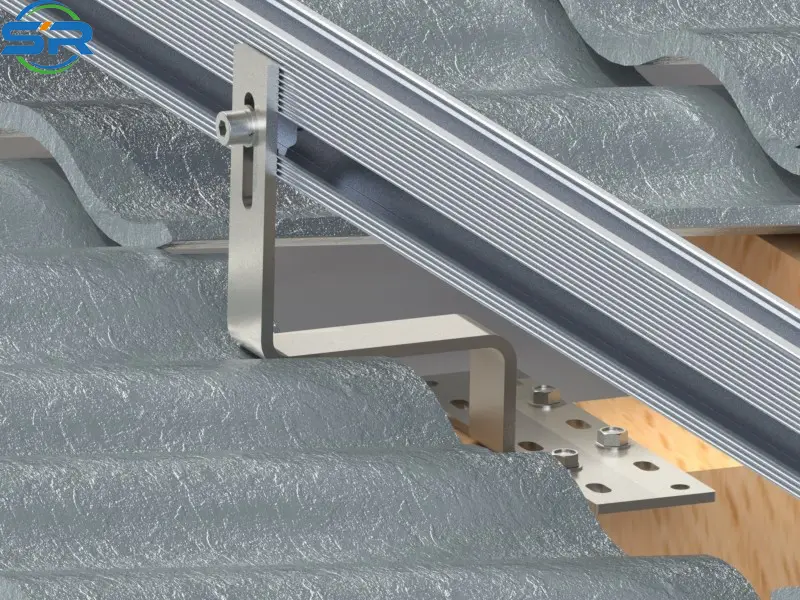
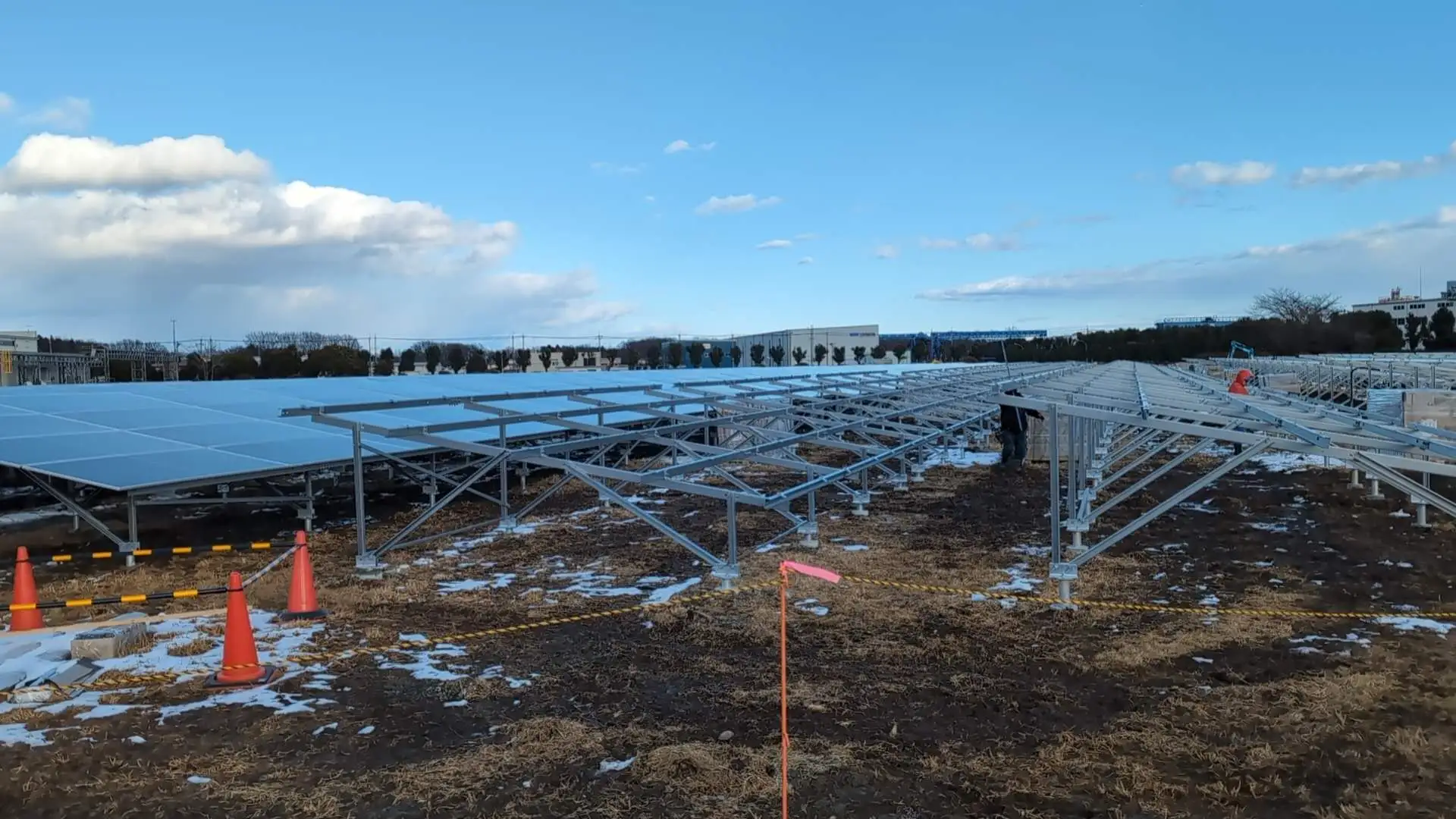
Ground mount solar panel racking systems are structures designed to install solar panels on the ground rather than directly on a building roof. They normally include posts, rails, brackets, clamps, foundations, and other structural components.
How do I choose a ground mount solar panel racking system?
Start with the project conditions rather than the product. Soil conditions, wind, terrain, module specifications, foundation requirements, corrosion environment, and installation method should all be considered before selecting the system.
Is Aluminum better than HDG Steel for ground mounted solar?
Not necessarily. Aluminum is lightweight and corrosion resistant, while HDG Steel provides high structural strength and is widely used for load bearing components. The better material depends on the project requirements.
What is the difference between HDG Steel and ZAM Steel?
HDG Steel is hot dip galvanized steel, while ZAM Steel is a zinc, aluminum, and magnesium coated steel material. ZAM Steel refers to the material itself and should not simply be described as a conventional coating applied to ordinary steel. The two materials can be selected based on structural requirements and environmental conditions.
Can SR Solar help choose the right ground mount system?
Yes. If you are not sure which system or material is suitable, SR Solar’s engineering team can review your project requirements. A geotechnical or soil investigation report can also be provided for reference, allowing the engineering team to make a more project specific recommendation.