Across Asia, engineering, procurement, and construction (EPC) companies face some of the most unforgiving geographic and geotechnical conditions on earth. From the steep, mountainous regions of Japan and the soft, waterlogged alluvial plains of Vietnam, to the highly corrosive coastal salt-spray of the Philippines and Indonesia, there is no such thing as a “one-size-fits-all” ground mounting system.
For an EPC, choosing the wrong structural topology or foundation type doesn’t just mean a minor delay in commercial operation date (COD)—it can lead to catastrophic structural failure, localized buckling, foundation pull-out, and a ruined levelized cost of energy (LCOE) over a 25-year lifecycle.
This technical guide analyzes how to match the right solar mounting system to Asia’s complex geological and topographical landscape, ensuring structural compliance, anti-corrosion longevity, and field-proven asset security.

1. Topographical Anatomy: Managing Variable Wind and Snow Loads in Asian Terrains
Asia’s topography is a study in extremes. Designing a solar racking layout on flat, continuous land is straightforward; however, much of Asia’s available land for solar deployment involves irregular plots, rolling hills, or complex mountainous slopes.
The Mountainous and Hilly Terrains of East and Southeast Asia
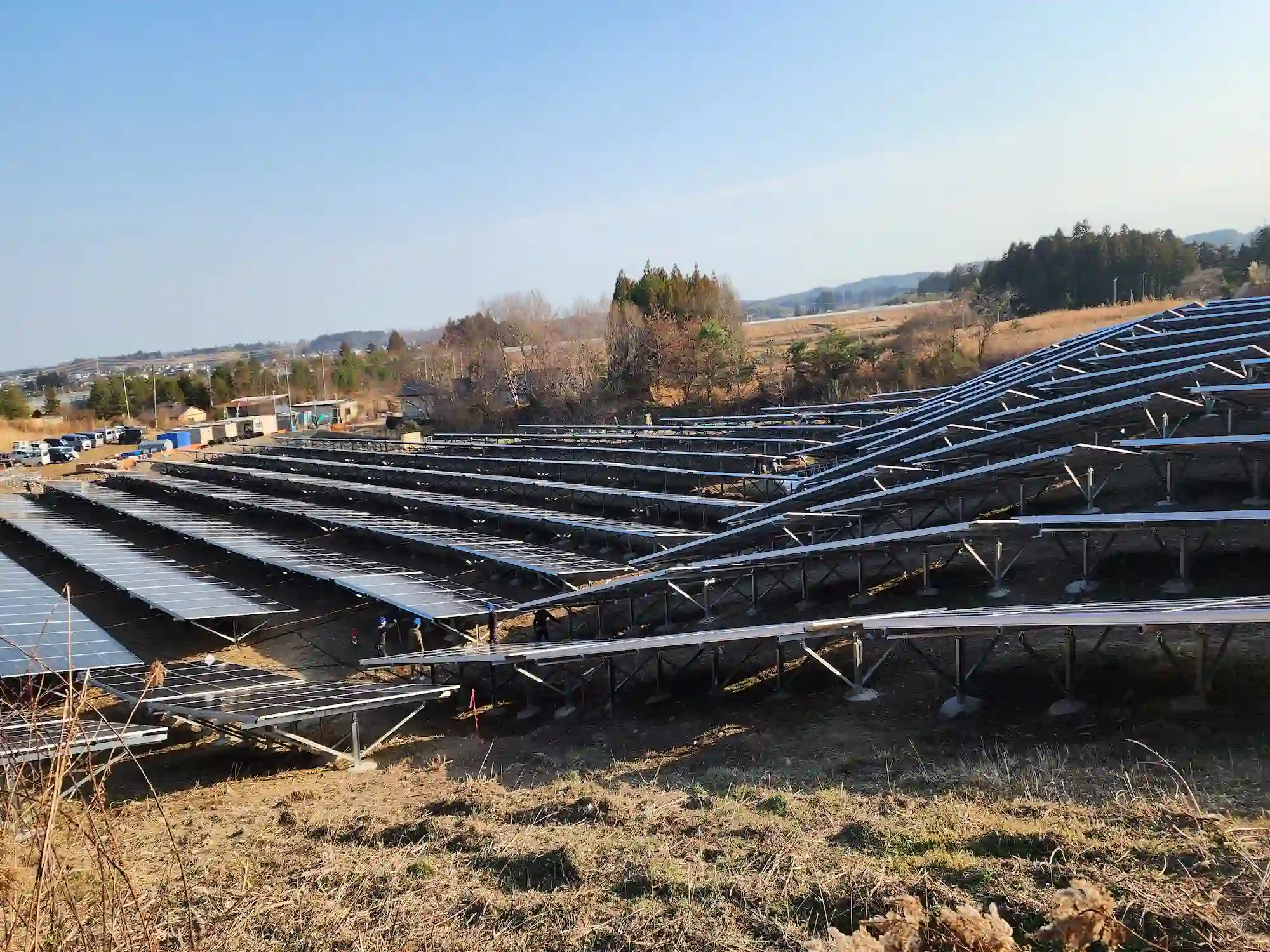
In regions like Japan, South Korea, and parts of Southern China, flat land is heavily restricted for agriculture or forestry. Solar developers are forced onto steep mountain slopes, often exceeding a 15-degree incline.
When wind flows over a mountain ridge, it accelerates drastically, creating severe localized wind shear and localized micro-climates. The windward slope experiences high positive pressures, while the leeward slope suffers from extreme turbulent wake and negative lift, or severe uplift forces.
A common EPC error is assuming uniform wind distribution across the entire site layout. If your racking system lacks structural freedom or independent row adjustments, the mismatch between the ground contour and the rigid frame introduces massive internal torsional stresses.
To mitigate this, EPCs must move away from long, continuous multi-row tables. Instead, short-table configurations, such as 2×10 or 2×20 portrait modules per table, with highly flexible, multi-directional joint adjustability are required. This allows the racking to follow the natural terrain contours without putting undue stress on the steel or aluminum profiles.
The Low-Lying Plains and Flood-Prone Basins
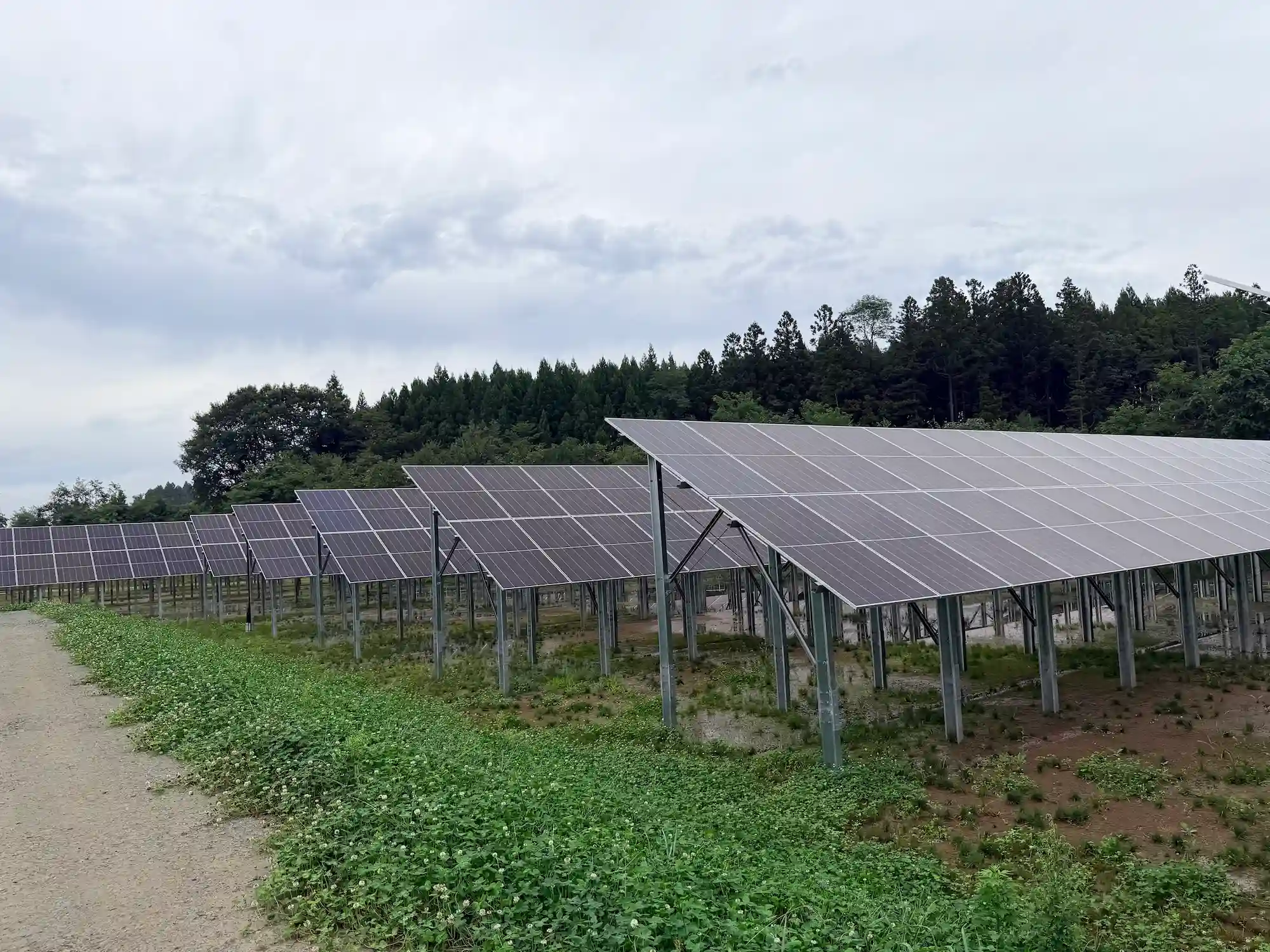
Conversely, Central Thailand, Bangladesh, and the Mekong Delta in Vietnam present completely flat but hyper-hydrological challenges. These basins experience severe seasonal flooding and high water tables during monsoon seasons.
In these environments, the critical parameter is the lowest clearance height, or ground clearance. Racking designs must elevate modules up to 1.5 to 2.5 meters above the highest recorded flood levels. This extended post length significantly increases the structural lever arm. As a result, the bending moment applied to the foundation pile during a high-wind event multiplies exponentially, demanding a substantial increase in steel pile thickness and embedment depth.
2. Geotechnical Matrix: Matching Foundation Types to Asian Soil Profiles
A structural frame is only as strong as the earth holding it. Relying on generic regional soil parameters without executing deep standard penetration tests (SPT) or comprehensive pull-out tests at the specific site is a recipe for foundation failure.
To help your engineering team make the correct baseline choice, we have summarized Asia’s primary soil profiles and their engineering foundations below:
Soil Foundation Selection Matrix
| Soil Classification | Dominant Regions in Asia | Primary Engineering Risk | Recommended Foundation Type | Key Structural Metric |
| Soft Alluvial / Expansive Clay | Mekong Delta, Central Thailand, Coastal Indonesia | High moisture swelling, settlement, zero lateral friction | PHC Concrete Piles or Deep-Driven C-Steel Piles | High embedment depth, high friction skin calculation |
| Loose Sand / Coastal Soils | Coastal Vietnam, Philippines, Indian Subcontinent | Liquefaction during earthquakes, poor pull-out resistance | Ground Screw (Spiral Piles) or Driven Flanged Piles | Wide screw blade diameter , maximized surface contact |
| Hard Rock / Weathered Granite | Mountainous Japan, South Korea, Inland India | Refusal of driven piles, high tool wear, micro-cracking | Concrete Block Foundation (Precast/Cast-in-situ) | Gravity-based stability, high deadweight or epoxy-grouted anchor bolts |
Engineering Deep-Dive: Driven Piles vs. Ground Screws in Soft Soils
In the soft clay and silt profiles common to Southeast Asian river valleys, the top 1 to 1.5 meters of soil often provides negligible lateral or axial support when saturated by seasonal monsoons. If a standard driven C-channel steel post is driven to a shallow depth, the risk of soil liquefaction or softening will cause the entire array to tilt or sink under the dead weight of the PV modules.
In our project experience, when engineering for soft alluvial soils, we utilize deep-driven steel C-piles with an embedment depth often exceeding 2.5 meters. By utilizing the skin friction of the deeper, denser soil layers, we ensure that the critical pull-out resistance meets a high safety factor under peak wind loads, preventing localized settlement.
In sandy or looser coastal soils, such as those found along the coastlines of Vietnam or the Indian subcontinent, standard driven piles can struggle with pull-out resistance due to low soil cohesion. Here, ground screws or spiral piles are significantly more effective. The continuous welded thread cuts into the sand grains, packing them tightly together and creating a localized bulb of compressed soil around the pile. This mechanism vastly enhances tension resistance against wind uplift.
3. The Micro-Climate Shield: Overcoming High-Corrosion and High-Wind Hazards
Asia holds the distinction of hosting some of the world’s most severe path-tracks for tropical cyclones, experiencing typhoons in the Western Pacific and intense cyclones in the Indian Ocean. Concurrently, its extensive coastlines represent a highly aggressive C4 to C5 corrosion environment.
Material Anti-Corrosion Performance Comparison
| Material & Coating | Corrosion Resistance Rating | Best Suited Environment | Key Engineering Constraint |
| Standard HDG Steel (Hot-Dip Galvanized) | Medium (C3-C4) | Inland utility plants, low humidity regions | Thick zinc layers needed; risk of peeling under high salinity. |
| Zinc-Aluminum-Magnesium (ZAM) Steel | High (C4-C5) | Coastal areas, high moisture and high-acid soils | Strict factory cutting required to maximize self-healing edges. |
| Anodized Aluminum (AL6005-T5) | Superior (C4-C5) | Coastal utility, rooftops, agricultural solar | Demands anodization film thickness 12mu\m for marine environments. |
The Marine Atmospheric Challenge (Salt-Spray and Humidity)
How long will your racking material last before red rust compromises its structural integrity? In countries like the Philippines, Malaysia, and the Maldives, solar plants are frequently built within hundreds of meters of the shoreline. The air is heavy with sodium chloride and humidity, accelerating the galvanic corrosion process.
For rooftop and medium-scale ground mounts, aluminum is highly resilient. However, standard commercial-grade anodization of 8 to 10 microns is entirely insufficient for Asian coastal environments. EPCs must demand an anodization thickness of 12 microns or greater to prevent pitting corrosion under high-salinity exposure.
For heavy-duty utility-scale ground structures, modern engineering favors Zinc-Aluminum-Magnesium (ZAM) steel coatings over traditional HDG. ZAM coatings provide a unique self-healing property. When the coating is scratched during transport or cut at the factory, the magnesium and aluminum form a dense, tightly adhering protective zinc-based film over the exposed cut edge, preventing localized rust propagation and eliminating the need for constant on-site paint touch-ups.
High Wind Engineering: Surviving Typhoon-Force Dynamics
In regions vulnerable to super typhoons, such as the Philippines’ Luzon region or Taiwan, design wind speeds in local building codes can reach up to 250 to 280 km/h. Are your static wind calculations sufficient for these forces? Under these extreme conditions, static calculations often fail because they ignore dynamic wind effects, such as vortex shedding and aeroelastic instability.
When wind hits a tilted solar table at high speeds, it sheds alternating vortices from the upper and lower edges. If the frequency of this vortex shedding matches the natural resonant frequency of the mounting structure, aerodynamic flutter occurs. This phenomenon can tear modules off their clamps or twist entire structures, even if the wind speed is below the ultimate static design limit.
To mitigate this risk, SR Solar’s structural engineering team applies a higher stiffness profile across all main beams and purlins, utilizing localized finite element modeling to ensure the natural frequency of the framework stays safely clear of expected aerodynamic vortex frequencies.
4. Structural Topology Selection: Fixed-Tilt vs. Tracking Systems on Fractured Land
When executing a large-scale project across fractured or undulating Asian topography, selecting the right structural layout can make or break the project’s bottom-line economics.
Fixed-Tilt Tripod Systems: The Workhorse of Rough Terrains
For steep slopes or lands split into irregular shapes by agricultural zoning, a Fixed-Tilt Tripod System or highly modular A-frame steel configuration offers the most stable structural performance.
A premium tripod configuration allows for significant independent vertical adjustment at each post connection interface. If a pile-driver encounters a subterranean boulder and stops short of its target depth, a flexible tripod bracket can absorb that height delta without requiring the pile to be extracted or re-driven. This structural flexibility provides the necessary adaptability to handle varying soil conditions and uneven ground.
Tracking Systems: The ROI Champions with High Terrain Costs
Single-axis trackers significantly boost energy yield in high-irradiance regions like Central India or Southern Vietnam. However, traditional single-axis trackers require long, continuous, perfectly straight rows with very tight terrain tolerances, typically under a 5-degree slope limit.
Forcing a traditional tracker onto an undulating terrain requires massive civil earthmoving and grading works, which can ruin both your budget and local environmental approvals. If tracking is mandatory for project ROI on uneven terrain, EPCs should specify independent, short-row trackers driven by multi-point decentralized drivetrains. These systems can handle north-south slope variances up to 10 degrees without putting excessive mechanical strain or binding risks on the central torque tubes.
5. Navigating Regulatory Standards Across Asian Borders
One of the steepest hurdles for international EPCs operating in Asia is navigating the highly fragmented regulatory framework. There is no unified building code across the continent.
In Japan, projects must strictly comply with JIS C 8955 (Load Guide for Photovoltaic Array Structures). The structural calculations require explicit consideration of both short-term wind gusts and long-term seismic activity, as well as complex ground roughness classifications.
Australia and Pacific-adjacent markets demand mandatory compliance with AS/NZS 1170.2, which requires severe internal pressure coefficient modeling. Meanwhile, Southeast Asia often uses a hybrid of local standards—like the National Structural Code of the Philippines (NSCP)—or falls back on Eurocodes and ASCE 7 guidelines.
A common EPC error is presenting a standard European calculation report to a local utility provider or governmental auditor in Japan or the Philippines. If the local wind terrain categories, wind recurrence intervals, and topography factors are not properly aligned with regional codes, your design will be rejected, resulting in costly retrofits or severe project delays.
At SR Solar, we bypass this friction by certifying our designs against specific regional load cases. Whether your project demands compliance with JIS C 8955 for heavy snow loads in Hokkaido or NSCP for typhoon-force wind loads in the Philippines, our engineering team provides stamped, fully audit-ready structural calculation books detailing exact stress, deflection, and unity-check metrics.
6. The Economic Reality: Pre-Assembly vs. On-Site Steel Logistics
In utility-scale solar engineering, procurement managers often chase the buzzword of universal pre-assembly to cut down field labor. However, experienced EPCs understand a fundamental material reality: true structural pre-assembly is strictly limited to lightweight aluminum components and small accessory clamp matrices. For heavy carbon steel structures, pre-assembly is a mechanical and financial impossibility.
Why Carbon Steel Racking Cannot Be Pre-Assembled
Carbon steel profiles used in large ground mounts are dense, rigid, and heavy. Pre-assembling an A-frame or tripod made of heavy steel in the factory creates massive, non-stackable three-dimensional volumes. Attempting to ship these assembled units would mean paying to transport empty air, skyrocketing logistics costs, and maximizing the risk of material damage during sea and land transport.
Furthermore, road vibrations during transit across rough Asian terrains apply high torsional stress to pre-assembled joints. For heavy steel, this results in localized deformation at bolt holes or micro-cracking of protective ZAM or hot-dip galvanized coatings before the rack even reaches the project site.
Aluminum profiles, on the other hand, can be manufactured with precision-engineered, integrated hinges and sliders via custom extrusion dies. This allows a complex aluminum tripod or matrix to fold completely flat for dense container shipping and be unfolded on-site in seconds. Steel, being roll-formed or welded, lacks this geometrical flexibility.
The Strategic Choice for EPCs
When engineering for Asia, the choice between steel and aluminum must be dictated by your labor versus material budget:
- The Aluminum Route: Best for medium-to-large projects, highly fractured terrains, and high-labor-cost regions. You maximize factory pre-assembly on components and accessories to achieve lightning-fast installation velocity.
- The Steel Route: Mandatory for ultra-large utility projects requiring maximum structural rigidity against Category 5 typhoons at a lower raw material cost. Here, you accept that the system will arrive as a flat-packed component matrix. Optimization is achieved not through pre-assembly, but through component reduction—minimizing unique bolt sizes, using self-aligning drop-in purlin connections, and ensuring zero on-site drilling or welding is required.
Request a Technical Consultation
Are you balancing tight LCOE targets with complex terrain challenges on an upcoming utility project in Asia? Contact SR Solar’s senior structural engineering department today to request a custom site analysis, localized wind-load assessment, and an optimized structural proposal tailored to your specific project needs.
Frequently Asked Questions
Q1: Why should I choose Zinc-Aluminum-Magnesium (ZAM) steel over Hot-Dip Galvanized (HDG) steel for large utility projects in Asia?
ZAM steel offers significantly better long-term corrosion resistance than HDG in high-humidity, high-salinity environments (C4 and C5 categories). It features a unique self-healing cut-edge protection that seals scratches and exposed metal edges with a dense zinc-magnesium protective film, preventing red rust propagation. Additionally, ZAM production delivers tighter manufacturing tolerances compared to traditional HDG dipping.
Q2: How does SR Solar handle wind design criteria for regions prone to super typhoons?
We design our structures using advanced finite element analysis based on the highest regional wind speeds, such as those specified in the NSCP or AS/NZS 1170.2. This ensures that the structural profiles, purlins, and connections maintain a safe structural margin against aerodynamic flutter under extreme wind loads.
Q3: Can a tracker system be deployed on a site with highly irregular terrain or variable slopes?
Yes, but it requires a decentralized, independent short-row tracker system. Traditional centralized trackers with a single long torque tube are susceptible to binding stresses on uneven ground. Independent rows with multi-point drive systems can adapt to north-south terrain slopes up to 10 degrees, avoiding the need for extensive and costly civil grading.
Q4: What is the typical depth requirement for driven piles in the soft alluvial soil found across Southeast Asia?
In soft clay or silt formations, the upper 1 to 1.5 meters of soil generally provides poor lateral support. Driven piles typically require an embedment depth of 2.5 meters or more to anchor firmly into deeper, more stable soil layers. The exact depth must be verified by on-site pull-out testing to confirm the required skin-friction and uplift resistance.
Q5: Can I order fully pre-assembled steel ground mounting systems to save on-site labor?
No. True factory pre-assembly is physically and economically restricted to lightweight aluminum profiles and specialized accessory components. Heavy carbon steel structures cannot be pre-assembled in the factory due to shipping volume constraints, excessive freight costs, and the high risk of structural deformation during transit. For steel systems, labor optimization is achieved by designing highly standardized, flat-packed component matrices with drop-in, self-aligning joints that require no on-site drilling or welding.