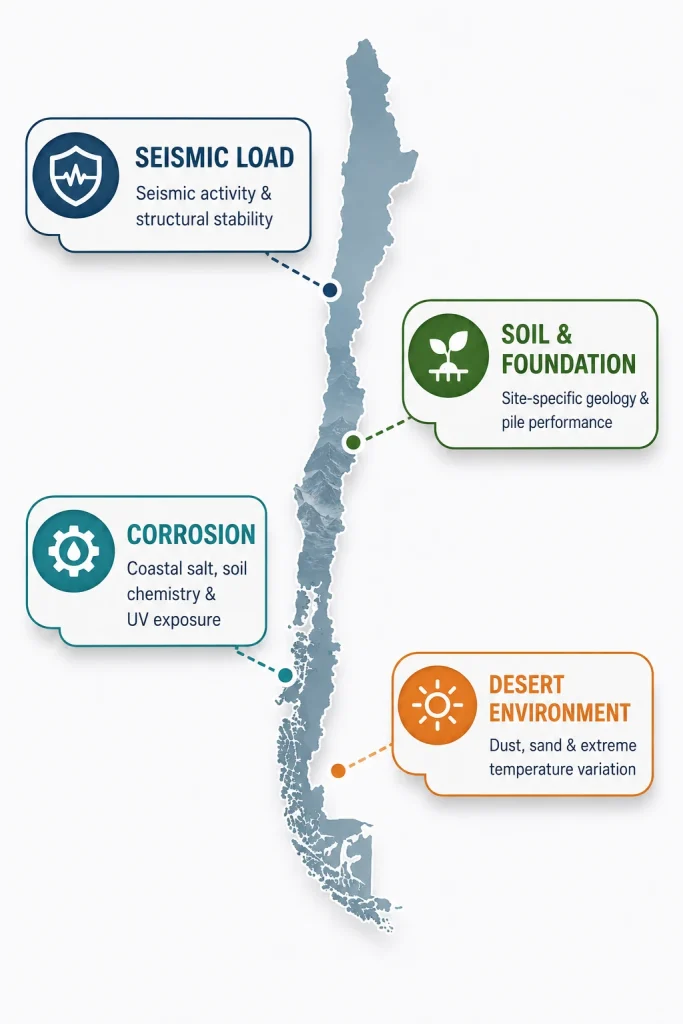
A solar mounting system Chile project cannot always rely on a standard mounting design. Chile offers excellent solar resources, but its project environments can vary significantly, from the dry conditions of the Atacama Desert to coastal areas, high-altitude sites and regions exposed to strong seismic activity. For EPC contractors, these differences directly affect structural design, foundation selection, material choice and installation efficiency.
A mounting system that performs well on one site may not be the right solution for another. Soil conditions can change within a relatively small project area. Wind and seismic loads can influence both the structure and foundation. Corrosion conditions can also vary depending on whether a project is located near the coast, in an arid region or in soil with aggressive chemical characteristics.
That is why a reliable solar mounting system in Chile should be engineered around the actual project conditions rather than selected as a one-size-fits-all product.
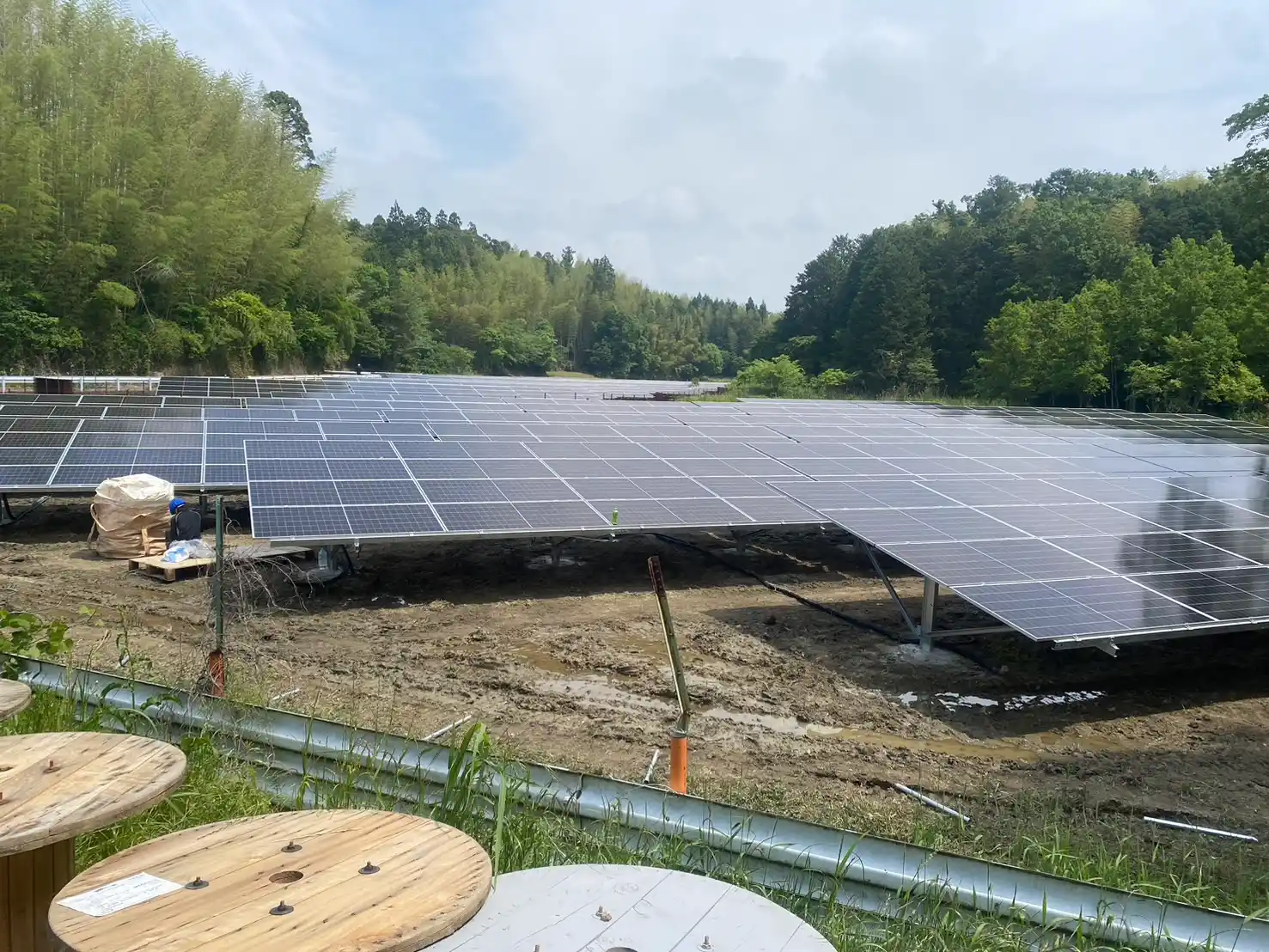
[Suggested image: Utility-scale ground-mounted solar project in the Chilean desert, showing the mounting structures and surrounding terrain]
Why Chile Requires Site-Specific Solar Mounting Design
Chile’s geography creates an unusual combination of engineering conditions for solar projects. A project in the Atacama region may face extremely dry conditions, high UV exposure, dust and challenging ground conditions, while a coastal project may have a completely different corrosion environment.
For EPCs, the important question is not simply whether a solar mounting structure is suitable for Chile.
The better question is:
Is the mounting system suitable for this particular site in Chile?
Chile Has Very Different Solar Project Environments
The main project conditions that can influence a solar mounting system include:
- Seismic activity and structural response
- Local wind conditions
- Soil type and geological profile
- Pile installation conditions
- Pull-out and lateral resistance
- Corrosion exposure
- UV radiation
- Temperature variations
- Project elevation
- Site accessibility and installation logistics
These factors are connected.
For example, soil conditions influence foundation selection, while foundation performance affects the overall structural response. Material selection depends partly on the environmental exposure, while the selected structure also needs to remain practical to transport and install.
This is why solar mounting structures Chile projects should be treated as an integrated engineering system rather than a collection of individual components.
Seismic Design for Solar Mounting Systems in Chile
Seismic conditions are one of the first engineering considerations for a solar mounting system Chile project.
Chile is located along the Pacific Ring of Fire and experiences significant seismic activity. For a utility-scale PV project, seismic design cannot be treated as a secondary consideration after the main structure has already been selected.
How Seismic Loads Affect Solar Mounting Structures
An earthquake does not simply place additional force on a solar panel.
The resulting structural response can involve the entire load path:
PV modules → rails → beams → posts → connections → foundation → soil
Every part of this system needs to work together.
Engineers may need to consider the effects of seismic loading on:
- Posts
- Beams and rails
- Bracing members
- Module clamps
- Bolted connections
- Foundation systems
- Soil and foundation interaction
A connection that looks adequate under normal operating conditions may require additional consideration when dynamic loading is introduced.
This is particularly important for large ground-mounted solar projects, where thousands of modules are connected to a common structural system.
Foundation Stability Matters as Much as Structural Strength
A common mistake is to focus heavily on the steel structure while treating the foundation as a separate issue.
But what happens if the foundation cannot provide sufficient resistance?
A stronger post does not automatically solve a weak soil condition.
For a seismic solar mounting system, engineers need to consider not only the strength of the steel members but also how the foundation transfers loads into the ground.
Depending on the site, this may involve evaluating:
- Embedment depth
- Soil resistance
- Vertical loading
- Uplift loading
- Lateral loading
- Foundation stiffness
- Pile-soil interaction
The appropriate design should therefore be based on the project’s structural requirements and geotechnical information rather than simply using a standard foundation depth.
[Suggested image: Close-up of ground-mounted solar posts, bracing and foundation connections at a utility-scale project]
Soil and Geological Conditions for Solar Foundations in Chile
For many EPCs, the soil report is one of the most important documents for selecting a ground-mounted solar system Chile solution.
Why?
Because the ground determines how the foundation can actually be installed and how it will perform after installation.
Different Soil Conditions Require Different Installation Strategies
Chilean solar projects can encounter a wide range of geological conditions, including:
- Sand
- Gravel
- Rock
- Caliche
- Cemented layers
- Mixed soil profiles
These conditions can have very different effects on pile installation.
A pile may be driven efficiently through one layer but encounter significant resistance when it reaches a cemented or rocky layer. In another location, the challenge may not be installation itself but achieving the required pull-out or lateral resistance.
This is why solar mounting soil conditions need to be considered before finalizing the foundation solution.
Pull-Out Capacity Is a Key Design Consideration
One important distinction for EPCs is the difference between installability and structural performance.
A pile being successfully installed does not automatically mean that the foundation is suitable for the final project loads.
The engineering assessment may need to consider:
- Vertical compression
- Uplift
- Lateral resistance
- Soil friction
- Soil bearing characteristics
- Embedment
- Installation method
For driven-pile systems, field testing can also provide valuable information about actual site conditions.
In our project experience, the most useful foundation decisions often come from combining the geotechnical report with practical installation feedback from the site.
This approach can prevent a situation where the theoretical design looks acceptable but installation productivity becomes a major problem during construction.
Corrosion Protection for Solar Mounting Systems in Chile
Corrosion is another factor that should not be treated as a simple material checklist.
The right choice depends on the actual exposure environment.
A coastal project, for example, may face chloride exposure, while an inland project may have different soil chemistry and atmospheric conditions. Even in dry environments, corrosion risks can still exist at specific interfaces and connections.
Coastal and Chloride-Rich Environments
For solar mounting structures near the coast, airborne salt and chlorides can increase corrosion risk.
Engineers should consider:
- Atmospheric exposure
- Soil chemistry
- Chloride levels
- Drainage conditions
- Connection details
- Material compatibility
- Expected design life
The objective is not simply to choose the material with the highest nominal corrosion resistance.
It is to select a material and protection strategy that provide the required durability without creating unnecessary cost.
ZAM, HDG Steel and Aluminum: How Should EPCs Choose?
For solar mounting structures, materials such as ZAM, hot-dip galvanized steel and aluminum can each have a place depending on the project.
| Material | Key Characteristics | EPC Consideration |
|---|---|---|
| ZAM | Zinc, aluminum and magnesium alloy steel material with strong corrosion resistance | Suitable where corrosion resistance and structural performance need to be balanced |
| HDG steel | Steel protected by a hot-dip galvanized zinc coating | Mature solution with coating requirements that should match the environment |
| Aluminum | Lightweight and corrosion resistant | Useful where weight reduction and corrosion resistance are important |
| Stainless steel | High corrosion resistance | Generally more suitable for selected components where its performance justifies the higher cost |
The important point is that ZAM is a material, not simply a coating applied to conventional steel.
Material selection should consider the complete system, including structural requirements, environmental exposure, connections, manufacturing processes and project economics.
For an EPC, the cheapest material on a unit-price basis is not necessarily the lowest-cost solution after installation and long-term operation are considered.
High-Altitude and Desert Conditions
Chile’s solar potential is closely associated with environments that can be demanding for equipment and construction teams.
The Atacama Desert is a good example.
Atacama Desert Is Not Just a Hot and Dry Environment
The desert environment can introduce several considerations for a solar mounting system, including:
- High solar radiation
- UV exposure
- Dust
- Large temperature variations
- Difficult soil conditions
- Remote project locations
- Construction and maintenance logistics
Dust itself may not determine the structural design, but the overall environment can influence component durability, site maintenance and installation conditions.
Temperature variation also deserves attention.
A structure installed in a location with significant day-to-night temperature differences will experience repeated thermal expansion and contraction. Connections and material interfaces should therefore be designed appropriately for the expected service environment.
High Altitude Can Change Project Requirements
High-altitude solar projects introduce another layer of complexity.
The engineering team may need to consider:
- Local wind exposure
- UV radiation
- Temperature
- Transportation
- Construction access
- Installation equipment
- Worker productivity
The logistics side is easy to underestimate.
A mounting component that is simple to install at a well-connected site may become much more expensive when equipment, materials and labor need to be transported to a remote high-altitude location.
For EPCs, structural efficiency and installation efficiency should therefore be considered together.
How EPCs Should Select a Solar Mounting System in Chile
Choosing a solar mounting system Chile solution should start with the project site, not with a product catalogue.
A practical engineering process can be divided into several steps.
Start With the Site Investigation
Before finalizing the mounting structure, collect the key project information:
- Project location
- Site elevation
- Wind conditions
- Seismic requirements
- Geotechnical report
- Soil profile
- Corrosion environment
- Module specifications
- Array configuration
- Required design life
The more complete the information, the fewer assumptions the engineering team needs to make.
Match the Foundation to the Soil
Do not begin with:
“We always use driven piles.”
Start with:
“Which foundation solution is appropriate for this ground condition?”
Depending on the project, the solution may involve driven piles, ground screws, concrete foundations or other approaches.
The correct choice depends on the soil, loads, installation equipment, construction schedule and project economics.
Select Materials Based on Exposure
The same logic applies to materials.
A coastal environment, desert environment and aggressive soil environment do not necessarily require the same material strategy.
The engineering team should consider:
Environment → Material → Connection → Expected service life
rather than simply selecting a material based on its catalogue specification.
Consider Installation Efficiency
For EPCs, installation efficiency can have a direct impact on project cost.
A mounting system may have an attractive material price, but if it requires:
- More labor
- More drilling
- More specialized equipment
- More field adjustment
- More complicated connections
the final installed cost can be considerably higher.
This is why structural optimization should include the construction process.
Common EPC Mistakes When Choosing Solar Mounting Structures in Chile
Using the Same Foundation Design Everywhere
Chile has diverse geological conditions.
Applying the same foundation configuration across different sites without properly reviewing the soil conditions can create unnecessary installation and performance risks.
Focusing Only on Steel Strength
Structural strength is important, but it is only one part of the system.
Connections, foundations and soil interaction also affect the final structural performance.
Ignoring Environmental Exposure
A mounting system designed for a dry inland site should not automatically be assumed to have the same corrosion requirements as a coastal project.
The environment should be part of the initial material-selection process.
Treating Installation as an Afterthought
The design may work perfectly on paper but still be inefficient in the field.
Pile installation conditions, equipment access, component handling and connection methods should be considered during engineering.
Selecting a Supplier Based Only on Unit Price
This is perhaps the most common commercial mistake.
For an EPC, the actual cost is closer to:
Material + logistics + installation + equipment + maintenance + risk
A slightly higher material price may make economic sense if it significantly reduces installation time or long-term risk.
How SR Solar Approaches Solar Mounting Projects in Chile
At SR Solar, we approach solar mounting projects from the project conditions first.
The engineering process considers the relationship between:
Site Conditions → Structural Design → Foundation Selection → Material Selection → Manufacturing → Quality Control
Our engineering team can work with project information such as site location, soil conditions, module specifications, structural requirements and environmental exposure to develop a suitable mounting solution.
Depending on the project requirements, SR Solar works with materials including ZAM, aluminum, hot-dip galvanized steel and stainless steel, with material selection based on the application rather than a one-size-fits-all approach.
Our engineering work can also be aligned with applicable international standards, including JIS, AS/NZS, Eurocode and ASCE, depending on the project requirements and applicable regulations.
With in-house manufacturing and engineering capabilities, we can support customized mounting structures as well as OEM and ODM requirements.
For EPC contractors, this approach is particularly important when the project has unusual soil conditions, seismic requirements, challenging environments or specific installation constraints.
[Suggested image: SR Solar manufacturing facility or engineering team inspecting solar mounting components]
Final Takeaway: Design the Mounting System Around the Site
A solar mounting system Chile project should never be reduced to selecting a standard structure from a catalogue.
Chile’s seismic conditions, diverse geology, coastal environments, desert climate and high-altitude locations can all influence the engineering requirements.
The right solution is not necessarily the strongest or the cheapest mounting system.
It is the system that is properly engineered for the actual site conditions, practical to install and economically suitable for the project.
For EPC contractors, this means involving the mounting supplier early in the project and providing accurate site information before the final design is locked in.
Planning a ground-mounted solar project in Chile? Share your project location, soil conditions and basic requirements with the SR Solar engineering team to discuss a suitable mounting solution.
FAQs About Solar Mounting Systems in Chile
What type of solar mounting system is commonly used in Chile?
Ground-mounted solar mounting systems are widely applicable to utility-scale PV projects in Chile, but the appropriate foundation and structural configuration depend on the site conditions, soil, loads and installation requirements.
Does seismic activity affect solar mounting system design in Chile?
Yes. Seismic conditions can affect the structural members, connections, foundation design and soil-structure interaction. A project-specific seismic assessment should be incorporated into the structural design where required.
How does Chilean soil affect solar mounting foundations?
Soil conditions can influence pile installation, embedment, pull-out resistance and lateral resistance. Sand, gravel, caliche, rock and cemented layers may require different installation strategies.
What material is suitable for solar mounting systems in Chile?
There is no single material that is optimal for every Chilean project. ZAM, HDG steel, aluminum and stainless steel can each be appropriate depending on structural requirements, corrosion exposure, design life and project economics.
How should EPCs choose a solar mounting supplier for a Chile project?
EPCs should evaluate more than the component price. Engineering capability, foundation design, material selection, manufacturing quality, installation efficiency, customization capability and experience with project-specific requirements should all be considered.