What Is Agrivoltaics
What is agrivoltaics, and why is it becoming one of the fastest-growing trends in both renewable energy and modern agriculture? Simply put, agrivoltaics, also known as agri-pv, is the practice of using the same piece of land for both solar power generation and agricultural production. Instead of choosing between growing food and producing clean electricity, agrivoltaics farming allows both activities to take place together, helping landowners improve land productivity while supporting long-term sustainability.
Unlike conventional ground-mounted solar projects, agrivoltaics systems are specifically designed to maintain agricultural use beneath the solar panels. Crops can continue to grow, livestock can graze, and farming equipment can still operate while the photovoltaic system generates electricity above. This dual-use approach makes farmland more productive without changing its primary agricultural purpose.
As pressure on land resources continues to increase, governments, developers, and EPC contractors are paying closer attention to agrivoltaics as a practical solution. By combining renewable energy with food production, these systems help address land-use challenges while creating new economic opportunities for farmers, investors, and project owners. As a result, agrivoltaics has become one of the fastest-growing applications in commercial and utility-scale solar development worldwide.
In this guide, you’ll learn what is agrivoltaics, why more countries are adopting agri-pv, the main types of agrivoltaics mounting systems, why elevated structures are essential, why fixed mounting systems are increasingly preferred, and which applications are best suited for agrivoltaics farming. Whether you are an EPC contractor, project developer, distributor, or landowner, this guide will help you better understand the engineering considerations behind successful agrivoltaics projects.
Why Nations Worldwide Are Rapidly Adopting Agrivoltaics
The rapid growth of agrivoltaics is driven by far more than global renewable energy targets. Around the world, governments, developers, and agricultural stakeholders are looking for practical ways to increase clean energy capacity without sacrificing valuable farmland. By allowing electricity generation and agricultural production to take place on the same site, agri-pv offers a balanced solution that addresses both energy demand and food security.
Today, the adoption of agrivoltaics farming is accelerating for three key reasons.
Resolving Land Competition
One of the biggest challenges facing utility-scale solar development is land availability. In many regions, particularly across Europe, East Asia, and parts of North America, large ground-mounted solar projects often compete directly with agricultural land. As a result, developers may encounter stricter permitting requirements, environmental concerns, or resistance from local communities that want to preserve farmland.
Agrivoltaics provides a practical alternative by maintaining agricultural activities while generating renewable electricity. Instead of converting productive farmland into land used exclusively for power generation, agrivoltaics farming allows crops, livestock, and solar infrastructure to coexist. This dual-use approach not only improves land-use efficiency but also helps projects meet agricultural land-use policies in many markets.
For EPC contractors and project developers, this can simplify project planning, improve permitting opportunities, and increase the long-term value of the land.
Creating a Better Growing Environment for Crops
Beyond producing clean electricity, a well-designed agri-pv system can create a more stable growing environment for many agricultural applications. Elevated solar panels partially filter sunlight rather than completely blocking it, helping regulate field conditions throughout the day.
This improved microclimate offers several potential benefits:
- Reduced soil moisture loss. Partial shading lowers surface temperatures and slows water evaporation, helping crops retain moisture during hot weather.
- More stable temperatures. Solar panels reduce excessive heat during the hottest part of the day while also moderating temperature fluctuations.
- Additional protection from extreme weather. Depending on the project design, elevated photovoltaic structures can provide a degree of protection against intense sunlight, heavy rainfall, hail, and other environmental stresses.
Although the benefits vary depending on crop type, climate, and system design, these advantages make agrivoltaics an attractive solution for many modern agricultural projects.
Government Support and Long-Term Sustainability
Policy support is another major factor driving the rapid expansion of agrivoltaics worldwide. As countries pursue ambitious renewable energy and carbon reduction goals, many governments are encouraging projects that make more efficient use of available land.
Compared with conventional ground-mounted solar projects, agri-pv developments are often viewed more favorably because they continue to support agricultural production while generating clean electricity. In some markets, developers may benefit from dedicated incentive programs, streamlined permitting processes, or agricultural policies that encourage dual land use.
For investors and project owners, this combination of policy support, improved land utilization, and long-term energy production makes agrivoltaics farming an increasingly attractive investment. Rather than choosing between agriculture and renewable energy, landowners can create additional revenue opportunities while maintaining the productive value of their land.
The Two Primary Structural Types of Agrivoltaics Systems
Not all agrivoltaics projects require the same structural design. The ideal mounting system depends on several factors, including crop type, farming methods, machinery requirements, wind conditions, and the overall project layout. Selecting the right structure is essential not only for ensuring long-term structural safety, but also for maintaining efficient agricultural operations throughout the life of the project.
Based on practical engineering experience and different agricultural applications, SR Solar classifies agri-pv mounting systems into two primary structural types. Each solution is designed to balance solar power generation with agricultural productivity while meeting the specific operational needs of the site.
Ordinary Ground Mount Type with Elevated Clearance
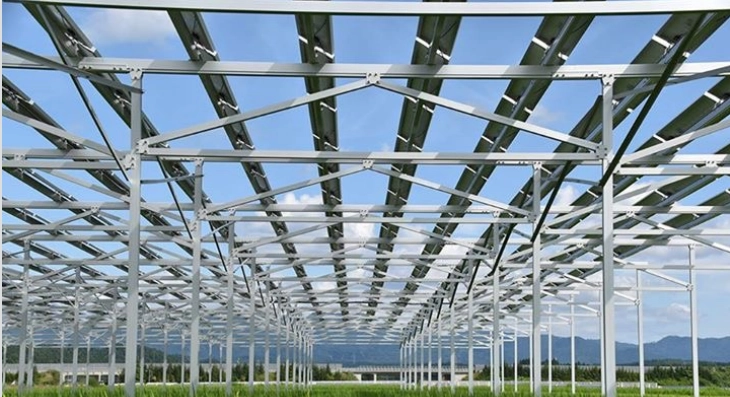
The Ordinary Ground Mount Type is developed from a conventional fixed-tilt ground-mounted solar structure. Rather than changing the overall structural layout, the system increases the height of the supporting posts to create sufficient clearance beneath the photovoltaic modules, allowing agricultural activities to continue below the array.
In most projects, the ground clearance is typically designed between 2.5 and 3.5 meters, depending on the type of crops, irrigation systems, and farming equipment used. This elevated design allows tractors, maintenance vehicles, and workers to move freely through the site while maintaining efficient solar energy production.
Because the supporting columns are significantly taller than those used in standard ground-mounted systems, they are subjected to greater wind loads and higher overturning moments. To maintain long-term structural stability, engineers often increase foundation embedment depth or adopt reinforced concrete foundations based on local soil conditions and site-specific load calculations.
This structural solution is particularly suitable for vegetables, berries, leafy crops, root crops, and livestock grazing such as sheep or poultry. Since it retains a structural layout similar to traditional ground-mounted systems, installation methods remain familiar for EPC contractors, helping reduce construction complexity and overall project costs.
Tripod-Type Agrivoltaics Structure
The Tripod-Type Agrivoltaics Structure is designed for agricultural environments that require significantly larger operating spaces. Unlike ordinary elevated ground-mounted systems, this design adopts a wide-span structural configuration similar to agricultural shade houses or greenhouse frameworks, creating a more open working area beneath the solar modules.
Its triangular support arrangement efficiently distributes structural loads while improving overall rigidity. By reducing the number of vertical columns within the cultivation area, the tripod configuration provides wider unobstructed spans, typically ranging from 5 to 9 meters, making it well suited for projects that rely on large agricultural machinery.
This design is commonly selected for vineyards, orchards, and large-scale commercial farms where tractors, harvesters, spraying equipment, and other mechanized farming operations require maximum clearance. The reduced number of support columns also lowers the risk of accidental impacts during routine agricultural work, helping improve operational efficiency over the lifetime of the project.
Although the tripod-type structure generally requires a greater initial investment due to its larger structural members and wider spans, it offers outstanding accessibility and long-term operational flexibility for modern mechanized farming.
Why Elevated Mounting Systems Are Essential for Agrivoltaics
Unlike conventional ground-mounted solar projects, agrivoltaics farming is designed to support two activities at the same time: generating renewable electricity and maintaining productive agricultural operations. To achieve this balance, simply installing solar panels on farmland is not enough. The mounting structure must provide sufficient space beneath the modules so that crops, livestock, farm workers, and agricultural machinery can continue operating safely and efficiently.
For this reason, elevated mounting systems are not an optional design feature—they are a fundamental requirement for successful agri-pv projects. The additional clearance improves farming operations while also contributing to the long-term performance of both the agricultural and photovoltaic systems.
Providing Clearance for Agricultural Machinery
Modern agriculture relies heavily on mechanized equipment, and the size of that equipment continues to increase. Tractors, harvesters, sprayers, and maintenance vehicles all require sufficient vertical and horizontal clearance to move safely beneath the solar array.
In many agrivoltaics projects, compact tractors typically require approximately 2.2 to 2.5 meters of clearance, while larger harvesting and spraying equipment may require 3.5 meters or more, depending on the type of machinery being used. Designing the mounting structure with adequate clearance helps prevent operational interruptions and allows normal farming activities to continue throughout the year.
Without adequate clearance, routine agricultural work becomes difficult or even impossible, significantly reducing the practical value of an agrivoltaics project.
Supporting Healthy Crop Growth
A common concern about agrivoltaics farming is whether solar panels reduce the amount of sunlight available for crops. In reality, a properly engineered elevated mounting system is designed to balance light availability with energy generation.
By increasing the distance between the photovoltaic modules and the crop canopy, sunlight can spread more evenly beneath the array rather than creating large areas of continuous shade. Combined with appropriate row spacing, this allows crops to receive a more balanced distribution of sunlight throughout the day while reducing excessive heat during peak afternoon hours.
For many shade-tolerant crops, this improved light environment can contribute to healthier growing conditions while helping maintain agricultural productivity.
Improving Airflow and Long-Term System Performance
Elevated mounting structures also improve natural air circulation across the entire site. Better airflow benefits both crop cultivation and photovoltaic performance.
Around the crops, improved ventilation helps reduce excessive humidity and lowers the risk of diseases associated with stagnant air. Around the solar modules, continuous airflow helps dissipate heat from the underside of the panels, allowing them to operate more efficiently under high-temperature conditions.
From an engineering perspective, proper ventilation also reduces long-term moisture accumulation around structural components, supporting the durability of the mounting system throughout its service life.
Creating a More Efficient Dual-Use Land System
Perhaps the greatest advantage of elevated mounting systems is that they allow agriculture and solar power generation to function together without compromising either activity.
Instead of treating farmland as land that must be converted for energy production, agrivoltaics transforms it into a dual-use asset capable of generating both agricultural output and renewable electricity. This integrated approach is one of the primary reasons why governments, developers, and landowners are increasingly investing in agri-pv projects around the world.
Why Fixed Mounting Systems Are Becoming the Preferred Choice for Agrivoltaics
In conventional utility-scale solar projects, single-axis tracking systems are often selected to maximize energy generation by following the movement of the sun throughout the day. However, the design priorities of agrivoltaics are fundamentally different.
An agri-pv project must balance photovoltaic performance with agricultural productivity, structural stability, equipment accessibility, and long-term maintenance. For this reason, fixed mounting systems have become the preferred solution for many modern agrivoltaics farming projects, particularly those designed for long-term agricultural use.
Greater Structural Stability for Elevated Systems
One of the biggest engineering challenges in agrivoltaics is the increased structural height. Compared with conventional ground-mounted solar installations, elevated mounting systems experience greater wind loads because the photovoltaic modules are positioned much higher above the ground.
While tracking systems introduce rotating components and continuously changing load conditions, fixed mounting structures maintain a stable geometry throughout their service life. This simplifies structural design and helps engineers better manage wind loads, foundation requirements, and long-term fatigue performance.
For projects located in regions with strong seasonal winds or complex environmental conditions, the additional rigidity of a fixed structure provides greater confidence in long-term structural reliability.
Better Compatibility with Agricultural Operations
Unlike traditional solar farms, agrivoltaics farming requires uninterrupted access for daily agricultural activities. Farmers need sufficient space to operate tractors, sprayers, harvesters, irrigation equipment, and other machinery without interference.
Tracking systems rely on moving components such as torque tubes, drive mechanisms, and motors that extend across the solar array. These components can reduce available operating space and increase the complexity of farming activities beneath the modules.
Fixed mounting systems provide a simpler and more open structural layout, allowing agricultural operations to continue with fewer physical obstructions. This improves site accessibility while reducing the risk of accidental contact between farm equipment and structural components.
Lower Maintenance Throughout the Project Lifecycle
Agricultural environments are often more demanding than standard solar installations. Dust, moisture, fertilizers, crop residue, and seasonal weather all place additional stress on mechanical equipment.
Because fixed mounting systems contain no motors, actuators, or moving drive assemblies, they generally require less routine maintenance than tracking systems. This simpler mechanical design also reduces the number of components that may require inspection or replacement during the operational life of the project.
For developers and investors evaluating long-term operating costs, reduced maintenance requirements can contribute to a more predictable total cost of ownership while improving overall system availability.
A Practical Choice for Large-Scale Agrivoltaics Projects
Although tracking systems may provide higher energy yields in certain utility-scale applications, maximizing energy production is only one objective in agri-pv projects.
Successful agrivoltaics developments must also support agricultural productivity, maintain safe working conditions, and ensure reliable structural performance over decades of operation. Fixed mounting systems provide a practical balance between energy generation, structural simplicity, operational efficiency, and long-term reliability.
As dual-use solar projects continue to expand worldwide, this balanced approach is one of the main reasons why fixed mounting systems are becoming the preferred choice for many commercial and utility-scale agrivoltaics developments.
Optimal Application Scenarios for Agrivoltaics Systems
Agrivoltaics systems are not designed with a one-size-fits-all approach. Different agricultural activities have different requirements for sunlight availability, operating space, equipment access, and structural layout.
The ideal Agri-PV solution depends not only on solar energy goals but also on how the land will continue to be used after installation.
By selecting the appropriate mounting structure based on agricultural conditions, project developers can achieve a better balance between renewable energy generation and farming productivity.
Vegetable and Low-Growth Crop Farming
Vegetable cultivation is one of the most common applications for agrivoltaics farming.
Crops such as leafy vegetables, herbs, berries, and other low-growing plants generally require regular sunlight exposure while benefiting from protection against excessive heat and water evaporation.
For these applications, elevated ground-mounted structures provide an effective solution by creating sufficient clearance beneath the solar modules while maintaining a relatively simple structural design.
Compared with conventional solar installations, elevated systems allow farmers to continue planting, irrigation, harvesting, and maintenance activities without major changes to existing farming practices.
The Ordinary Ground Mount Type with elevated clearance is often suitable for these applications because it provides:
- Sufficient working space for agricultural operations
- Familiar installation methods for EPC contractors
- Reliable structural performance
- A balanced investment cost
This makes it a practical choice for many crop-based agrivoltaics projects.
Vineyards and Orchards
Vineyards and orchards typically require a different structural approach because plants have longer growth cycles and often require larger operating spaces.
Agricultural activities such as pruning, harvesting, and spraying may involve larger equipment, making accessibility an important design consideration.
For these applications, wider-span agrivoltaics structures, such as tripod-type systems, can provide significant advantages.
By reducing the number of support columns within the cultivation area, tripod structures create a more open working environment and minimize interference with agricultural operations.
This configuration is particularly suitable for:
- Vineyards
- Fruit orchards
- Large-scale commercial farms
- Mechanized agricultural operations
The wider structural spans allow tractors and harvesting equipment to operate more efficiently while maintaining stable support for the photovoltaic modules.
Livestock Farming and Solar Grazing
Agrivoltaics is also increasingly applied in livestock farming, especially through solar grazing projects.
In these systems, animals such as sheep can continue grazing beneath solar panels while the photovoltaic system generates electricity above.
The elevated structure provides several benefits for livestock applications:
- Additional shade for animals during hot weather
- Improved land utilization
- Reduced vegetation management requirements
- Continued agricultural productivity
However, livestock projects require careful consideration of structural safety. The mounting system must provide adequate clearance while maintaining durability against environmental exposure and daily agricultural activities.
A properly designed fixed agrivoltaics structure can create a stable environment where both livestock management and solar energy production operate together.
Large-Scale Mechanized Farming
For commercial farms that rely heavily on tractors, harvesters, and automated equipment, structural accessibility becomes one of the most important design factors.
Large machinery requires sufficient vertical clearance and open working areas to avoid operational limitations.
In these projects, wider-span structures with customized designs may provide better long-term value compared with standard solar mounting systems.
The structure must consider:
- Equipment dimensions
- Farming routes
- Seasonal operation requirements
- Maintenance access
This is why engineering customization plays an important role in large-scale agrivoltaics development.
Matching the Right Structure with the Right Agricultural Application
A successful agrivoltaics project is not determined only by the amount of electricity generated. It must also support efficient agricultural production throughout the project lifecycle.
Different applications require different structural priorities:
| Agricultural Application | Recommended Structure Considerations |
|---|---|
| Vegetables and low crops | Elevated clearance with cost-effective fixed structures |
| Vineyards and orchards | Wider spans with fewer columns for machinery access |
| Livestock grazing | Durable elevated structures with sufficient animal clearance |
| Large mechanized farms | Customized structures designed around equipment operation |
By understanding the relationship between agricultural requirements and structural design, project developers can select an Agri-PV solution that delivers both energy and agricultural benefits.
For EPC contractors and solar developers, partnering with an experienced mounting manufacturer is essential to ensure that the final system is engineered around the real requirements of the project site.
Key Engineering Considerations for Long-Term Agrivoltaics Performance
Compared with conventional solar mounting systems, agrivoltaics projects face additional engineering challenges because the structure must support both photovoltaic generation and agricultural activities.
The increased height, wider spans, and unique operating environment require more detailed planning during the design stage. A successful Agri-PV system must not only support solar modules safely but also maintain structural reliability throughout decades of outdoor exposure.
For EPC contractors and project developers, evaluating engineering factors before construction is essential to ensure long-term project performance, reduce maintenance requirements, and protect the overall investment.
Structural Design Based on Site Conditions
Every agrivoltaics project has different environmental and agricultural requirements. The mounting structure must be designed according to the specific conditions of the installation site rather than using a standard solution for every application.
Key factors that influence structural design include:
- Local wind conditions
- Snow load requirements
- Soil characteristics
- Terrain conditions
- Agricultural equipment requirements
- Solar module layout
Because Agri-PV systems are usually installed with higher clearance than traditional ground-mounted systems, the structure experiences greater wind pressure and larger bending moments.
Professional structural analysis is therefore essential to determine appropriate post dimensions, foundation requirements, and connection designs.
A properly engineered structure ensures that the solar system remains stable while allowing agricultural operations to continue safely underneath.
Foundation Selection for Agrivoltaics Projects
The foundation is one of the most critical components of an agrivoltaics mounting system.
Unlike standard solar installations, Agri-PV structures often require taller support columns and larger structural loads. The foundation must provide sufficient stability while considering installation efficiency and site conditions.
Common foundation solutions include:
Ground Screw Foundations
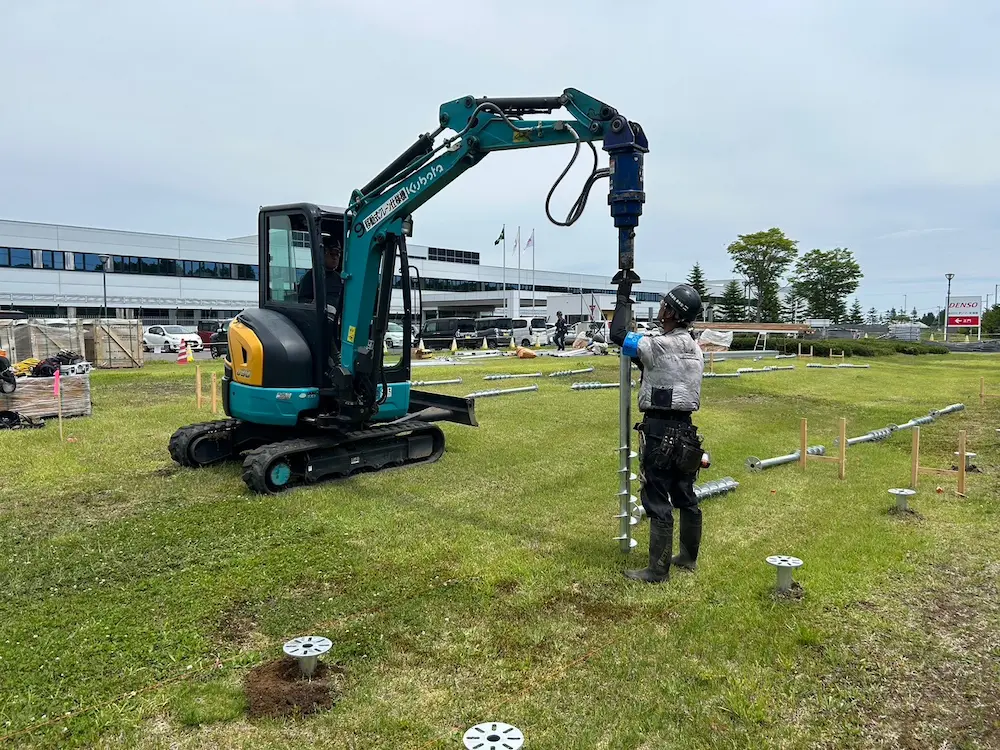
Ground screws are widely used in agrivoltaics projects where fast installation and minimal ground disturbance are important.
Their advantages include:
- Reduced construction time
- No large-scale excavation requirements
- Lower impact on agricultural soil
- Easier installation in suitable ground conditions
Because they minimize disturbance to the land, ground screws can be an attractive solution for agricultural environments where soil preservation is important.
Driven Pile Foundations
Driven pile foundations are commonly applied in large-scale Agri-PV projects where installation speed and structural strength are key considerations.
By directly installing steel piles into the ground, this method provides efficient construction while maintaining reliable structural support.
For large commercial projects with suitable soil conditions, driven piles can offer an effective balance between installation efficiency and long-term performance.
Concrete Foundations
Concrete foundations may be selected for projects where additional structural support is required or where soil conditions limit other foundation options.
Although they typically involve more construction work, concrete foundations can provide strong stability for specific project environments.
The final foundation selection should always be based on professional site evaluation and structural calculations.
Wind and Snow Load Considerations
Agrivoltaics systems are often installed in open agricultural areas where exposure to environmental conditions can be significant.
Compared with conventional low-profile solar systems, elevated structures experience stronger wind effects due to their increased height.
Therefore, engineers must carefully evaluate:
- Maximum wind speed
- Wind direction
- Snow accumulation
- Structural deflection
- Foundation loading
For projects located in areas with extreme weather conditions, accurate load calculations are essential to ensure long-term safety.
A well-designed mounting system should maintain structural integrity while minimizing unnecessary material usage, helping achieve an efficient balance between safety and cost.
Material Selection and Corrosion Protection
Agricultural environments can create additional challenges for solar mounting structures.
Exposure to:
- Moisture
- Fertilizers
- Agricultural chemicals
- Soil conditions
- Seasonal weather changes
can accelerate corrosion if unsuitable materials or protective treatments are used.
For long-term outdoor performance, high-quality materials and corrosion protection systems are essential.
Common solutions include:
Hot-Dip Galvanized Steel
Hot-dip galvanization provides a protective zinc coating that improves resistance against corrosion and extends structural service life.
ZAM-Coated Steel
ZAM coating, consisting of zinc, aluminum, and magnesium, provides enhanced corrosion resistance and is suitable for demanding outdoor environments.
Aluminum Alloy Components
Materials such as AL6005-T6 aluminum are often used for lightweight structural components where corrosion resistance and durability are required.
Stainless Steel Components
Stainless steel is commonly used for critical connection points where additional corrosion protection is necessary.
Selecting the right material combination helps reduce maintenance requirements and improves the long-term reliability of agrivoltaics systems.
Customized Engineering for Different Agri-PV Projects
No two agrivoltaics projects are exactly the same.
A system designed for vegetable farming may have completely different requirements from one designed for vineyards, orchards, or livestock applications.
Factors such as:
- Crop characteristics
- Equipment operation
- Climate conditions
- Land layout
- Project scale
all influence the final structural design.
This is why customized engineering plays an important role in successful Agri-PV development.
At SR Solar, we provide customized agrivoltaics mounting solutions based on project-specific requirements. From structural optimization and foundation selection to material recommendation and manufacturing, our engineering team helps EPC contractors and developers create reliable solar structures designed for long-term agricultural and energy production.
Why Choose an Experienced Agrivoltaics Mounting Manufacturer
The success of an agrivoltaics project depends on more than selecting high-quality solar modules. While photovoltaic panels generate electricity, the mounting structure determines how effectively the entire system can operate in real agricultural environments.
Compared with conventional solar projects, Agri-PV systems require a deeper understanding of both solar engineering and agricultural operations. The structure must support photovoltaic performance while also allowing farming activities to continue efficiently throughout the project lifecycle.
For this reason, choosing an experienced agrivoltaics mounting manufacturer is an important decision for EPC contractors, project developers, and investors.
Engineering Experience Beyond Standard Solar Mounting
Agrivoltaics projects involve more complex requirements than traditional ground-mounted solar systems.
Higher installation heights, wider structural spans, and agricultural accessibility requirements all require careful engineering consideration.
An experienced manufacturer should be able to provide support in areas such as:
- Structural design optimization
- Load calculation and analysis
- Foundation selection
- Site-specific customization
- Material selection
- Installation guidance
Rather than providing a standard mounting structure, professional suppliers work with project teams to develop solutions based on actual site conditions.
This approach helps ensure that the final system meets both energy generation goals and agricultural requirements.
Manufacturing Capability and Quality Control
For large-scale agrivoltaics projects, manufacturing capability is another important consideration.
A reliable mounting manufacturer should have the ability to control product quality throughout the entire production process, from raw material selection to final inspection.
Key manufacturing factors include:
- Stable material supply
- Precise fabrication processes
- Consistent welding quality
- Professional surface treatment
- Strict quality inspection procedures
These factors directly influence the durability and performance of solar mounting structures after installation.
For EPC contractors managing large projects, working with a manufacturer that has strong production capabilities can help reduce supply risks and ensure consistent delivery.
Customized Solutions for Different Project Requirements
Because every Agri-PV project has different agricultural and environmental conditions, customization is often necessary.
A professional mounting partner should be able to adapt solutions according to:
- Crop types
- Required clearance height
- Machinery access requirements
- Soil conditions
- Wind and snow loads
- Regional installation standards
For example, a vineyard project may require wider spans and fewer columns, while a vegetable farming project may prioritize cost efficiency and easier installation.
The ability to provide flexible engineering solutions allows developers to create systems that are optimized for each application.
Supporting EPC Contractors from Design to Installation
A successful solar project requires close cooperation between manufacturers, EPC contractors, and developers.
Beyond supplying components, an experienced mounting partner can provide technical support throughout different project stages, including:
- Preliminary design consultation
- Structural optimization
- Production coordination
- Installation support
- Technical documentation
This cooperation helps EPC companies improve project execution efficiency and reduce potential issues during construction.
SR Solar’s Approach to Agrivoltaics Solutions
With experience in solar mounting structure manufacturing, SR Solar provides customized Agri-PV solutions designed for different agricultural applications.
From elevated ground-mounted systems to wider-span agrivoltaics structures, SR Solar focuses on creating reliable solutions that balance:
- Structural safety
- Agricultural accessibility
- Long-term durability
- Installation efficiency
Through professional engineering support and manufacturing capabilities, SR Solar helps EPC contractors, developers, and project owners build solar systems that integrate renewable energy production with sustainable agriculture.
As agrivoltaics continues to expand globally, selecting the right mounting partner will become increasingly important for achieving reliable and economically viable projects.
Conclusion: The Future of Agrivoltaics and Agri-PV Development
Agrivoltaics represents a new approach to renewable energy development by combining solar power generation with agricultural production on the same piece of land.
Unlike traditional solar farms that focus mainly on electricity generation, agrivoltaics farming is designed to create a balance between clean energy production and continued agricultural activity. Through carefully engineered solar mounting systems, crops can continue growing, livestock can be managed, and farming operations can remain active while photovoltaic systems generate renewable electricity.
The success of an agrivoltaics project depends on more than simply installing solar panels above farmland. Structural design, mounting height, foundation selection, material durability, and agricultural requirements all play important roles in determining long-term performance.
For EPC contractors, developers, and investors, selecting the right Agri-PV structure and an experienced mounting partner is essential. A reliable solution must not only withstand environmental conditions but also support practical farming operations throughout the entire project lifecycle.
As countries continue to increase renewable energy deployment while protecting valuable agricultural resources, agrivoltaics will become an increasingly important part of the global solar industry.
By integrating solar technology with modern agriculture, Agri-PV demonstrates that renewable energy development and food production do not have to compete. Instead, they can work together to create a more sustainable and efficient future.
At SR Solar, we provide customized agrivoltaics mounting solutions designed for different agricultural applications, helping global partners develop reliable solar projects that combine energy generation with productive land use.
FAQ
Agrivoltaics is the practice of combining solar photovoltaic power generation with agricultural activities on the same piece of land.
Also known as agri-pv, agrivoltaics allows crops, livestock, or other farming operations to continue while solar panels generate renewable electricity above or around the agricultural area.
Unlike traditional solar farms, agrivoltaics systems are designed specifically to maintain agricultural productivity while producing clean energy.
The main difference is how the land is used.
A traditional solar farm is primarily designed for electricity generation, with the land mainly dedicated to photovoltaic installation.
Agrivoltaics uses a dual-use approach, allowing solar panels and agricultural activities to coexist on the same site. Crops can grow beneath the modules, livestock can graze around the system, and farmers can continue normal agricultural operations.
The suitability of crops depends on local climate conditions, sunlight requirements, and system design.
Common applications include:
Vegetables
Leafy crops
Berries
Herbs
Specialty agricultural products
Some crops may benefit from partial shading because it can reduce heat stress and moisture loss. However, the solar structure must be designed according to the specific requirements of each crop.
Elevated mounting systems are used because agricultural activities require sufficient space beneath the solar modules.
Higher clearance allows:
Tractors and farming equipment to operate
Workers to access the cultivation area
Livestock to move safely
Better airflow and sunlight distribution
Without adequate clearance, solar installations may interfere with farming operations and reduce the effectiveness of a dual-use solar system.
Fixed mounting systems are widely used in agrivoltaics because they provide a strong balance between structural reliability, operational simplicity, and long-term maintenance performance.
Compared with tracking systems, fixed structures have fewer mechanical components, making them easier to maintain and more compatible with agricultural environments where reliability and accessibility are important.
The service life of an agrivoltaics mounting system depends on material quality, environmental conditions, and maintenance practices.
High-quality solar mounting structures using appropriate corrosion protection and engineering design are typically developed for long-term outdoor operation and can support the expected lifespan of modern solar projects.
Yes. Agrivoltaics systems can be designed for different environmental conditions, including regions with strong winds, heavy snow, or extreme temperatures.
However, the mounting structure must be engineered according to local requirements, including:
Wind speed
Snow load
Soil conditions
Terrain characteristics
Professional structural analysis and suitable material selection are essential for ensuring long-term safety and reliability.
The ideal structure depends on the agricultural application and project requirements.
For example:
Elevated fixed structures are commonly used for vegetables and general crop farming.
Wider-span structures are suitable for vineyards, orchards, and large mechanized farms.
Customized designs may be required for projects with unique agricultural conditions.
A professional solar mounting manufacturer can help select and optimize the right solution based on the specific site requirements.