If you are managing a large-scale commercial solar rollout, you already know that the roof is the most unpredictable part of the job. You aren’t just looking for “parts”; you are looking for an engineering insurance policy. When we talk about Solar Tile Roof Hook Engineering, we aren’t just discussing pieces of metal—we are talking about the structural interface that determines whether a multi-million dollar asset stays put during a hurricane or becomes a liability. At SR Solar, we’ve seen how the right engineering choices in material standards and load-bearing design can drastically shift the ROI of a B2B project.
The High Stakes of Commercial Tile Roof Solar Engineering
In the world of B2B solar, “good enough” usually isn’t. When you’re installing thousands of modules across a sprawling commercial complex, the mechanical stress on each individual tile hook is immense. Think about the thermal expansion, the constant vibration from the wind, and the sheer weight of the glass. If a single hook fails or a tile cracks under pressure, the resulting water damage can lead to litigation that wipes out years of energy savings.
Why “Standard” Isn’t Enough for B2B Solar Infrastructure
Most residential-grade hooks are designed for “ideal” conditions, but commercial EPCs (Engineering, Procurement, and Construction) work in the real world. You might be dealing with 30-year-old rafters, uneven tile spacing, or local codes that require much higher safety factors than a standard home. This is where Solar Tile Roof Hook Engineering moves from simple manufacturing into the realm of structural science. We focus on exceeding standards like JIS C 8955 and AS/NZS 1170.2 because your reputation—and ours—depends on it.
Material Science: The SUS304 and AL6005-T5 Power Duo
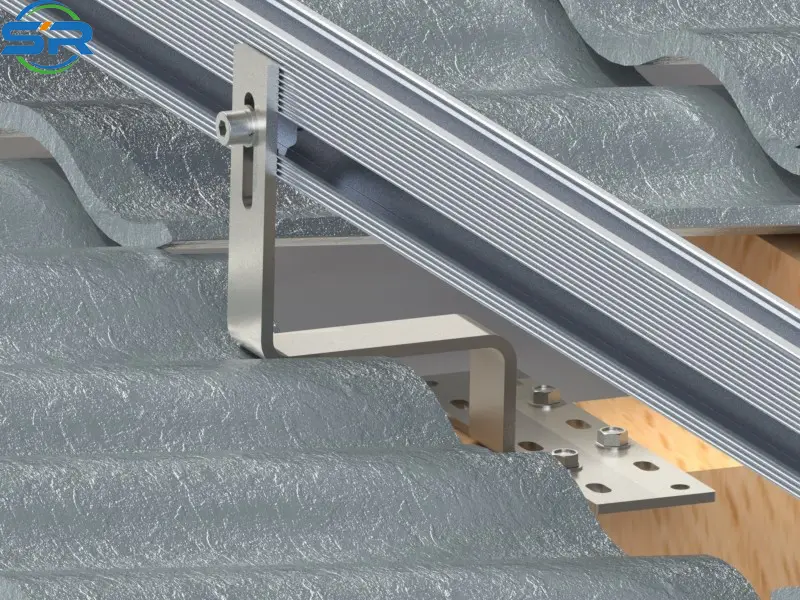
Why do we use specific materials for different parts of the rack? It’s all about synergy. We use SUS304 stainless steel for the hooks because of its incredible tensile strength and AL6005-T5 aluminum for the rails because it’s lightweight and stiff. This combination ensures that the entire system is “over-engineered” for safety but “lean-engineered” for weight.
SUS304 Stainless Steel: Beyond Basic Rust Protection
Not all stainless steel is created equal. Our SUS304 hooks undergo a specialized shot-blasting or sandblasting process. Why does this matter to you? It’s not just for looks. This treatment increases the surface density, making the metal even more resistant to the salt-mist found in coastal regions or the corrosive industrial smog often found near commercial warehouses. When you’re promising a 25-year service life to a client, these are the details that prevent “tea staining” and structural fatigue.
AL6005-T5 Aluminum: Managing Dead Load Without Sacrificing Strength
If you’ve ever had to reinforce an old roof just to support a solar array, you know how expensive “dead load” can be. By using anodized AL6005-T5 aluminum for our rails, we provide a structural grade solution that doesn’t add unnecessary tonnage to the building. It’s stiff enough to prevent sagging between spans but light enough to keep the structural engineers happy. It’s the perfect balance for high-density commercial layouts.
Engineering for the Extremes: Wind and Snow Load Dynamics
Weather is becoming more violent—that’s just the reality of 2026. We don’t design for a “sunny day”; we design for the worst-case scenario. Our Solar Tile Roof Hook Engineering focuses heavily on how the system reacts when nature gets angry. Have you ever stood on a commercial roof during a 50m/s gust? The uplift forces are terrifying.
Taming the Gale: Achieving 60m/s Wind Resilience
Our hooks are engineered to withstand wind speeds of up to 60m/s. We achieve this through reinforced base plates and specific geometry that minimizes the “lever arm” effect. By keeping the profile as low as possible while maintaining tile clearance, we reduce the torque applied to the rafters. This means even in high-velocity wind zones, the array stays exactly where you put it.
Heavy Snow Management: Protecting the Structural Integrity of Tiles
Snow is heavy, but the real danger isn’t the snow itself—it’s the way that weight is transferred. A poorly designed hook will flex and press down on the tile below it, causing a “hidden” crack. You won’t see it until the first spring rain starts leaking into the building’s insulation. SR Solar hooks are designed with a structural arc that transfers up to 1.4 kN/m² of snow load directly to the rafters, bypassing the fragile tiles entirely. It’s like a bridge for your solar panels.
Maximizing ROI: Reducing Soft Costs Through Intelligent Design
In a commercial project, labor is often your biggest “soft cost” headache. If your crew is spending five extra minutes on every hook because they have to fiddle with loose nuts and bolts, you’re losing money. We’ve designed our hardware to be “installer-friendly” because we know time is literally currency on a job site.
Pre-Assembled Efficiency: Shaving 30% Off Installation Labor
Our hooks arrive at the site pre-assembled with T-bolts and sliding nuts. It sounds like a small detail until you’re on a roof with 2,000 hooks to install. No more dropping small parts into the gutters or fumbling with wrenches in the cold. This “plug-and-play” approach can reduce your on-site assembly time by up to 30%, allowing you to hit those aggressive EPC deadlines and move on to the next project.
The No-Drill Philosophy: Preserving Roof Warranty and Integrity
The fastest way to void a commercial roof warranty is to start cutting or drilling into the tiles. Our hooks are designed to slide into the existing tile overlap. No on-site modification means no debris, no cracked tiles, and—most importantly—no leaks. We preserve the original “water-shedding” capability of the roof, which is a massive selling point when you’re talking to building owners who are nervous about their roof’s longevity.
Solving Complex Geometries with Adjustable Engineering
No commercial roof is perfectly flat. Tiles vary, rafters are occasionally warped, and the building might have settled over decades. A “fixed” hook is a nightmare in these conditions. That’s why we lean so heavily into adjustable engineering.
Double-Adjustable Hooks for Real-World Roof Imperfections
We offer double-adjustable hook designs that allow for both horizontal and vertical alignment. This means your crew can create a perfectly level rail plane even if the roof underneath looks like a rolling sea. It ensures the panels look professional—which is great for the client’s brand—but it also prevents internal stress in the solar glass caused by twisted mounting.
The SR Solar Commitment: Reliability as a B2B Asset
At SR Solar, we don’t just sell hooks; we sell bankability. When a financier looks at a solar project, they want to see components that are certified, tested, and backed by a solid warranty. Our 25-year design life and 10-12 year warranties are built on a foundation of rigorous Solar Tile Roof Hook Engineering. We empower our partners to deliver a lower Levelized Cost of Energy (LCOE) by providing hardware that lasts as long as the panels themselves.
Conclusion: Building a 25-Year Foundation
Investing in high-quality Solar Tile Roof Hook Engineering is the smartest way to de-risk a commercial solar project. By prioritizing material standards like SUS304 and AL6005-T5, and ensuring your system can handle extreme wind and snow loads, you aren’t just building a power plant—you’re building a long-term asset. At SR, we are here to make sure that foundation is rock solid. Let’s make your next rooftop project the gold standard for durability and efficiency.
Frequently Asked Questions
1. Can SR Solar hooks handle both Spanish and Flat tiles on the same project?
Absolutely. We offer universal and adjustable hooks specifically designed to bridge the gap between different tile profiles. Our double-adjustable models are particularly popular for projects where tile types might vary across different sections of a large commercial roof.
2. How does the 60m/s wind rating translate to real-world safety?
A 60m/s rating means our hooks are engineered to withstand “Super Typhoon” or “Category 4/5 Hurricane” force winds. This is achieved through reinforced base plates that prevent the hook from deforming or pulling out of the rafter under extreme upward suction.
3. Why do you use shot-blasting on stainless steel hooks?
Shot-blasting isn’t just for aesthetics. It creates a compressive stress layer on the surface of the SUS304 steel, which significantly improves its resistance to stress corrosion cracking and surface oxidation. This is vital for projects located within 5 miles of the coastline.
4. Will these hooks cause my roof tiles to crack over time?
No, if installed correctly. Our engineering focus is on maintaining a specific clearance (gap) between the hook and the tile. The loads are transferred directly to the building’s wooden or steel rafters, ensuring the tiles remain purely as a protective “skin” for the building.
5. How much time can I really save with pre-assembled components?
On a typical 100kW commercial project, using pre-assembled hooks can save between 20 to 40 man-hours of labor. By eliminating the need to assemble bolts and nuts on the roof, your crew stays focused on layout and securing the rails, which speeds up the entire timeline.