If you are searching for what is BIPV, the easiest place to start is with the name itself. BIPV stands for Building-Integrated Photovoltaics. In simple terms, it means using solar materials as part of a building rather than simply putting solar panels on top of it.
A normal solar installation is usually added after the building has been designed. You have a roof, you finish the roof, and then you install a solar mounting system and panels above it.
BIPV takes a different route.
The roof itself can become the solar surface. So can a glass facade, skylight, canopy, or external sunshade. The building material still does its normal job, but now it can generate electricity too.
That is the basic idea behind BIPV.
What is BIPV?
Building-Integrated Photovoltaics, usually shortened to BIPV, refers to photovoltaic products that are incorporated directly into a building.
The easiest way to understand the difference is to imagine removing the solar system.
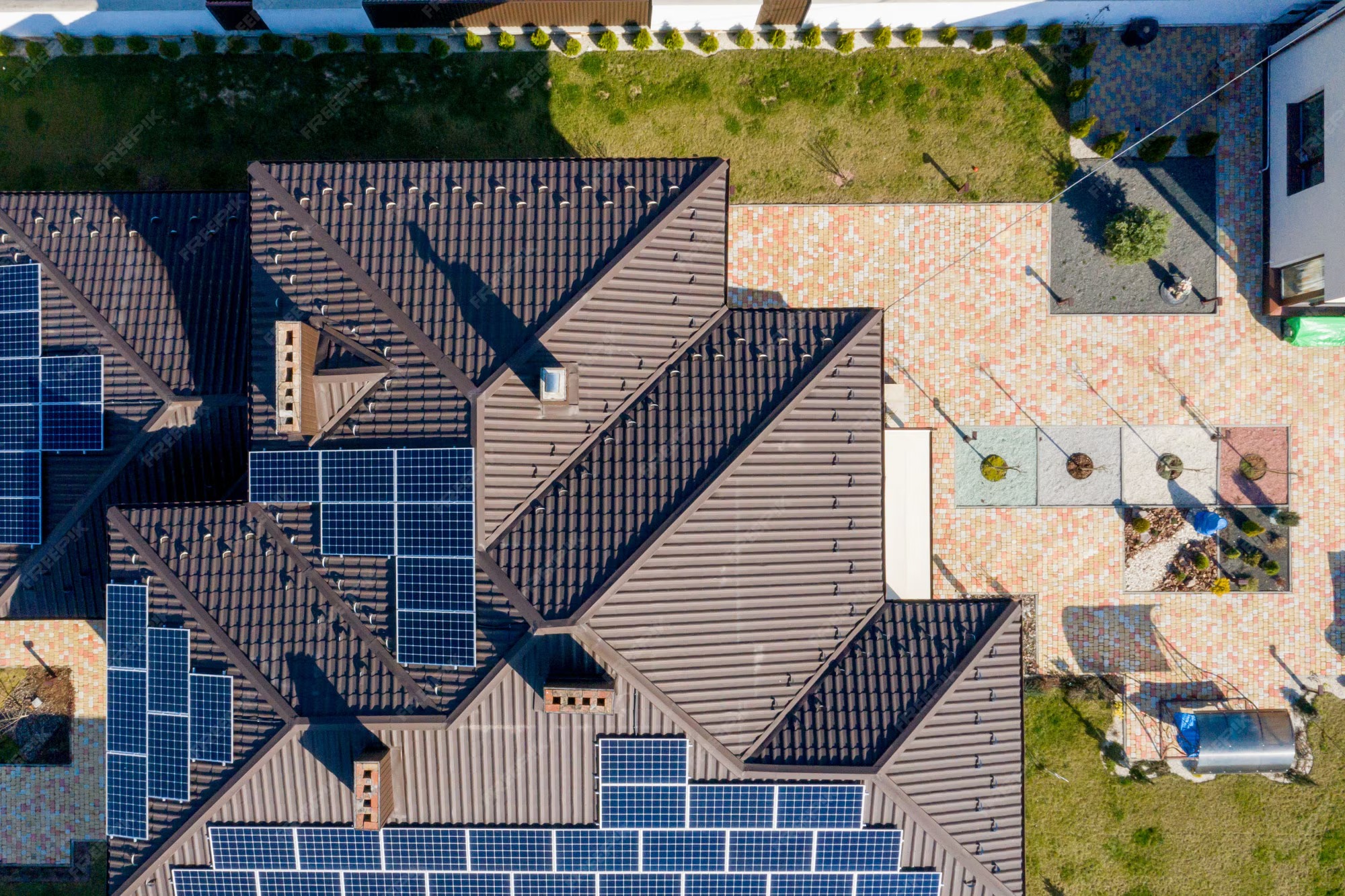
Take a conventional rooftop solar installation. If you take the panels away, the roof is still there. It still protects the building from rain and weather. The solar system was added to the building, but it was never an essential part of the roof.
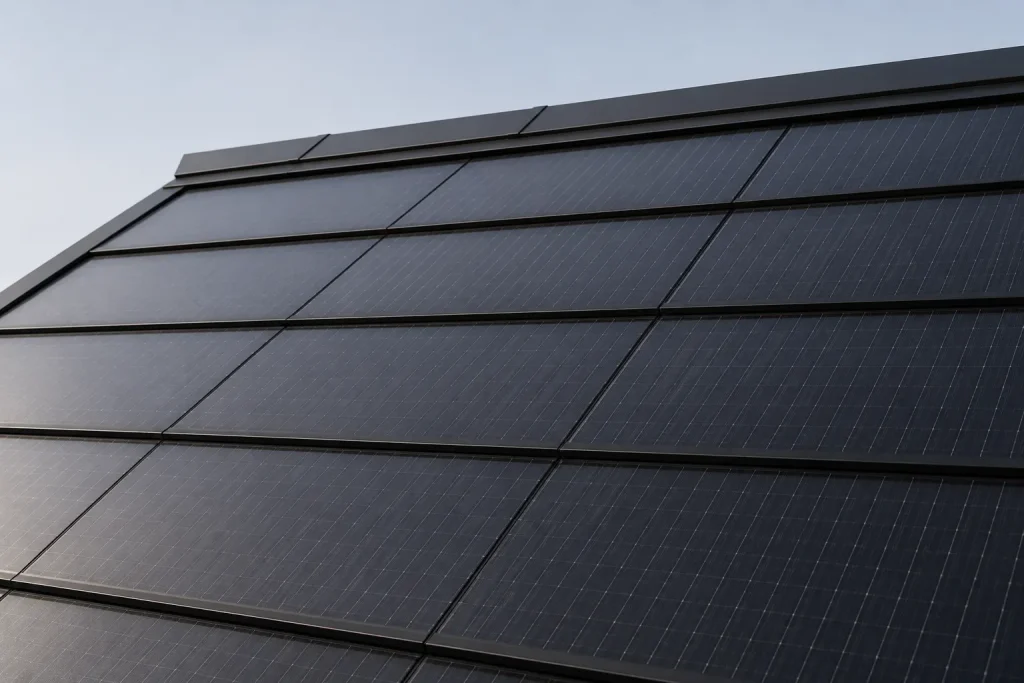
Now imagine a roof made with photovoltaic tiles.
Remove those tiles and you have a problem. They were not simply there to generate electricity. They were also part of the roof.
That small difference explains a lot about BIPV.
A BIPV product has a dual role. It is part of the building envelope, and it generates solar power. Depending on the application, it may replace roofing materials, architectural glass, cladding, skylights, or shading elements.
The solar function is only half of the story.
How Does BIPV Work?
There is nothing mysterious about the way BIPV generates electricity.
Photovoltaic cells absorb sunlight and convert it into electrical energy. The electricity can then be used by the building or sent to the grid, just as it can with a conventional solar system.
The interesting part is where those cells are used.
Instead of installing a standard solar panel above a finished building surface, photovoltaic materials are incorporated into the building material itself.
Think about a piece of solar glass. It can still function as part of a facade or skylight, but photovoltaic cells inside the glass allow it to generate electricity.
The same idea can be applied to roofing products.
This is why BIPV is not simply another type of solar panel. The important change is the relationship between the solar product and the building.
With traditional solar, the building supports the solar system.
With BIPV, the solar material becomes part of the building.
Where Is BIPV Used?
BIPV can be used in quite a few places, although some applications are much more common than others.
Roofs are an obvious starting point. Glass facades are another. Then there are skylights, canopies, balconies, and external shading systems.
The right application depends heavily on the building itself.
BIPV Solar Roofs
A solar roof is probably the most straightforward example of BIPV.
Instead of putting ordinary roofing materials down first and installing solar panels above them later, photovoltaic roofing products are designed to serve as the roof surface.
They can look very different depending on the project. Some are designed to resemble traditional roof tiles. Others take the form of larger integrated roofing panels.
Either way, the principle is the same: the roof protects the building while also producing electricity.
This can be particularly attractive for new homes, villas, commercial buildings, and projects where the roof is being replaced anyway.
If you are already paying for a new roof, it is reasonable to ask whether part of that roof can generate power.
BIPV Glass Facades
The facade is where BIPV starts to become especially interesting.
Many modern commercial buildings have enormous areas of glass. In a conventional building, most of that glass is simply part of the building envelope.
With photovoltaic glass, some of that surface can also produce electricity.
The appearance can vary considerably. Depending on the product, the glass may be more transparent, semi-transparent, or designed with a particular color or visual finish.
That gives architects more freedom than simply attaching rows of standard solar panels to a wall.
BIPV glass is commonly considered for office buildings, commercial developments, public buildings, and other projects where the facade plays a major role in the overall design.
BIPV Skylights and Canopies
Skylights have an obvious purpose: bring daylight into a space.
Canopies provide shade and protection from the weather.
Neither one normally produces electricity.
BIPV changes that.
Photovoltaic glass can be used in skylights and canopies so that the structure continues to provide daylight or shade while also generating power. In some applications, semi-transparent materials are used to let part of the sunlight through.
Shopping centers, walkways, entrances, transport facilities, and public spaces can all provide opportunities for this type of installation.
It is a fairly simple idea, but it makes use of surfaces that would otherwise be doing only one job.
BIPV Solar Shading
Solar shading is another application that is easy to overlook.
External louvers and sunshades are already used on many buildings to control sunlight and reduce unwanted heat entering through windows. Adding photovoltaic materials gives these structures another function.
They can provide shade and generate electricity at the same time.
This can be particularly useful on buildings with large glazed areas. Instead of treating shading and solar generation as two completely separate systems, they can be combined into one part of the building design.
BIPV vs BAPV: What Is the Difference?
If someone asks what is BIPV, one of the most useful comparisons is BAPV.
BAPV stands for Building-Applied Photovoltaics. This is much closer to the solar installation most people already know.
The building is there first. The solar panels are installed afterward.
A typical example would be a commercial building with a finished metal roof. Solar mounting rails are attached to the roof, and standard photovoltaic modules are installed above the existing surface.
Nothing unusual about that.
BIPV changes the relationship between the two.
| Feature | BIPV | BAPV |
|---|---|---|
| Main role | Building material and solar generator | Solar generator |
| Relationship with building | Integrated into the building | Added onto the building |
| Appearance | Designed as part of the architecture | Solar panels are usually clearly visible |
| Conventional building material | Can replace some materials | Usually remains in place |
| Initial cost | Generally higher | Generally lower |
| Typical opportunity | New construction or major renovation | New or existing buildings |
A useful way to remember it is simple:
BAPV puts solar on the building. BIPV puts solar into the building.
The distinction matters because the two approaches are solving slightly different problems.
Why Choose BIPV?
There is no single reason people choose BIPV.
For one project, the appearance may be the deciding factor. For another, the available surface area may be more important. Sometimes the building is already due for a new roof or facade, which changes the economics completely.
A More Integrated Appearance
Traditional solar panels are not necessarily unattractive, but they can be difficult to incorporate into certain architectural designs.
A carefully designed facade can look very different once rows of conventional panels are attached to it.
BIPV offers another option.
The solar material can be selected as part of the architectural design rather than treated as something that gets added afterward. Color, transparency, pattern, and overall appearance can all become part of the discussion.
For some buildings, that is a major advantage.
One Surface, More Than One Job
This is perhaps the most practical reason to consider BIPV.
A roof already has to cover the building. A facade already has to form the exterior surface. A canopy may already be needed for shade or weather protection.
Why not let those surfaces generate electricity as well?
That does not automatically make BIPV the cheaper option. It simply changes the way the project should be looked at.
Instead of asking only, “How much does the solar system cost?”, you also need to ask, “What building material is the solar system replacing?”
Making Use of More Building Surfaces
Rooftops are useful for solar, but they are not the only part of a building exposed to sunlight.
Consider a tall office building with a relatively small roof and a huge facade. A conventional rooftop system can only use the roof.
BIPV opens up another possibility.
The facade itself can become part of the solar strategy.
Of course, a vertical surface will not necessarily produce the same amount of energy as an ideally positioned roof. But the available area can be much larger, and that can matter on the right project.
What Are the Disadvantages of BIPV?
BIPV has some obvious advantages, but it would be misleading to present it as a better replacement for conventional solar in every situation.
It is not.
BIPV Usually Costs More
The price of a BIPV product is generally higher than the price of a standard solar panel.
There is a reason for that. A BIPV product has more work to do.
Depending on the application, it may need to function as a roof, facade, skylight, canopy, or shading element in addition to generating electricity.
But there is another side to the cost discussion.
Suppose a new building needs a facade anyway. If the project uses BIPV glass, some of the money that would have been spent on conventional facade materials is now part of the BIPV solution.
That does not make BIPV cheap. It simply means that comparing the price of one solar panel with another does not give you the complete picture.
Efficiency May Be Lower
BIPV does not always achieve the same efficiency as a high-performance conventional solar panel.
There are several reasons.
A facade may face the wrong direction. A skylight may need to allow light through. A roof-integrated product may have different conditions from a panel mounted above the roof.
The building comes first, after all.
With a conventional solar installation, you can often choose the orientation and angle primarily for energy production. With BIPV, the surface also has to make sense as part of the building.
That trade-off is important.
The Design Needs to Happen Earlier
This is one of the biggest practical differences.
Traditional solar can often be considered after the building has already been designed.
BIPV works much better when it is discussed early.
The architect needs to know what the photovoltaic material will look like. The building team needs to understand how it will be installed. The solar side needs to consider the available surfaces and expected energy production.
Nobody wants to discover these issues after the facade has already been finalized.
Is BIPV More Expensive Than Traditional Solar?
Usually, yes.
But the answer becomes less straightforward once you look at the entire building.
Imagine a new commercial project that needs a roof. With conventional construction, the owner pays for the roof, and a separate solar system is installed on top of it.
With BIPV, the solar roof can replace part of the conventional roofing system.
The same logic applies to facades and glass.
So the useful comparison is not simply:
BIPV solar panel vs conventional solar panel.
It is closer to:
BIPV building system vs conventional building material plus a separate solar system.
That distinction can make a significant difference to the economics of a new construction project.
It is also why BIPV often makes more financial sense during new construction or a major renovation than on a perfectly good existing roof.
When Does BIPV Make Sense?
BIPV is worth looking at when the building and the solar system need to work together.
That could mean a new commercial building with a large glass facade. It could be a villa where the owner wants the roof to look cleaner. It could be a major renovation where the existing roof is going to be replaced anyway.
Some common situations include:
- New commercial buildings
- Modern office developments
- Buildings with large glass facades
- Projects with strong architectural requirements
- Major roof or facade renovations
- Buildings with limited conventional rooftop space
But there are plenty of cases where BIPV is not necessary.
If an existing building has a good roof and the main goal is simply to generate electricity at the lowest practical cost, a conventional rooftop system may be the better answer.
There is no prize for choosing the more complicated technology.
The right solar solution is the one that fits the building and the project.
What Should You Consider Before Choosing BIPV?
Start with the building.
That sounds obvious, but it is easy to do the opposite and start by looking at solar products.
Look at the roof, the facade, the orientation, the amount of sunlight, and the surfaces that are actually available. A beautiful BIPV product is not very useful if the part of the building where it will be installed receives very little sunlight.
Then consider what the surface needs to do.
A BIPV roof still needs to work as a roof. A photovoltaic facade still needs to meet the requirements of the building envelope. A canopy still needs to provide the protection it was designed to provide.
Solar generation cannot be the only consideration.
Cost matters too, of course. But it should be looked at over the whole project rather than by comparing the price of individual panels.
And then there is maintenance.
A system that is difficult to inspect or repair may become frustrating years down the road. Good BIPV design should consider how the building and photovoltaic components will be maintained over their service life.
BIPV and Solar Mounting Structures
The fact that BIPV is integrated into a building does not mean the supporting structure becomes unimportant.
Quite the opposite.
The photovoltaic components still need to be supported, aligned, and connected properly. When they form part of a roof or facade, the supporting system needs to work with the building rather than simply sit on top of it.
This is an area where experience with solar mounting structures can be useful.
At SR Solar, we manufacture mounting and structural solutions for different solar applications, including ground-mounted systems, rooftop solar, solar carports, and other specialized projects.
For an integrated application, the structure has to fit the overall design. It cannot be treated as an ordinary solar rack that happens to be attached to a building.
The details will vary from one project to another, but the principle is the same: the supporting system needs to be stable, practical, and compatible with the building.
Is BIPV Suitable for Commercial Buildings?
Commercial buildings are one of the more interesting areas for BIPV.
Think about a modern office building. It may have a relatively small roof, but several thousand square meters of exterior glass.
A conventional solar installation cannot make much use of that facade.
BIPV can.
The same applies to canopies, entrance structures, skylights, and shading systems. These parts of the building already occupy valuable space. Integrating photovoltaics gives them another purpose.
There is also an architectural benefit.
For a building where appearance matters, solar does not necessarily have to look like solar panels anymore.
It can simply look like part of the building.
Summary: What Is BIPV?
So, what is BIPV?
BIPV stands for Building-Integrated Photovoltaics. It is a way of incorporating solar generation directly into a building rather than treating the solar system as an additional layer installed afterward.
Roof tiles can generate electricity.
Glass can generate electricity.
A canopy can generate electricity.
Even a shading system can become part of the building’s solar generation strategy.
That is what makes BIPV different.
It is also why BIPV should not be judged only by panel efficiency or the price of the photovoltaic material. The building material being replaced, the available surface area, the architectural requirements, and the overall project cost all matter.
For some projects, conventional rooftop solar will still be the smarter choice.
For others, particularly new buildings and major renovations, integrating solar into the building from the start can make a lot of sense.
At its core, the idea is quite simple.
Instead of asking where to put the solar panels, BIPV asks a slightly different question:
What parts of this building could generate electricity?
Frequently Asked Questions About BIPV
What does BIPV stand for?
BIPV stands for Building-Integrated Photovoltaics. It describes photovoltaic materials that are incorporated into a building and perform both a building function and a solar power generation function.
What is the difference between BIPV and traditional solar panels?
Traditional solar panels are usually installed on top of an existing roof or structure. BIPV becomes part of the building and can replace materials such as roofing, glass, or facade elements.
Is BIPV more expensive than regular solar panels?
Generally, yes. BIPV products usually cost more than conventional solar panels. However, they can also replace building materials that the project would have needed anyway, so the difference in total project cost may be smaller than the difference in solar component price.
Is BIPV less efficient than traditional solar panels?
It can be. The final output depends on the building orientation, available sunlight, shading, transparency requirements, and the way the photovoltaic material is integrated. Conventional rooftop panels may achieve higher efficiency in some situations, but BIPV can make use of surfaces that traditional solar cannot easily use.
Where is BIPV commonly used?
BIPV is commonly used in solar roofs, photovoltaic glass facades, skylights, canopies, and external shading systems. It is particularly interesting for buildings where architectural design and solar generation need to be considered together.
Can BIPV be installed on an existing building?
Yes. However, BIPV is generally easier to integrate during new construction or a major renovation. If an existing roof is still in good condition, conventional rooftop solar may be a simpler and more economical option.
Is BIPV suitable for every building?
No. The right choice depends on the building, available sunlight, project budget, architectural requirements, and the materials that need to be replaced. In many cases, traditional solar remains the more practical solution.