As a structural engineer who has spent a decade in the trenches of utility-scale solar, I know the question isn’t “Which is better?” but “Which yields the highest IRR for this specific site?”
When you’re an EPC (Engineering, Procurement, and Construction) firm, you aren’t just buying hardware; you’re managing risk. Every moving part in a tracker is a potential failure point 15 years down the line. Every extra bolt in a fixed mount is a wasted man-hour.
Let’s cut through the marketing noise and look at the structural and economic reality of Solar Tracking Systems vs. Fixed Ground Mount Solar Panels.
The Structural Reality: Wind Loads and Torsional Instability
The biggest mistake I see EPCs make is underestimating the “Stow Position” physics.
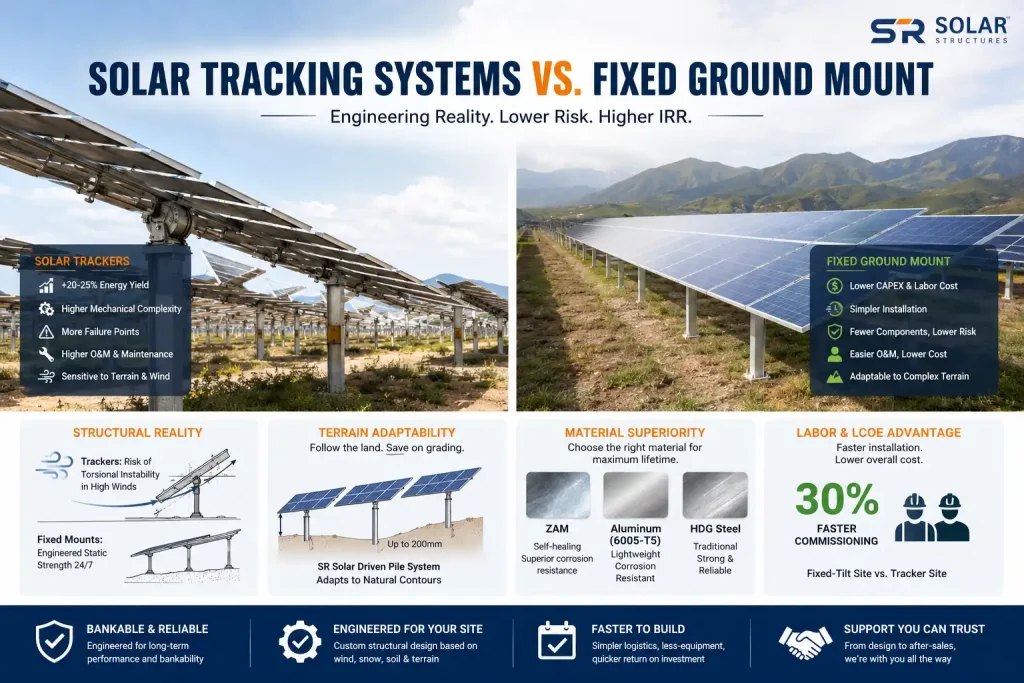
Solar Trackers are dynamic machines. When wind speeds hit 100km/h, a tracker must “stow” (usually flat). If the tracking algorithm or the mechanical dampeners fail, you face torsional galloping—a phenomenon that has literally twisted steel piles like licorice in recent US and Australian projects.
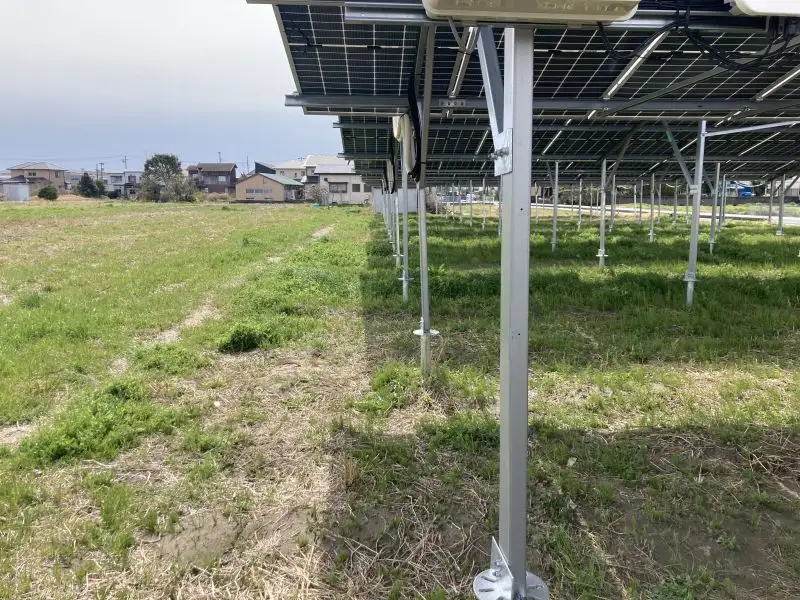
Fixed Ground Mounts are static. We engineer these for the “Worst Case Scenario” 24/7. Using ASCE/JIS/EN standards, we calculate the wind load based on a permanent tilt.
- Engineering Insight: Fixed mounts allow for much higher ground clearance with less steel, whereas trackers require massive torque tubes to resist twisting forces.
Terrain: The Hidden Margin Killer
Can your site handle the grading?
Trackers are “divas” when it comes to topography. If your site has undulating hills or a slope exceeding 10%, your grading costs (civil works) will skyrocket. I’ve seen EPCs lose their entire profit margin because they chose a tracker for a site that required $200k in additional earthmoving.
In contrast, Fixed Ground Mounts—specifically Driven Pile Systems—are the “all-terrain vehicles” of solar.
- SR Solar Engineering Tip: We design our pile systems with vertical adjustment ranges of up to 200mm. This allows you to follow the natural contour of the land, eliminating the need for heavy machinery and site leveling.
Terrain: The Hidden Margin Killer
Can your site handle the grading?
Trackers are “divas” when it comes to topography. If your site has undulating hills or a slope exceeding 10%, your grading costs (civil works) will skyrocket. I’ve seen EPCs lose their entire profit margin because they chose a tracker for a site that required $200k in additional earthmoving.
In contrast, Fixed Ground Mounts—specifically Driven Pile Systems—are the “all-terrain vehicles” of solar.
SR Solar Engineering Tip: We design our pile systems with vertical adjustment ranges of up to 200mm. This allows you to follow the natural contour of the land, eliminating the need for heavy machinery and site leveling.
Material Science: ZAM vs. Aluminum vs. HDG Steel
The choice of material isn’t just about cost; it’s about the soil’s chemistry.
- ZAM (Zinc-Aluminum-Magnesium): This is our “gold standard.” It offers self-healing properties on cut edges. If you’re building near the coast or on “hot” (corrosive) soil, ZAM outperforms standard Hot-Dip Galvanized (HDG) steel significantly.
- Anodized Aluminum (6005-T5): Best for smaller utility projects or high-corrosion environments. It’s lightweight, which reduces shipping costs and makes manual handling on-site much faster.
- HDG Steel: The traditional choice. Reliable, but heavy and prone to “white rust” if not stored correctly on-site.
A common EPC error: Using Aluminum rails with Steel piles without proper bimetallic isolation. This leads to galvanic corrosion that eats your structure in five years. At SR Solar, we ensure all interface points utilize non-conductive gaskets or specific coating thicknesses to prevent this.
The “Labor-to-LCOE” Correlation
Why are more EPCs reverting to fixed mounts despite the 20-25% yield boost of trackers? Complexity.
A tracker installation requires:
- Electronic commissioning.
- Precise sensor calibration.
- Specialized O&M teams for the next 25 years.
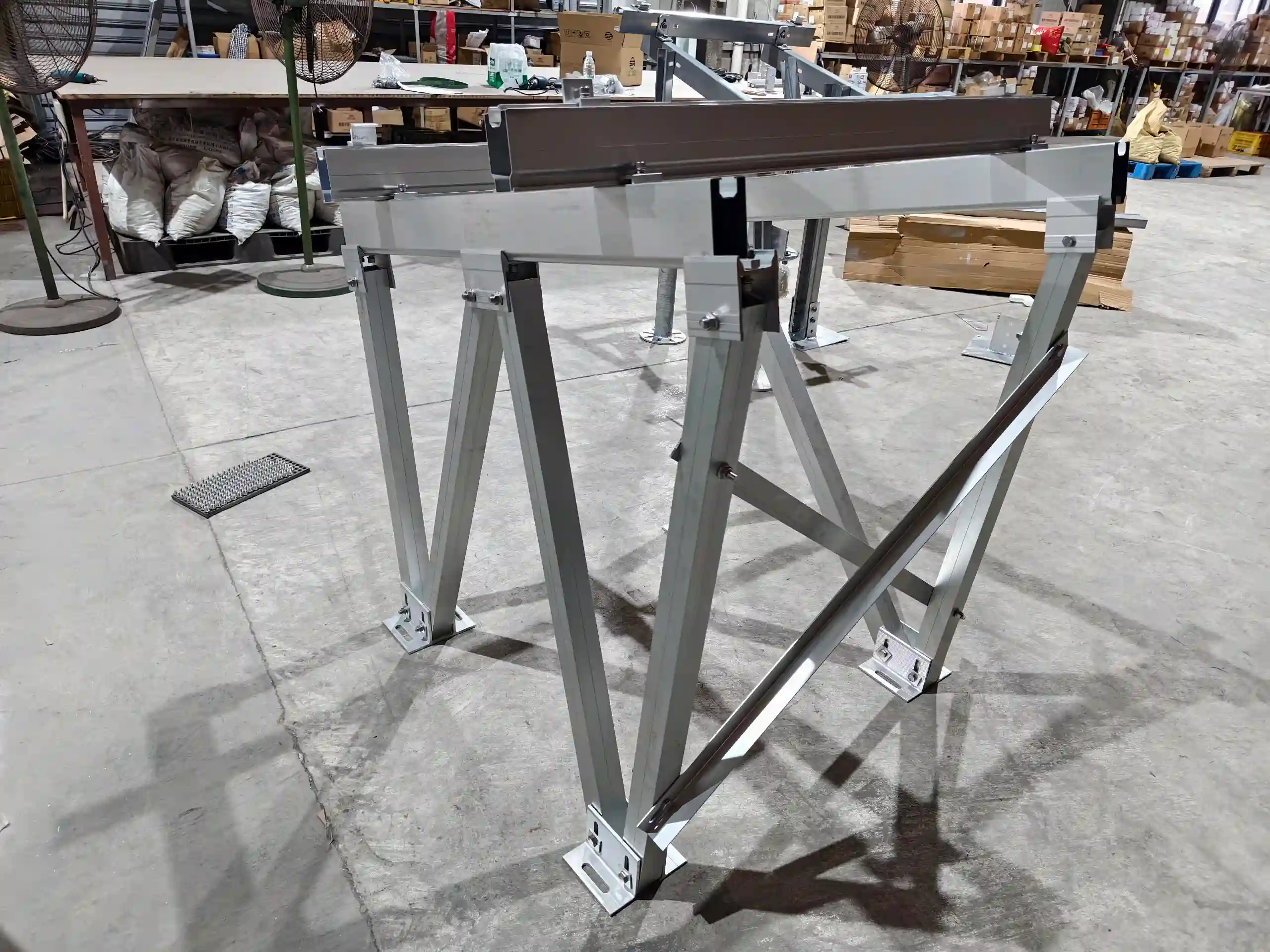
A Fixed Ground Mount installation is a mechanical “Lego” set. Our SR-Solar Ground Mounts utilize pre-assembled supports.
“In our project experience, a 5MW fixed-tilt site can be commissioned 30% faster than a tracking site of the same capacity.”
For an EPC, that 30% reduction in labor hours and heavy equipment rental (cranes, specialized pile drivers) often outweighs the incremental energy gain of a tracker, especially in regions with lower labor costs or high interest rates where speed-to-grid is everything.
Which Should You Choose?
- Choose Trackers if: You have a flat, high-DNI (Direct Normal Irradiance) site, high electricity sell-back rates, and a dedicated O&M budget.
- Choose Fixed Ground Mounts if: Your site has complex terrain, high wind/snow loads, or if you need to minimize upfront CAPEX and long-term maintenance liabilities.
Summary for EPCs
Fixed ground mounts remain the “safe bet” for bankability and rapid deployment. While trackers offer a sexier yield profile, the structural risks and civil costs often tilt the scales back toward high-quality, engineered fixed systems like those we produce at SR Solar.
FAQ
1. What is the maximum wind speed SR Solar ground mounts can withstand? Our systems are typically engineered for up to 60m/s (Region C in Australia), but we customize the thickness and pile depth based on your specific site’s wind-loading report.
2. Is ZAM better than Hot-Dip Galvanized (HDG)? Yes, in most cases. ZAM provides better protection in acidic soils and is more resistant to “edge-creep” corrosion where the steel is cut or drilled.
3. How does the “Slide-In” rail system save labor? Traditional systems require T-bolts for every mid and end clamp. Our system allows modules to slide into a pre-spaced channel, reducing the “nut-and-bolt” count by nearly 40%.
4. Can fixed mounts be used on landfill sites? Absolutely. For landfills where you cannot penetrate the cap, we utilize Concrete Ballast Mounts instead of driven piles.
5. How do I decide between Aluminum and Steel for my project? Steel (ZAM/HDG) is usually more cost-effective for large-scale utility projects (>1MW). Aluminum is superior for smaller projects or coastal environments where weight and corrosion are the primary concerns.
Ready to de-risk your next project? [Contact SR Solar’s Engineering Team] for a complimentary structural review and wind-load calculation for your next site.