Not every rooftop solar installation is waterproofed in the same way. A mounting solution that works well on a standing seam metal roof may not be suitable for a tile roof or an asphalt shingle roof. Each roofing system has its own structure, drainage path, and waterproofing method, which means the solar mounting system must be designed around the roof—not against it.
For EPC contractors, distributors, and installers, waterproofing is one of the key factors that determines the long-term reliability of a rooftop solar project. The challenge is not simply fixing solar panels securely to the roof, but doing so while maintaining the roof’s original ability to manage rainwater, thermal expansion, and environmental exposure over decades of operation.
Rooftop solar systems are expected to perform for 25 to 30 years, and during that time the mounting structure must withstand continuous exposure to wind, rain, temperature changes, and other environmental conditions. In many projects, the quality of the roof attachment points and waterproofing details has a greater impact on long-term maintenance costs than the initial installation process itself.
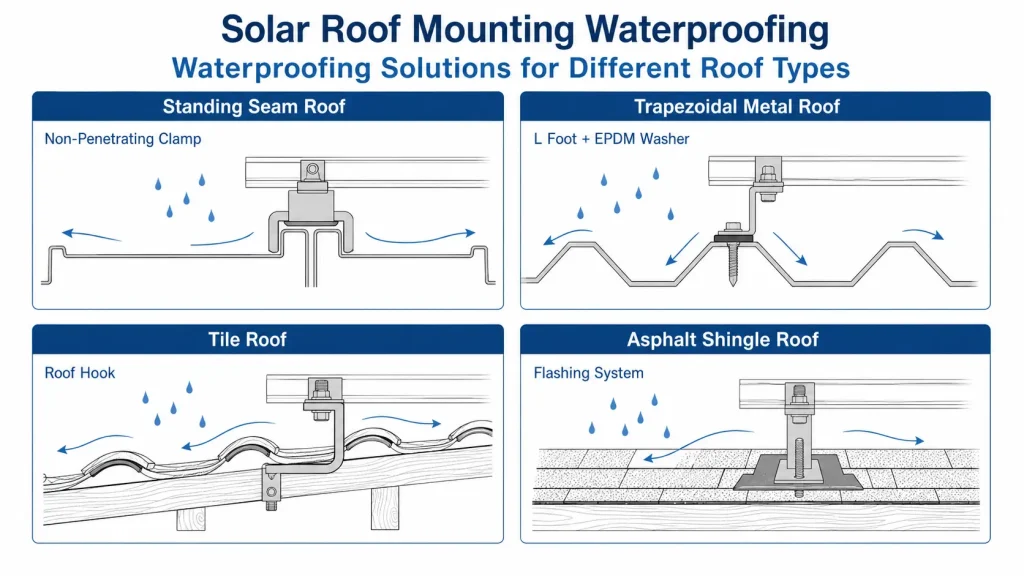
This is why solar roof mounting waterproofing requires different approaches for different roof types. Standing seam metal roofs typically rely on non-penetrating clamps, while trapezoidal metal roofs, tile roofs, and asphalt shingle roofs require carefully engineered penetration methods to prevent water ingress. Understanding how each system achieves waterproofing is essential for designing reliable rooftop solar installations.
1. Standing Seam Metal Roofs: Non-Penetrating Clamp Solutions
Standing seam metal roofs are one of the most solar-friendly roofing systems because the mounting structure can be installed without creating holes in the roof surface. By using specialized roof clamps that attach directly to the standing seams, solar installations can maintain the original waterproofing performance of the roof while providing reliable structural support.
Unlike traditional penetrating mounting methods, standing seam solar mounting systems secure the array through mechanical attachment rather than drilling into the roof sheet. This makes them an ideal solution for projects where preserving roof integrity and minimizing leakage risks are top priorities.
Mechanical Attachment Principles
Non-penetrating clamp systems rely on mechanical gripping and interlocking with the standing seam profile. The clamp surrounds the vertical seam of the metal roof, while set screws apply controlled pressure to create sufficient holding force without puncturing the metal sheet or damaging its protective coating.
For EPC contractors, clamp strength is only one part of the design consideration. Compatibility between the clamp and the specific standing seam profile is equally important. Different roof manufacturers use different seam geometries, such as Snap-Lock or Double Lock profiles, and each requires a suitable clamp design to ensure proper engagement.
Using an incompatible clamp may create uneven pressure on the seam, resulting in deformation of the roof profile or reduced long-term reliability of the mounting system.
Thermal Expansion Considerations
One common issue with standing seam installations is not clamp failure, but poor management of thermal movement. Metal roof panels naturally expand and contract as temperatures change throughout the day. On large rooftop projects, this movement can become significant.
If the mounting system restricts the natural expansion and contraction of the roof panels, additional stress may be transferred to the seams and supporting structures. Over time, this can affect roof performance and increase maintenance risks.
A properly engineered standing seam mounting system should provide secure attachment while allowing the roof to move naturally with temperature changes.
Key Installation Considerations for EPC Contractors
Seam Compatibility
Standing seam clamps are not universal components. Before installation, the roof profile should be confirmed to ensure the clamp matches the seam geometry.
For example, a clamp designed for one standing seam profile may not provide proper engagement on another type of seam. Incorrect matching can create excessive local pressure and potentially affect the roof structure.
Proper Torque Control
Fastener torque plays an important role in maintaining clamp performance. Under-tightening may reduce holding strength, while excessive tightening can deform the metal seam or damage protective coatings.
Installers should always follow the manufacturer’s recommended torque specifications and use appropriate tools to ensure consistent installation quality.
Preventing Galvanic Corrosion
Material compatibility should also be considered, especially for projects located in coastal or high-humidity environments.
When aluminum clamps and stainless steel fasteners are used with metal roofing materials, proper isolation measures should be applied to reduce the risk of galvanic corrosion and maintain long-term durability.
2. Trapezoidal Metal Roofs: Waterproofing Through Proper Penetration
Unlike standing seam roofs, trapezoidal metal roofs cannot usually support non-penetrating clamp systems. The mounting structure is typically secured using L-feet or short rails fastened directly to the roof with self-tapping screws. Because the roof must be penetrated, waterproofing depends not only on the sealing components but also on where and how the fasteners are installed.
Fastening Location Matters
One of the most common installation mistakes is fixing the mounting brackets in the bottom valley of the roof profile. Since rainwater naturally flows through these drainage channels, any penetration in the valley remains exposed to water for much longer during rainfall, increasing the risk of leakage over time.
Instead, fasteners should be installed on the top crown of the trapezoidal rib whenever the roof design allows it. Raising the penetration point above the primary drainage path allows rainwater to flow around the fastener rather than directly across it, significantly reducing the amount of standing water around the sealing point.
Why EPDM Washers Are Essential
When roof penetration is unavoidable, the waterproofing system relies heavily on EPDM sealing washers. High-quality L-feet and short-rail mounting systems are typically supplied with factory-bonded EPDM pads or sealing washers that compress around the fastener to create a durable weather seal.
Compared with conventional rubber, EPDM offers excellent resistance to UV exposure, ozone, moisture, and temperature fluctuations, making it well suited for rooftop environments where the sealing materials are expected to perform for decades.
Correct Compression Is Just as Important
An EPDM washer only performs as intended when it is compressed correctly. If the fastener is not tightened enough, small gaps may remain between the washer and the roof surface, allowing water to reach the penetration point. Excessive tightening creates the opposite problem by deforming the washer, reducing its elasticity and shortening its service life.
Based on practical installation experience, improper tightening is one of the most common causes of waterproofing failures on trapezoidal metal roofs. Using calibrated tools or torque-controlled drivers helps maintain consistent sealing performance across the entire installation.
3. Tile Roofs: Waterproofing Beneath the Tiles
Unlike metal roofs, tile roofs are not designed to be completely waterproof on their own. The tiles mainly shed rainwater, while the waterproof underlayment beneath them provides the primary barrier against moisture. This is why drilling directly through a tile and sealing the hole with adhesive is rarely considered a reliable long-term solution for solar installations.
Instead, solar mounting systems use roof hooks that are fixed directly to the structural rafters beneath the tiles. The hook passes through the gap between overlapping tiles, allowing the roof to retain its original drainage path while transferring structural loads safely into the building.
How Roof Hooks Transfer Structural Loads
Tile roofs are excellent at protecting buildings from the weather, but they are not designed to carry concentrated loads. The weight of the solar array, together with wind uplift and snow loads, must be transferred into the structural framing rather than the tiles themselves.
This is why roof hooks are fixed directly to wooden rafters or other structural members below the roof covering. Manufactured from stainless steel or high-strength aluminum, the hooks extend through the overlapping tiles and provide a secure connection for the mounting rails without placing unnecessary stress on the tiles.
A properly installed hook should never support its load by pressing against the tile. Its role is to bridge the tile layer while allowing the roof structure underneath to carry the load.
Preserving the Roof’s Waterproofing System
Successful tile roof waterproofing depends on preserving both the underlayment and the roof’s natural drainage path.
The hook base is fastened to the structural rafter, while the penetrations through the underlayment are protected using appropriate sealing materials, such as butyl tape or EPDM sealing pads. Once installed, the overlapping tiles are returned to their original position, allowing rainwater to continue flowing over the roof surface as intended.
Equally important is maintaining sufficient clearance between the roof hook and the surrounding tiles. A small gap prevents the hook from placing continuous pressure on the tile during thermal movement, wind loading, or normal structural deflection.
Common Installation Mistakes
One of the most common causes of tile damage is insufficient clearance between the hook and the tile. If the hook bears directly against the tile, repeated movement caused by wind or temperature changes can eventually lead to cracking. Once a tile cracks, rainwater is directed onto the underlayment far more frequently than the roof was originally designed to handle, increasing the likelihood of future leaks.
Another issue seen on some projects is failing to trim the underside of the upper tile where the roof hook passes through. If the tile cannot sit flat after installation, the enlarged gap between overlapping tiles may allow wind-driven rain to reach areas that would normally remain protected.
For this reason, careful tile adjustment is often just as important as selecting the correct roof hook.
4. Asphalt Shingle Roofs: Waterproofing with Flashing
Asphalt shingle roofs are among the most common roofing systems for residential solar projects. Unlike standing seam or tile roofs, they offer no seams or gaps that can be used for mounting. The brackets must therefore be fastened through the shingles and into the structural rafters below.
Because roof penetration is unavoidable, long-term waterproofing depends on managing rainwater before it reaches the fastener rather than simply sealing the penetration itself.
Why Flashing Is Essential
A common misconception is that sealants alone are enough to waterproof a roof penetration. In reality, silicone or other roofing sealants are intended as secondary protection rather than the primary waterproofing method. Over years of exposure to sunlight, temperature changes, and weather, sealants gradually age and lose their effectiveness.
For this reason, modern asphalt shingle solar mounting systems rely on flashing to direct water away from the penetration point instead of depending entirely on sealants.
How Flashing Prevents Roof Leaks
The flashing is installed beneath the upper course of shingles and overlaps the shingles below, following the same water-shedding principle used throughout the roof.
As rainwater flows down the roof, it passes over the upper shingles, across the flashing, and continues onto the lower shingles without reaching the mounting penetration underneath. Rather than blocking water, the flashing simply redirects it, allowing the roof to continue draining naturally.
This overlapping design is what makes flashing one of the most reliable waterproofing methods for asphalt shingle solar installations.
The Role of EPDM Seals
Most modern flashing systems also include an integrated EPDM gasket or compression seal around the lag bolt.
As the lag bolt is tightened into the structural rafter, the EPDM seal compresses around the fastener to prevent moisture from travelling along the bolt path. Combined with the flashing above, this creates two complementary layers of protection: the flashing diverts most of the water away from the penetration, while the EPDM seal protects the fastener itself.
When both components are installed correctly, the roof maintains its original drainage performance while providing a durable mounting point for the solar array.
5. Why Roof Waterproofing Can Still Fail
Choosing the correct mounting method is only the first step. Even when the right system is used for the roof type, poor engineering practices or installation errors can gradually compromise the roof’s waterproofing performance over time.
In many cases, leaks are not caused by the mounting system itself, but by the way it responds to movement, weather, and long-term environmental exposure.
Thermal Movement
Solar mounting systems and roof structures rarely expand and contract at the same rate. Aluminum rails, steel roofing, and timber framing all respond differently to temperature changes.
If the mounting system does not allow for thermal movement, repeated expansion and contraction can place additional stress on fasteners, brackets, and sealing components. Over time, this movement may deform mounting holes, reduce the effectiveness of EPDM seals, or create small gaps that allow water to reach the roof penetration.
Allowing controlled movement within the mounting system is an important part of long-term waterproofing design, particularly on large commercial rooftops.
Water Doesn’t Always Flow Straight Down
Another factor that is often overlooked is the way water behaves around roof penetrations.
Under certain conditions, moisture can travel through extremely small gaps by capillary action, even when there is no visible opening. If two metal surfaces are in direct contact without an effective sealing material, water may gradually work its way into the joint and remain trapped for long periods.
For this reason, quality mounting systems typically incorporate EPDM seals, raised sealing ribs, or molded drainage features that help separate metal surfaces and prevent water from reaching the fasteners.
Engineering Matters as Much as Components
High-quality hardware alone cannot guarantee a waterproof installation. Long-term performance depends on the combination of proper system design, correct installation practices, and components that are matched to the roof structure.
Whether the project uses roof clamps, L-feet, roof hooks, or flashing systems, preserving the roof’s natural drainage path while accommodating structural movement is the key to reliable solar roof mounting waterproofing.
6. The Cost of Getting Waterproofing Wrong
For EPC contractors, waterproofing is not just a technical issue—it has a direct impact on project costs, installation efficiency, and long-term customer satisfaction. A mounting system that is quick to install but difficult to maintain can easily become more expensive over the lifetime of the project.
Faster Installation on Site
Well-designed mounting systems help reduce installation time by simplifying the work required on the roof.
- Standing seam roofs: Non-penetrating clamps eliminate drilling and reduce the number of installation steps.
- Trapezoidal metal roofs: L-feet supplied with factory-installed EPDM sealing washers simplify roof penetrations and improve installation consistency.
- Tile roofs: Adjustable roof hooks reduce the amount of tile trimming and make it easier to achieve a level mounting plane.
Although the time savings for a single mounting point may seem small, they become significant on large commercial rooftops where thousands of attachments are installed.
The Real Cost of Roof Leaks
The financial impact of a roof leak is rarely limited to replacing a seal or tightening a fastener.
In many cases, identifying the source of a leak requires removing solar modules, mounting rails, and electrical components before the roof penetration can even be inspected. If water has already entered the building, additional repairs may be needed for insulation, ceilings, or equipment below the roof.
For commercial projects, these costs are often far greater than the price difference between standard mounting hardware and a properly engineered system.
Waterproofing Is a Long-Term Investment
Reliable waterproofing reduces more than the risk of leaks. It helps minimize maintenance visits, lowers warranty claims, and gives building owners greater confidence in the long-term performance of the solar installation.
For EPC contractors, selecting roof-specific mounting systems from the beginning is often one of the simplest ways to reduce lifecycle costs while improving project quality.
Conclusion
Effective solar roof mounting waterproofing is not achieved with a single product or installation method. It depends on understanding how each roof is designed to manage water and selecting a mounting system that works with that design.
Standing seam metal roofs avoid roof penetrations altogether by using non-penetrating clamps. Trapezoidal metal roofs rely on properly positioned fasteners and EPDM sealing washers to keep water away from the penetration. Tile roofs protect against leaks by transferring loads into the roof structure while preserving the underlayment and natural drainage path. Asphalt shingle roofs use flashing to redirect rainwater before it reaches the mounting point.
No matter which roof type is involved, long-term waterproofing comes down to the same principle: preserve the roof’s original drainage system instead of trying to compensate for poor installation with additional sealants.
For EPC contractors and installers, selecting the right mounting system from the beginning is one of the most effective ways to improve installation quality, reduce maintenance costs, and minimize warranty claims over the lifetime of the project.
Frequently Asked Questions
Is sealant alone enough to waterproof a solar roof penetration?
No. Sealants should be regarded as secondary protection rather than the primary waterproofing method. Over time, exposure to sunlight, temperature changes, and weather can reduce their effectiveness. Reliable waterproofing is achieved by using roof-specific solutions such as non-penetrating clamps, flashing systems, or EPDM sealing components that keep water away from the penetration point.
Why should solar mounts be installed on the top crown of a trapezoidal metal roof?
The bottom valley of a trapezoidal roof is the main drainage channel, where rainwater naturally collects and flows. Installing fasteners in this area exposes the penetration to far more water than necessary. Mounting on the top crown keeps the attachment point above the primary flow path, helping to reduce the risk of long-term leakage.
How can galvanic corrosion be prevented on metal roofs?
Galvanic corrosion occurs when dissimilar metals remain in contact in the presence of moisture. Using compatible materials, anodized aluminum components, stainless steel fasteners, and appropriate isolation pads helps reduce the risk of corrosion, particularly in coastal or high-humidity environments.
Do tile roof hooks always require tile trimming?
Not always. Some roof hook designs fit standard tile profiles without modification. However, many concrete and clay tile roofs require minor trimming on the underside of the tile so it can sit flat after the hook is installed. This helps maintain the roof’s original drainage path and prevents unnecessary stress on the tile.
How tight should self-drilling screws be on metal roofs?
The correct torque depends on the fastener and roof specification, but the objective is always the same: compress the EPDM sealing washer enough to create a reliable seal without deforming it. Following the fastener manufacturer’s recommended torque values is the best way to achieve consistent waterproofing performance.
Need Help Selecting the Right Roof Mounting System?
Every roofing system presents different structural and waterproofing challenges. Choosing the right mounting solution requires more than matching brackets to roof types—it also involves understanding load transfer, drainage paths, thermal movement, and long-term durability.
If you’re planning a commercial or utility-scale rooftop solar project, SR Solar can provide technical support, mounting recommendations, and project-specific solutions for standing seam, trapezoidal metal, tile, and asphalt shingle roofs. Our engineering team works with EPC contractors, distributors, and installers to help deliver reliable rooftop solar mounting systems that perform over the long term.