Have you ever stood in the middle of a desert at high noon? The heat isn’t just a feeling; it’s a force. For those of us in the industry, we know that while solar power’s potential in the middle east is practically limitless, the environment is also one of the most punishing on Earth. At SR Solar, we’ve spent a lot of time thinking about how to make sure a solar farm doesn’t just look good in a press release but actually survives twenty-five years of sand, wind, and salt. It all comes down to what’s holding those panels up: the ground mounting system.
The Desert Gold Rush: Why Everyone is Looking at Middle Eastern Solar
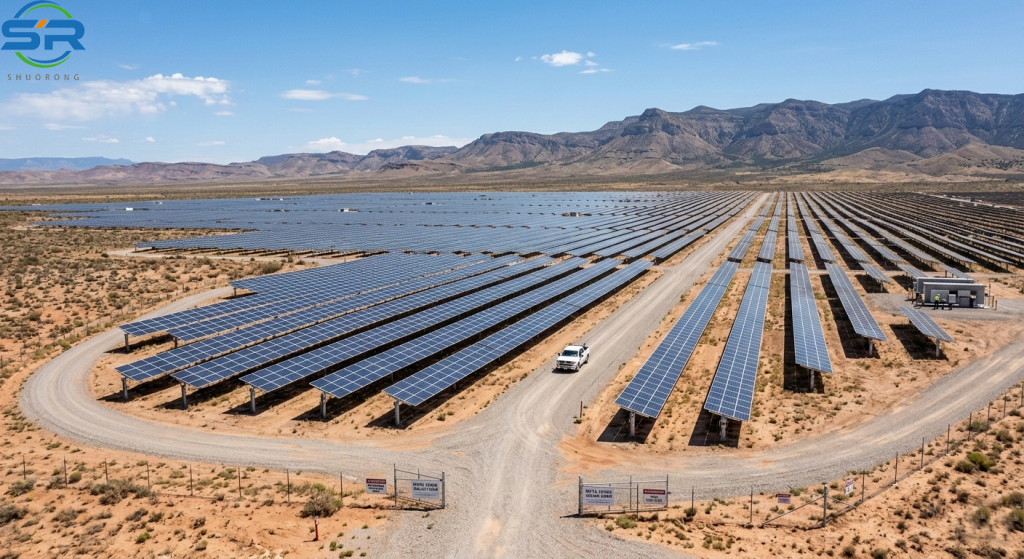
It’s no secret that countries like Saudi Arabia, the UAE, and Oman are pivoting hard toward renewables. They aren’t just dipping their toes in the water; they are diving headfirst into some of the world’s largest PV projects. When we talk about solar power’s potential in the middle east, we’re talking about gigawatts of capacity that could power entire cities. But here’s the thing—the sun is the easy part. The hard part is the ground.
As a B2B partner, you know that utility-scale projects are the backbone of this regional decarbonization. But for an EPC or a developer, the success of these projects hinges on a mounting system that can handle extreme thermal fluctuations. One minute it’s 50°C, and a few hours later, the desert chill sets in. If your mounting racks aren’t designed for that expansion and contraction, you’re looking at structural fatigue before the five-year mark.
Taming the “Desert Stressors”: Wind, Sand, and Structural Integrity
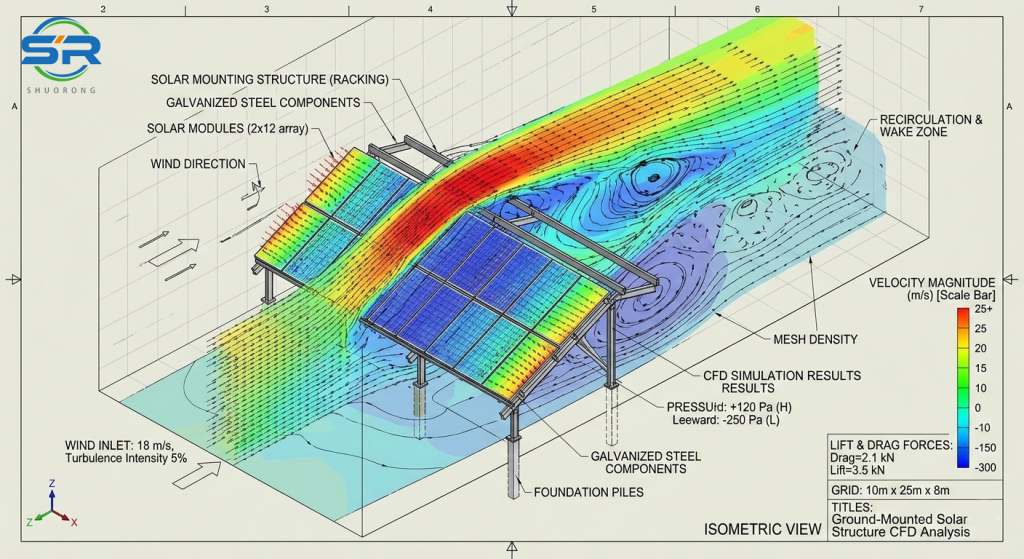
If heat is the slow killer, wind is the fast one. In the Middle East, we don’t just deal with breezes; we deal with intense sandstorms that can turn a solar array into a giant sail. This “sail effect” is responsible for more structural failures than almost any other factor. At SR Solar, we don’t guess; we engineer.
We design our ground mounting solutions to meet and exceed international standards like AS/NZS 1170 and JIS C 8955. Why? Because a “standard” mount isn’t enough when a Shimal wind starts blowing. We use dynamic wind load analysis to find the sweet spot for tilt angles—usually between 10° and 25°. This balances the need for maximum energy yield with the necessity of reducing wind uplift. It’s a delicate dance between physics and profit.
The Sail Effect: How We Engineer Against High-Velocity Sandstorms
Imagine a wall of sand hitting your array at 120 km/h. If the brackets are too rigid, they snap. If they are too flexible, the panels vibrate until the glass shatters. We focus on the structural “give” and the reinforcement of the joints. By optimizing the profile of our rails, SR Solar ensures that the wind flows around the structure rather than trying to push it over.
Material Science in the Heat: Defeating High-Temperature Corrosion
When people think of the desert, they think “dry.” But if you’re working on a project in Abu Dhabi or Muscat, you’re dealing with high humidity and airborne salts from the coast. This creates what we call a “C5” corrosive environment. It’s basically a chemistry set designed to eat metal. To truly tap into solar power’s potential in the middle east, your materials have to be essentially bulletproof.
At SR Solar, we prioritize metallurgy that doesn’t just “resist” rust but actively fights it. We see a lot of developers trying to cut corners here, and honestly, it breaks our hearts. Replacing a rusted mounting system ten years early completely destroys your ROI. We want your project to be a legacy, not a liability.
AL6005-T5 Aluminum vs. Mac Steel: Choosing the Right Armor for the UAE and Oman
We often get asked: “Aluminum or Steel?” The answer is: “It depends on your soil and your sea.” For many projects, we recommend AL6005-T5 Aluminum. We anodize it to 12-15μm, which gives it incredible corrosion resistance while keeping it lightweight. This is a huge plus for logistics—if the mounting is lighter, your transport costs per megawatt drop significantly.
However, for those massive heavy-duty utility projects in the heart of the desert, we often turn to Mac Steel (Zinc-Aluminum-Magnesium). This stuff is like magic. It has “self-healing” properties. If a grain of sand scratches the surface or if a technician makes a cut during installation, the coating actually migrates to protect the exposed edge. In a sand-scoured environment, that’s not just a feature; it’s a necessity.
The Magic of Self-Healing Coatings in Salt-Heavy Coastal Zones
Think of Mac Steel as a living shield. In coastal areas, salt spray is relentless. Standard galvanized steel will eventually show “white rust” and then “red rust.” But with the Zinc-Aluminum-Magnesium alloy, the chemical reaction creates a dense, protective layer that stays stable for decades. We’ve seen this material outperform standard galvanization by four to five times in salt-spray tests. It’s the kind of reliability that makes local municipality approvals much smoother.
Slashing “Soft Costs” with Smart Logistics and Pre-Assembly
Let’s talk business for a second. In the B2B world, labor is often your biggest variable. Working in the Middle Eastern sun is brutal, and site safety is paramount. The longer your crew is out there fumbling with nuts and bolts, the higher your risk and your “soft costs.”
At SR Solar, we’ve moved toward what we call Highly Pre-assembled (HPA) designs. We don’t just ship you a box of parts. We ship you a system that’s ready to grow.
How SR Solar Cuts On-Site Installation Time by 40%
Our systems arrive with pre-folded supports and clamps that are already clicked into place. This isn’t just about speed—though cutting installation time by 30% to 40% is a massive win for your bottom line. It’s about reducing errors. When it’s 45°C outside, even the best technician can make a mistake. By simplifying the component list and doing the heavy lifting in our factory, we ensure that the project stays on track and the structural integrity is exactly what the engineers intended.
Geotechnical Adaptability: Rock, Sand, and Everything In Between
The ground in the Middle East is a bit of a trickster. One site might be soft, shifting dunes, while the next is hard, prehistoric rock. You can’t use a “one size fits all” foundation. If you want to maximize solar power’s potential in the middle east, you have to be ready to pivot your foundation strategy based on the geotechnical report.
We’ve seen projects stall because the mounting supplier didn’t account for “caprock” layers. At SR Solar, we look at the soil first, then we design the legs. Whether it’s a ramming post that goes deep into the sand or a concrete foundation for rocky flats, we make sure the “anchor” is as strong as the “sail.”
Ramming Posts or Concrete Foundations? Navigating Saudi and Jordanian Terrain
In the sandy expanses of Saudi Arabia, ramming posts are often the go-to. They are fast and cost-effective. But what if you hit a layer of limestone? That’s where our engineering team steps in. We provide the static load calculations for both options. We’ve helped EPCs in Jordan navigate some of the rockiest terrains by providing customized base plates that distribute the load without requiring massive amounts of expensive concrete.
Meeting the Standards: Compliance with DEWA, SBC 401, and Beyond
Navigating local building codes is one of the biggest headaches for international developers. Whether it’s Dubai’s DEWA standards or Saudi Arabia’s SBC 401, the paperwork is as important as the steel. SR Solar provides a full technical dossier for every single project.
We don’t just say it’s strong; we prove it. Our certified reports include material traceability and static load calculations that are ready for municipality review. When a sovereign wealth fund or an international investor looks at your project, they want to see that every bolt is accounted for. We provide that peace of mind.
Lowering LCOE: The B2B Math Behind High-Quality Mounting Systems
At the end of the day, it’s all about the Levelized Cost of Energy (LCOE). You want to produce the most kilowatt-hours for the lowest possible cost over the life of the plant. It’s tempting to buy the cheapest mounting system you can find to save on CAPEX. But if that system requires constant maintenance or, heaven forbid, fails during a storm, your LCOE skyrockets.
SR Solar isn’t just a supplier; we are your engineering partner. By selecting the right materials and optimizing the structure for the specific Middle Eastern climate, we help you enhance the Bankability of your solar assets. A well-built mounting system is the “quiet” part of a solar farm, but it’s the part that ensures the investment doesn’t blow away in the wind.
Conclusion: Building a Sustainable Legacy in the Sand
The Middle East is at a turning point. The transition from oil-dependent economies to solar powerhouses is one of the greatest engineering feats of our time. At SR Solar, we are proud to be the structural backbone of this change. By focusing on durability, ease of installation, and regional compliance, we ensure that solar power’s potential in the middle east isn’t just a dream—it’s a long-term, profitable reality. Let’s build something that lasts.
Frequently Asked Questions (FAQ)
1. Why is ground mounting preferred over other types in the Middle East?
Given the vast availability of flat desert land, ground mounting allows for massive utility-scale arrays that are easier to maintain and clean (essential for dust management) compared to roof-mounted systems.
2. How does SR Solar handle the high salt content in coastal regions?
We use AL6005-T5 Aluminum with high-grade anodization or Mac Steel (Zinc-Aluminum-Magnesium) which offers superior corrosion resistance in C5-rated coastal environments.
3. Can your systems withstand the extreme heat of the Saudi desert?
Yes. Our designs account for thermal expansion and contraction, and we use materials that maintain their structural integrity even in temperatures exceeding 50°C.
4. How much time can we save on-site with your pre-assembled systems?
On average, our Highly Pre-assembled (HPA) designs allow EPCs to reduce on-site labor time by 30% to 40% compared to traditional “piece-by-piece” mounting kits.
5. Do you provide engineering support for local municipality approvals?
Absolutely. We provide a full technical dossier, including static load calculations and material certifications, to help you meet standards like DEWA (UAE) and SBC 401 (Saudi Arabia).